
Upload failure 38 usually shows up in the little upload panel at the bottom right of Google Drive when a batch of files stops moving. The fix that works most often is the boring one: a steady connection, free storage, and uploading the failed files again.
In this tutorial, I’ll walk you through what Google Drive upload failure 38 does and doesn’t tell you, then eight fixes in the order I’d try them. I’ll also show you how to keep big uploads from failing in the first place.
What “upload failure 38” means
Here’s the honest part most articles skip. Google doesn’t publish what the number 38 means. It isn’t listed anywhere in Google Drive Help, so anyone who tells you it means one exact thing is guessing.
What we do know is where it appears. You’ll see it in Drive’s upload panel when a file stops partway through and Drive gives up on it. The other files in the batch may finish just fine.
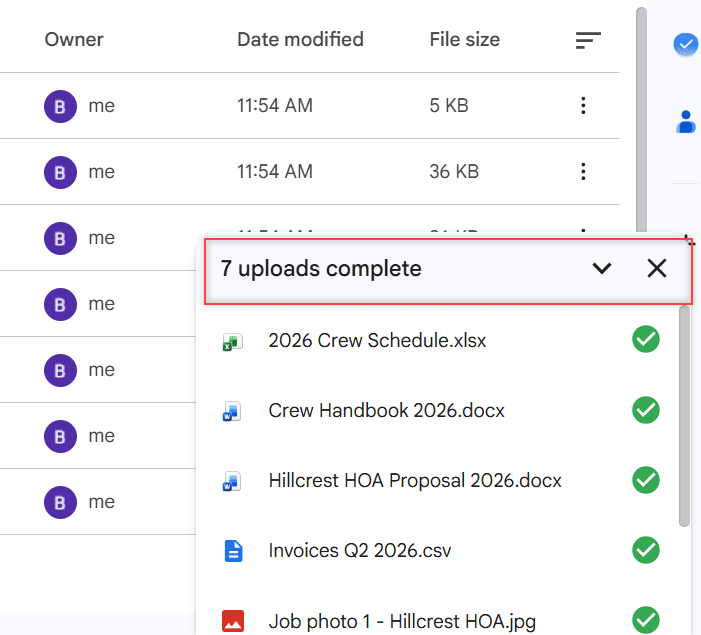
So treat it like any other failed upload. The fixes below are the ones Google documents for uploads that won’t finish. If you see a whole list of failed files instead, my post on the Google Drive error list and Retry all covers that panel too.
Quick test before you start: does one small file upload? If a 1 MB PDF goes through and your 4 GB video doesn’t, jump to the file size fix. If nothing uploads at all, start at the top.
Fix 1: Check your connection and upload the file again
A dropped or slow connection is the most common reason an upload stops halfway. Google’s own troubleshooting advice starts here too: check your internet connection and try another network if you can.
You’ll know this is the cause if pages load slowly, video calls stutter, or the upload panel sat at the same percentage for a long time before it failed.
- Turn Wi-Fi off and back on, or unplug your router for 30 seconds and plug it back in.
- If you’re on a VPN or a busy public network, switch to your home or office connection.
- Back in Drive, click New at the top left.
- Click File upload and pick only the files that failed.
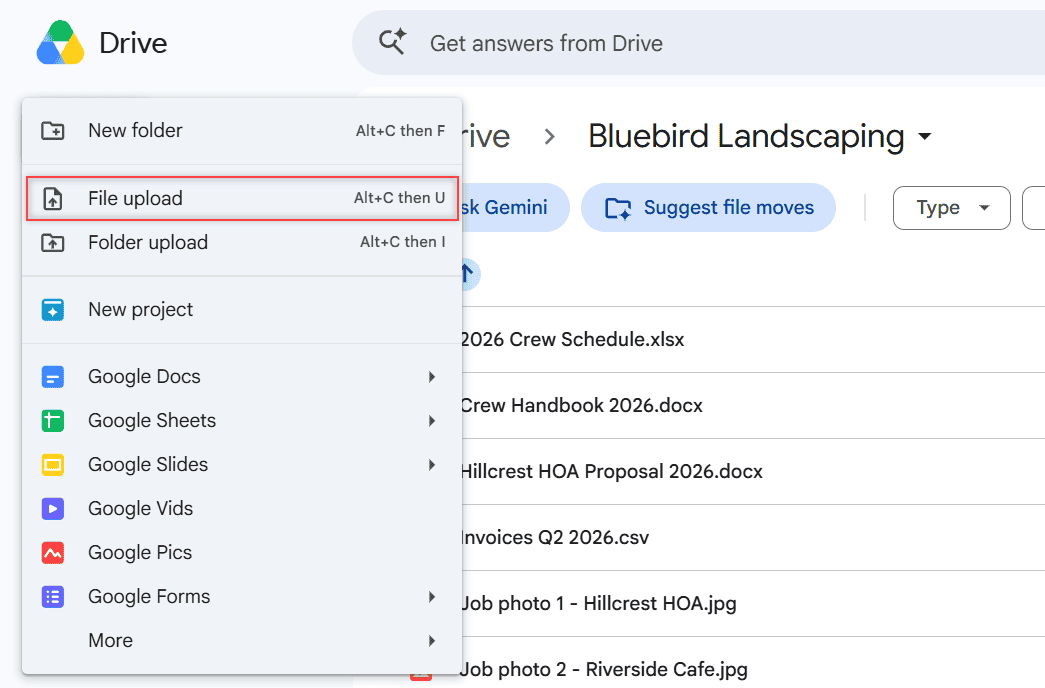
Don’t keep re-adding the whole batch. Files that already finished are in your Drive, and uploading them again just adds new versions. If Drive keeps dropping the connection even with good Wi-Fi, read why Google Drive keeps going offline.
Fix 2: Free up Google storage
When your storage is full, Drive simply stops accepting new files. Google says so plainly in its storage help, and it’s the second thing I check every time.
Remember that a free personal account gets 15 GB shared across Drive, Gmail, and Google Photos. A big inbox full of attachments can fill your Drive without you adding a single file there.
- Open drive.google.com.
- Click Storage in the left menu.
- Look at the used amount at the top, and scan the list below, which shows your files from largest to smallest.
- Delete or download anything big you no longer need, then try the upload again.
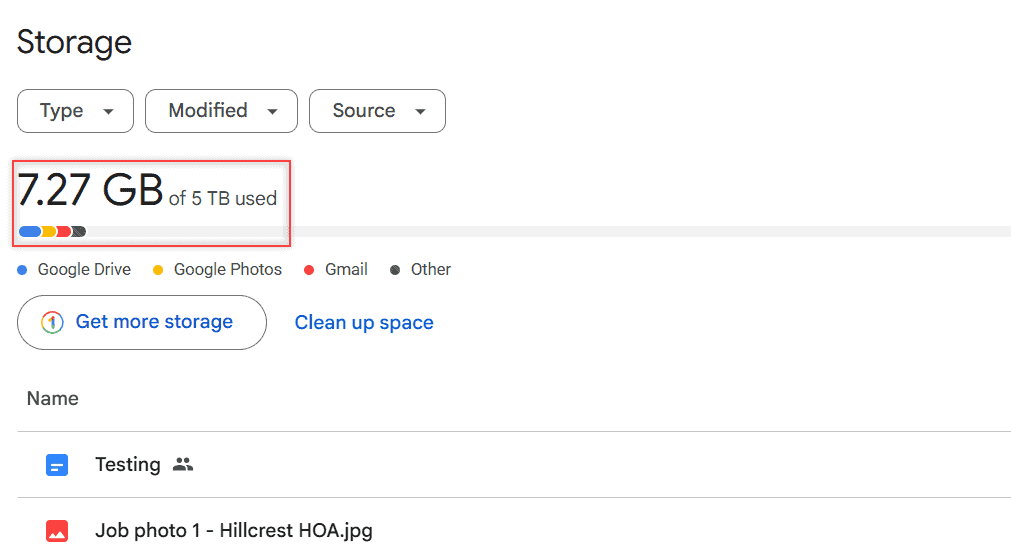
One catch: files in Trash still count until they’re permanently deleted. Once you’re sure, you can empty the trash in Google Drive to get that space back.
If the meter says you’re full but you can’t find the files, my guide on Google Drive storage full but no files walks through where the space usually hides. You can also buy more space through Google One.
Heads up: Uploads count against your storage even when you drop them into a folder someone else owns. A shared folder doesn’t borrow the owner’s space.
Fix 3: Check the file size and the daily upload limit
Most everyday files are nowhere near Drive’s limits, but a few situations trip people up. Google lets you upload files up to 5 TB, so a single giant file is rarely the problem on its own.
The limit people actually hit is the daily one. Google’s Workspace admin help says each user can upload and copy 750 GB within 24 hours. After that, uploads stop until the limit resets, and only the first file that crosses the line finishes.
Drive for desktop help also says Drive users are subject to a daily upload limit, so if you just moved a whole camera card of 4K video, waiting a day is the real fix.
If the file converts to a Google format
Conversion has much smaller limits. If Drive is set to turn uploads into Google Docs, Sheets, or Slides, these caps apply:
| File converted to | Size limit |
|---|---|
| Google Docs | 50 MB (text documents) |
| Google Sheets | 100 MB or 20 million cells |
| Google Slides | 100 MB |
A 70 MB Word file can upload fine as a .docx but fail if Drive tries to convert it. For really big files, my walk-through on how to upload large files to Google Drive has the setup I use.
Fix 4: Clear Chrome cache and cookies
Old cached files and broken cookies can make Drive’s page misbehave, and Google lists clearing them as a fix when Drive won’t work right. Try this if uploads fail in one browser but work on your phone.
- In Chrome, click More (the three dots) at the top right.
- Click Delete browsing data.
- Pick a time range. I start with Last hour and use All time if that doesn’t help.
- Check Cookies and other site data and Cached images and files.
- Click Delete data, then sign back in to Drive and upload again.
This only clears your browser’s copies. Your Drive files stay safe in your account. You will be signed out of most websites, though, so have your passwords handy. I go deeper on this in how to clear cache in Google Drive.
Fix 5: Try an Incognito window or another browser
This is my favorite quick test because it tells you so much. An Incognito window starts without your saved cookies, and extensions don’t run there unless you’ve allowed them.
- In Chrome, click More > New Incognito window, or press Ctrl + Shift + N (Cmd + Shift + N on a Mac).
- Go to drive.google.com and sign in.
- Upload the file that failed.
If it works in Incognito, the problem lives in your normal Chrome profile, usually an extension or stored site data. Fix 6 helps you find it.
You can also try Firefox, Safari, or Edge. Google says Drive works with the two most recent versions of major browsers, so update yours if it’s behind. If you get a different message, such as a Failed – Server error in Google Drive, that one has its own fixes.
Fix 6: Turn off extensions, ad blockers, and antivirus checks
Google warns that virus scanning software and ad blockers can interfere with Drive files, and that custom firewall and proxy settings can block it. The old version of this post saved this tip for the end, but it deserves its own spot.
- In Chrome, click More > Extensions > Manage extensions.
- Switch off ad blockers, download managers, and privacy tools one at a time.
- Try the upload after each one so you know which one caused it.
For antivirus or firewall software, look for a setting that scans web traffic, and make sure it allows Google Drive. On a work laptop, ask your IT team instead of turning security tools off yourself.
Fix 7: Upload smaller batches and rename duplicates
Dropping hundreds of photos in one go makes every hiccup more likely to kill something. When I upload a season of job-site photos for Bluebird Landscaping, I send about 50 at a time.
- Split the batch. Smaller groups finish faster and are easier to retry.
- Zip big folders. One compressed file is often easier to send than a thousand tiny ones.
- Watch for same-name files. Uploading a file with the same name as one already in the folder adds it as a new version. Click Keep both files if you want two separate copies.
Here’s the prompt I got when I uploaded Invoices Q2 2026.csv a second time. Pick an option before you walk away, because the upload waits on your answer.
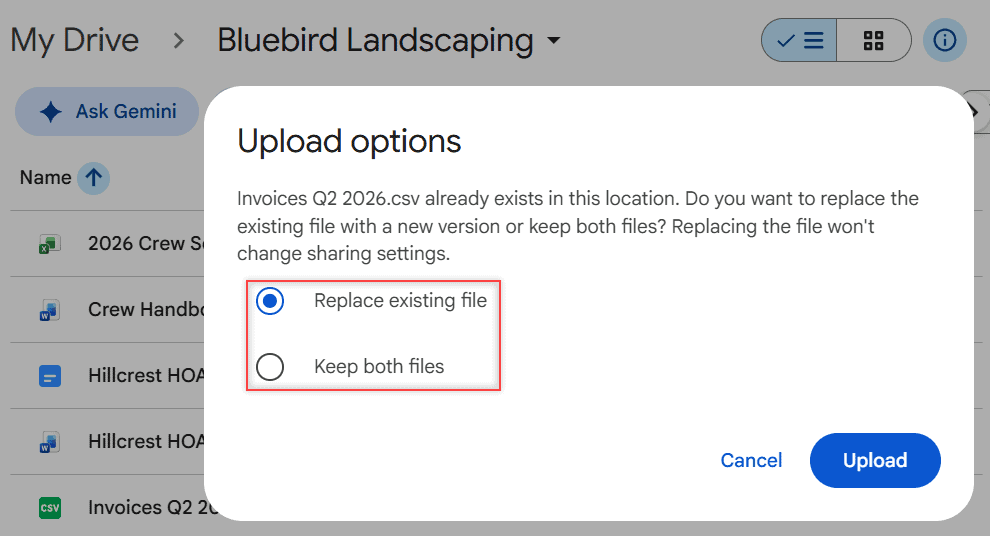
If a file is just too heavy, it’s worth learning how to reduce file size for Google Drive before you try again. Shrinking a video or PDF also saves storage.
Fix 8: Fix stuck uploads in Drive for desktop
Here’s the one the other guides miss. If you use Drive for desktop, a failed upload doesn’t vanish. Google says files it couldn’t upload, because of permissions or network errors, are copied to a Lost and Found folder on your computer.
C:\Users\<username>\AppData\Local\Google\DriveFS\lost_and_foundThat’s the Windows location. On a Mac, it’s in your Library folder under Application Support, Google, DriveFS, lost_and_found. Drive for desktop also shows a notification that links straight to it.
- Open the Lost and Found folder and move the files back into My Drive to retry.
- Restart the app: click Settings > Quit, then open Drive for desktop again.
- If it still won’t sync, go to Settings > Preferences > Advanced Settings and click Disconnect account, then sign in again.
Watch out: Copy anything out of Lost and Found before you disconnect. Google says those files are deleted when the account is disconnected.
Syncing to a shared folder also needs edit access. If the app won’t open at all, see what to do when you can’t launch Drive for desktop.
Still failing? Check these last
If you’ve worked through all eight, a few less common causes are left. I’d check them in this order:
- Google is having an outage. Check the Google Workspace Status Dashboard. If Drive shows a problem, wait and try later.
- You’re on your phone. In the Drive app, tap Menu > Settings and look at Transfer files only over Wi-Fi. If it’s on, uploads wait until you join Wi-Fi.
- It’s a shared folder. You need permission to add files. Upload to My Drive first to see if the folder is the problem.
- Cookies or JavaScript are off. Google says Drive needs both turned on in your browser.
Phone uploads have their own quirks, so if that’s where you’re stuck, read my fixes for Google Drive not uploading from your phone. If files sit in the queue without starting, see Google Drive waiting to upload.
How to prevent it
Once I started following a few habits, failed uploads became rare for me. None of these take long:
- Keep at least a few GB free, and glance at the Storage page before a big upload.
- Upload large batches on a wired or strong home connection, not on hotel or coffee-shop Wi-Fi.
- Leave the browser tab open until the panel says every upload is complete.
- Use Drive for desktop for huge folders, since it retries on its own.
- Spread really big transfers over more than one day so you stay under the daily limit.
And if you start an upload by mistake, you don’t have to wait it out. Here’s how to stop a Google Drive upload cleanly.
A few more Drive fixes that pair well with this one:
- error accessing folder contents
- upload a folder from an Android phone
- how shared folders use your storage
- turn off Google Drive sync
More about this error
What does upload failure 38 mean in Google Drive?
Google doesn’t publish a meaning for code 38. It appears in Drive’s upload panel when a file stops before it finishes, so treat it as a failed upload and work through connection, storage, and browser fixes.
Why does Google Drive keep failing to upload?
The usual causes are an unstable connection, full storage, the daily upload limit, or a browser extension getting in the way. Testing one small file in an Incognito window narrows it down quickly.
Why does my upload fail on my phone?
Check that Transfer files only over Wi-Fi is off if you’re on mobile data, keep the Drive app open, and make sure you have free storage left in your account.
Why can’t I upload large files to Google Drive?
Files can be up to 5 TB, but converted Google Docs, Sheets, and Slides have much smaller caps, and there’s a daily upload limit. Google Drive Help on file size limits lists them.
Does clearing cache delete my Google Drive files?
No. Clearing Chrome’s cache and cookies only removes data stored in your browser. Your Drive files stay in your Google account, though you’ll need to sign back in to most sites.

I am Carissa Gudinoa, a technology buff, and Office online and Apple expert with over 9 years of experience. I am passionate about helping others get the most out of their Apple devices. I have written extensively about Apple products and technologies. I am committed to providing my clients with the best possible service and am always up-to-date on the latest Apple products and features. I also write extensively on other software available for use at minimal cost or free. This includes Word Online, Outlook Online, Excel Online, and other Office online programs… Check out more.