
It looks like a bug: “Your Drive says storage is full, but My Drive is almost empty.” Good news: it usually isn’t an error. Open the storage breakdown, and most of the time Google Photos or Gmail is using the space.
In this tutorial, I’ll show you why Google Drive storage is full but no files show up, how to see exactly which service is eating your quota, and how to clear it, starting with the fix that frees the most space.
Why Drive says it’s full when My Drive looks empty
Your free Google storage isn’t a Drive-only bucket. Every Google account gets up to 15 GB free, and that 15 GB is shared across Gmail, Google Drive, and Google Photos. The storage bar in Drive shows the total for all three.
So My Drive can hold a few small spreadsheets while the bar still says full. Here’s what counts against that shared quota, according to Google:
- Gmail messages and attachments, including everything in Spam and Trash.
- Photos and videos backed up in original quality, plus Storage saver backups made after June 1, 2021.
- Google Docs, Sheets, and Slides created or edited after June 1, 2021, and Google Meet recordings.
- Android device backups, including WhatsApp backups, text messages, call logs, and app data.
- Hidden app data, background system files, and anything still sitting in the Drive Trash.
Shared files work differently. A file in a shared folder counts only against its owner, not you. But if you make a copy of someone’s shared file, or add a file to their folder, that one uses your storage.
My guide on whether shared folders take up space walks through that in detail.
Check the storage breakdown first
This is how to tell which fix applies to you. Open Drive on a computer and select Storage in the left menu. The bar at the top shows your total, and hovering over each colored segment shows one service.
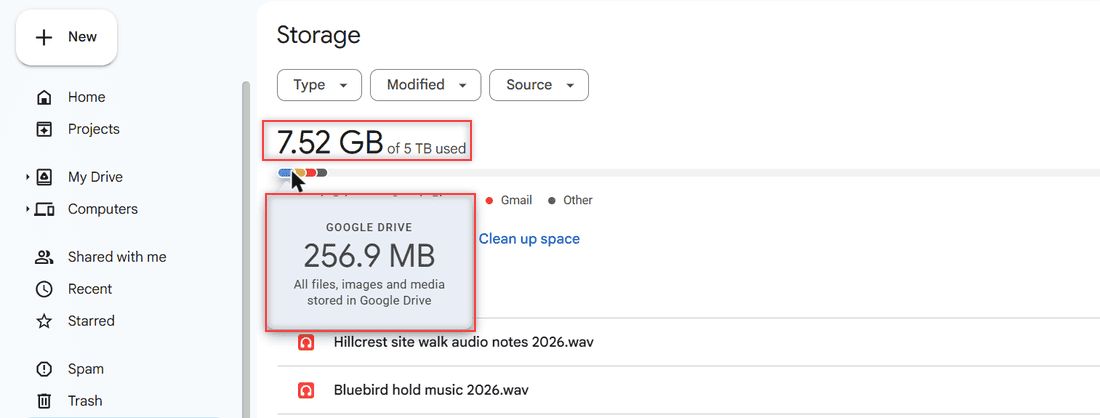
My demo account is on a paid 5 TB Google One plan, so it’s nowhere near full. But the pattern is exactly what trips people up. The bar says 7.52 GB used, and when I hover the blue Drive segment, Drive itself is only 256.9 MB.
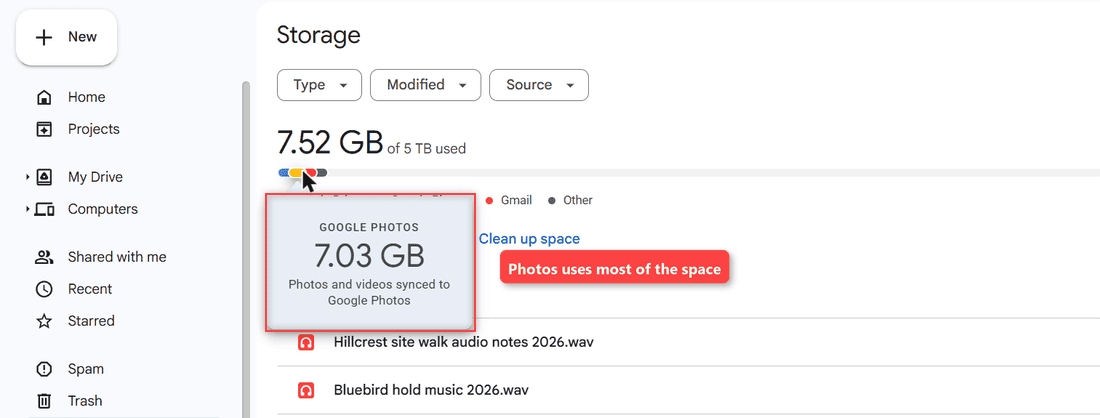
Now look at the yellow segment. Google Photos is using 7.03 GB, which is more than 27 times what my Drive files take up. If your account were on the free 15 GB, this is the moment you’d realize the “Drive is full” problem isn’t really about Drive.
For the full picture, select Clean up space on the same page. That opens the Google One Storage Manager, which lists every service with its size.
Mine reads Google Photos 7.03 GB, Google Drive 256.91 MB, Gmail 101.19 MB, Device Backup 75.36 MB, and Other 60.91 MB. If you want to dig into Drive itself, you can also check the size of a Drive folder.
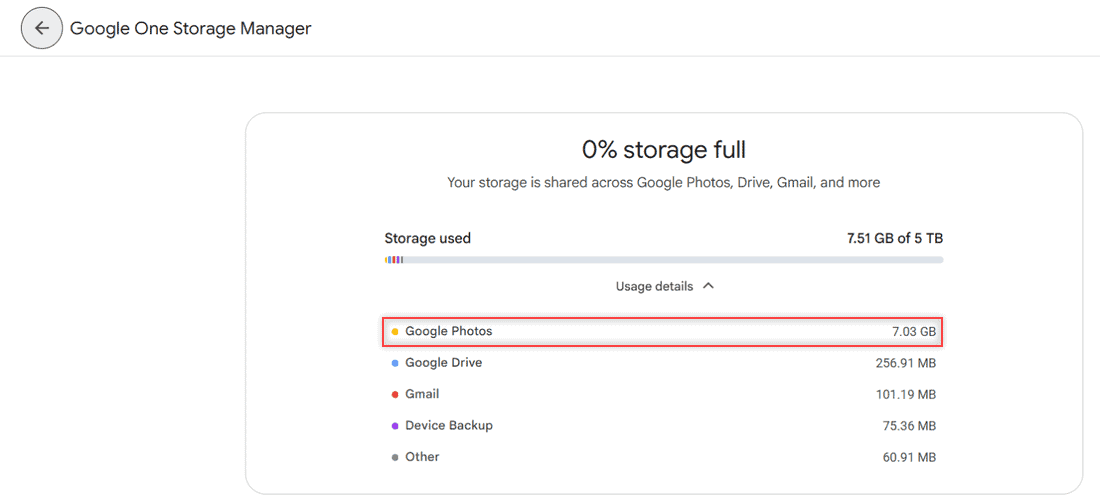
Whichever row is biggest tells you where to start. In most accounts I’ve helped with, it’s Photos first and Gmail second.
Fix 1: Clear out large Google Photos backups
If Photos is your biggest row, this frees the most space. Scroll down the Storage Manager to Clean up suggested items. Google groups the heaviest stuff into cards so you don’t have to hunt for it.
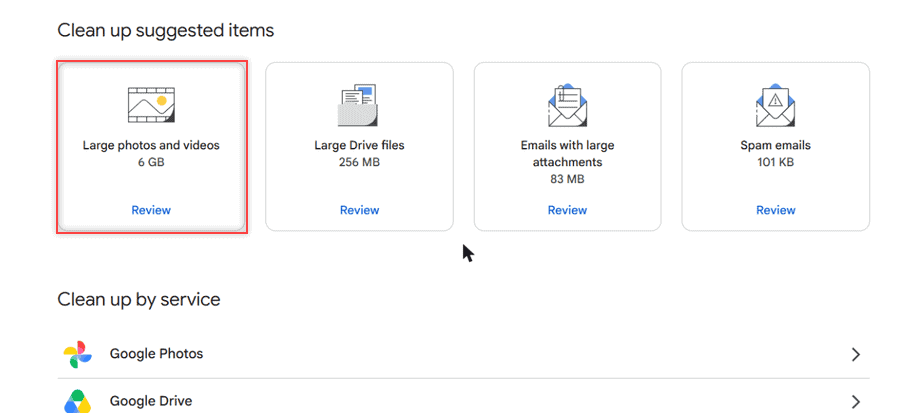
- Select Review on the Large photos and videos card. In my account that card alone was 6 GB.
- Pick the videos and photos you don’t need, usually long screen recordings and duplicate clips.
- Delete them, then empty the Photos Trash so the space actually comes back.
Before you delete anything you care about, save a copy to your computer. If you’re on an iPhone, you can save several photos to your iPhone first. Deleting in Photos removes the item everywhere it syncs.
Fix 2: Delete large Gmail attachments and Spam
If Gmail is near the top of your breakdown, old attachments are the usual reason. Open Gmail and paste this into the search box to find messages with attachments bigger than 10 MB:
has:attachment larger:10MOlder mail with attachments is another big one. This search finds anything with an attachment older than two years:
older_than:2y has:attachmentSelect the messages you don’t need and delete them. Then open Spam and Trash in Gmail and empty both. Google counts every message in them against your storage until they’re cleared.
Prefer clicking to searching? The Storage Manager cards for Emails with large attachments (83 MB in my account) and Spam emails (101 KB) do the same job. If an attachment matters, save it to your computer before you delete the email.
Sort Drive by size and remove the big files
If the Drive row is the big one, the Storage page is your best tool. It lists every file you own with the largest at the top, so the worst offenders are right there.
In my account, the top two were audio files, Hillcrest site walk audio notes 2026.wav and Bluebird hold music 2026.wav. Raw audio and video files are usually the culprits, because they’re far bigger than documents.
- Open Storage in the Drive left menu.
- Check the files at the top of the list and decide which ones you still need.
- Download anything you want to keep, then right-click the rest and move them to Trash.
The Large Drive files card in the Storage Manager shows the same files. If you’d rather keep a big file but make it smaller, my tips to reduce file sizes in Google Drive can help.
Empty the Trash in Drive, Gmail and Photos
This catches more people than anything else. When you delete a file in Drive, it moves to Trash and keeps using space. Google keeps it there for 30 days, then deletes it forever.
If you just cleaned up and the bar didn’t move, the Trash is why. Here’s more on how long Google Drive keeps deleted files.
- In Drive, select Trash in the left menu.
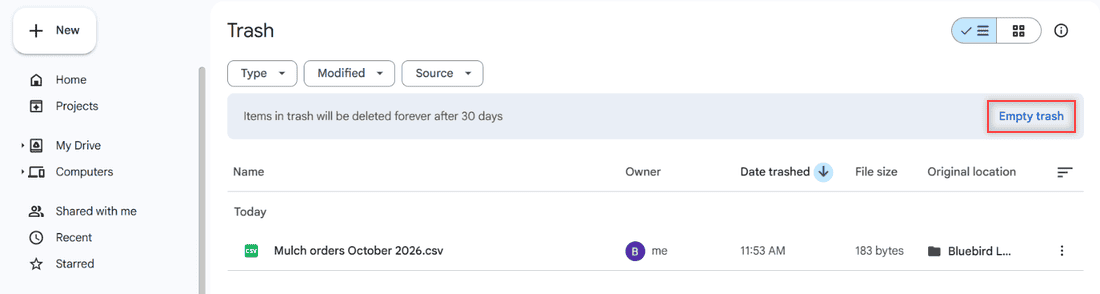
- Check the list first. My Trash held one file, Mulch orders October 2026.csv, which I didn’t need.
- Select Empty trash in the banner at the top.
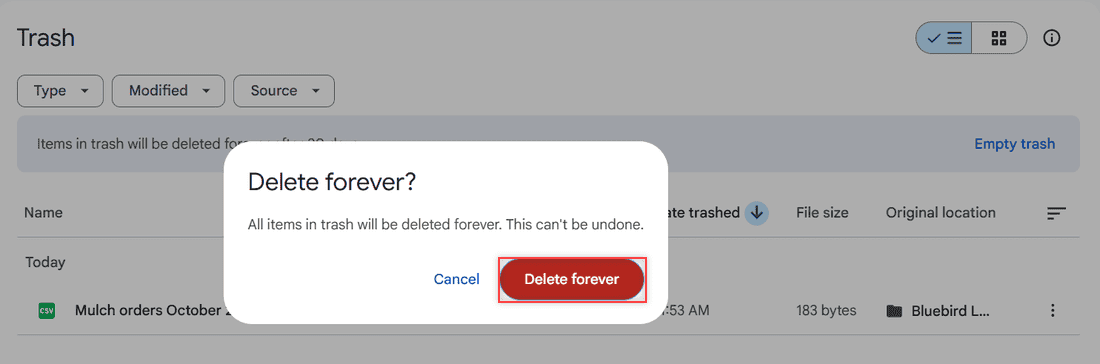
Drive asks you to confirm. Select Delete forever. There’s no undo, so only do this once you’re sure nothing in there matters. My Trash showed “Trash is empty” right after.
Do the same in Gmail (Trash and Spam) and in Google Photos (Trash). Each one has its own Trash, and each one counts. I have a step-by-step guide to emptying the trash in Google Drive on the phone app too.
Look for hidden app data and device backups
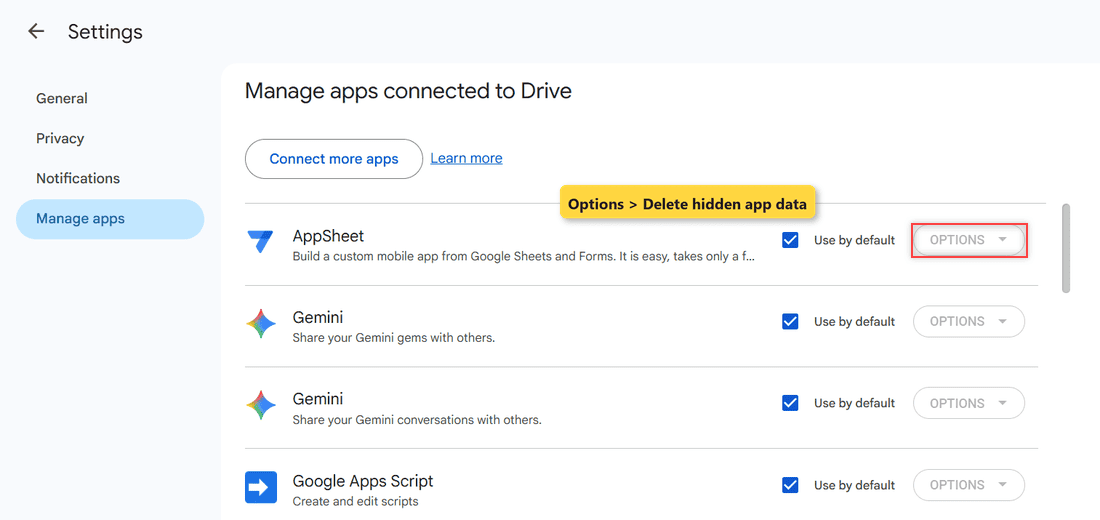
Some apps connected to Drive save data you can’t see in My Drive, such as settings or game saves. To check, open Drive on a computer, select the gear, then Settings > Manage apps. If an app stores hidden data, the amount shows under its description.
To remove it, open that app’s Options menu and select Delete hidden app data. In my account, none of the apps stored anything, so the Options buttons stayed greyed out. That’s a normal result too.
Next, look at the Backups section of the Storage page. Old phone backups, including WhatsApp backups, can quietly take up space long after you’ve switched phones. My demo account’s Device Backup row was 75.36 MB.
Delete the backups for devices you no longer use. If you might need one, read how to restore a backup from Google Drive before you delete it.
Find orphaned files and copies of shared files
Sometimes files lose their parent folder, often when someone deletes a shared folder you’d added files to. Your files still exist and still use your storage, but they don’t show in My Drive. Run this in the Drive search box to find them:
is:unorganized owner:meWhen I ran it on my demo account, Drive said “None of your files or folders matched this search.” If you get results, move them into a folder or delete them.
Duplicates are the other quiet space hog. Drive doesn’t have a built-in duplicate finder, so sort your files by name and look for names ending in “(1)” or starting with “Copy of”. The Storage page itself lists files largest first, which is the quickest way to spot big ones.
Also check files other people shared that you copied. Those copies are yours. If a shared folder is cluttering your view but not your storage, you can remove shared files from your Drive without touching the owner’s copy.
Still showing full? Give the total time to update
If you deleted a lot and the bar hasn’t budged, wait. Google says it normally takes up to 48 to 72 hours for storage totals to update after you remove many files. If you just bought more storage, that can take up to 24 hours to show.
Next, make sure you’re looking at the right account. I’ve seen people clean one Google account while their phone backs up to another. Check which account is signed in on each device, especially your phone’s Photos app.
On a work or school account, your admin sets the storage, and it may be pooled across your organization. If your bar looks wrong there, ask your admin.
Here’s why it’s worth fixing soon. Once you’re over your quota, you can’t upload to Drive, Photos stops backing up, Gmail may not send or receive mail, and you can’t create new Docs, Sheets, or Slides.
If you stay over for two years or more, Google may delete your content, with at least three months’ notice.
How to keep it from filling up again
- Open the storage breakdown once a month. It takes a minute and shows which service is growing.
- Empty the Trash in Drive, Gmail, and Photos after every big cleanup, instead of waiting 30 days.
- Delete old phone backups when you replace a phone.
- Ask the people you share with to keep big files in their own folders, so the files count against them.
Seeing a different message, like a download limit on a shared file? That’s a separate problem, and my guide to the download quota exceeded error covers it.
Want to keep your Drive tidy from here? These help:
- all my Google Drive tutorials
- find folders in Google Drive
- upload large files to Google Drive
- fix Google Drive not uploading from your phone
More about this error
Does Google Photos count toward Google Drive storage?
Yes. Photos and videos backed up in original quality count, and so do Storage saver backups made after June 1, 2021. Photos shares the same 15 GB as Drive and Gmail.
Why didn’t my storage go down after I deleted files?
Deleted files sit in Trash and keep using space until you empty it. After that, Google says the total can take up to 48 to 72 hours to update.
Do files shared with me use my storage?
No. Files in a shared folder count only against the owner. A copy you make of a shared file, or a file you add to someone else’s folder, does use your storage.
What happens if I stay over my Google storage limit?
You can’t upload to Drive, back up to Photos, or create new Docs, and Gmail may stop sending or receiving. After two years over quota, Google may delete content, with at least three months’ notice. See Google One: how storage works.

I am Carissa Gudinoa, a technology buff, and Office online and Apple expert with over 9 years of experience. I am passionate about helping others get the most out of their Apple devices. I have written extensively about Apple products and technologies. I am committed to providing my clients with the best possible service and am always up-to-date on the latest Apple products and features. I also write extensively on other software available for use at minimal cost or free. This includes Word Online, Outlook Online, Excel Online, and other Office online programs… Check out more.