
Last week I had to get a 252 MB audio recording of a client site walk into Google Drive before a meeting. I was sure it would choke. It didn’t: Drive took it in about a minute, straight from my browser.
In this tutorial, I’ll show you how to upload large files to Google Drive four ways: from the Drive website, with folder upload or drag and drop, with Drive for desktop, and from the phone app. I’ll also cover big video files, Google’s real size limits, and what to do when an upload stalls.
How big a file can Google Drive take?
Much bigger than most people think. Google’s limit for regular files, including videos, ZIP archives, and audio, is 5 TB per file. The catch is your storage: you can’t upload a file bigger than the free space you have left.
A free personal account gets 15 GB, shared across Drive, Gmail, and Google Photos. When that fills up, Drive stops accepting uploads. If the numbers don’t add up, here’s why Drive storage looks full with no files.
Google also documents a daily cap for Google Workspace accounts: each user can upload and copy 750 GB within 24 hours. Only the file that crosses the line finishes uploading, and the limit refreshes within 24 hours. Google’s personal-account help pages don’t spell out a daily figure.
| What you upload | Google limit |
|---|---|
| Videos, audio, ZIP, PDF and other regular files | Up to 5 TB per file |
| Text file converted to Google Docs | Up to 50 MB |
| Spreadsheet converted to Google Sheets | Up to 100 MB or 20 million cells |
| Presentation converted to Google Slides | Up to 100 MB |
| Daily upload and copy (Google Workspace) | 750 GB per user in 24 hours |
My examples come from the demo account for Bluebird Landscaping Co., a made-up landscaping business in Austin, Texas. To be upfront, it’s a personal Gmail account on a paid 5 TB Google One plan, so storage was never the problem in my test.
Method 1: Upload a large file with New > File upload
This is the method I use most. It works in any browser and needs nothing installed.
- Go to drive.google.com and open the folder you want, like Bluebird Landscaping.
- Click New in the top left.
- Click File upload, pick your file, and click Open.
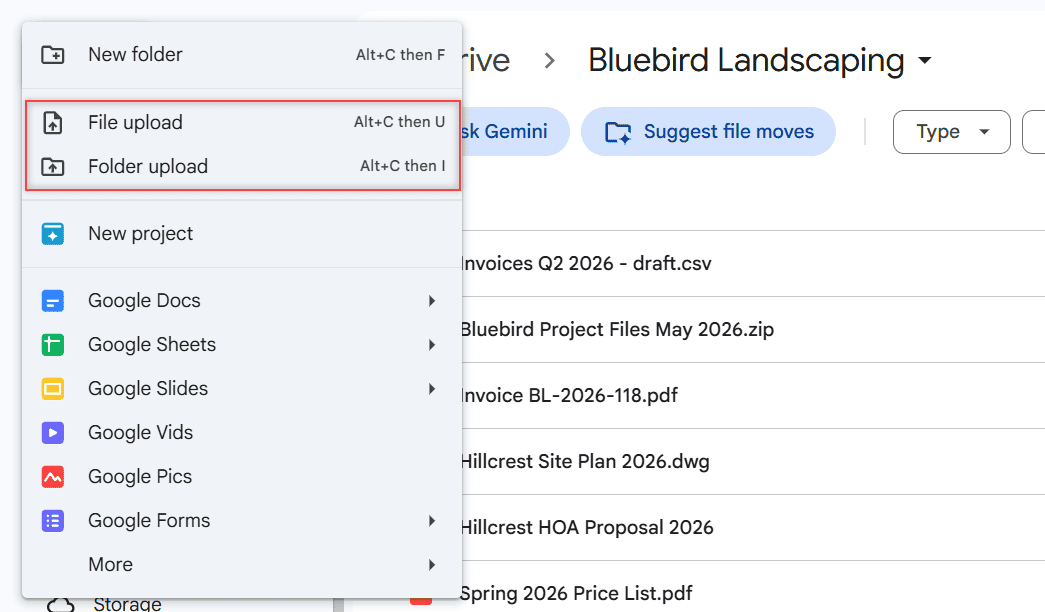
Keyboard fans can press Alt+C then U for File upload, as the menu shows. A panel appears in the bottom right corner with the file name and a time estimate.
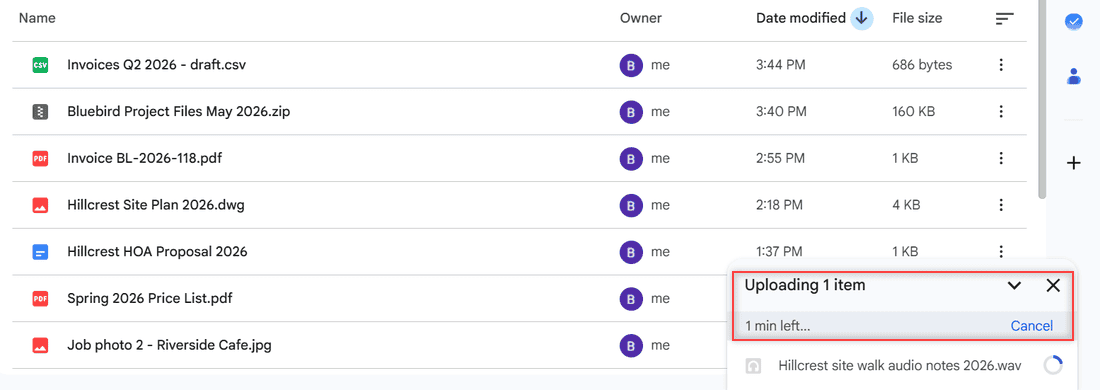
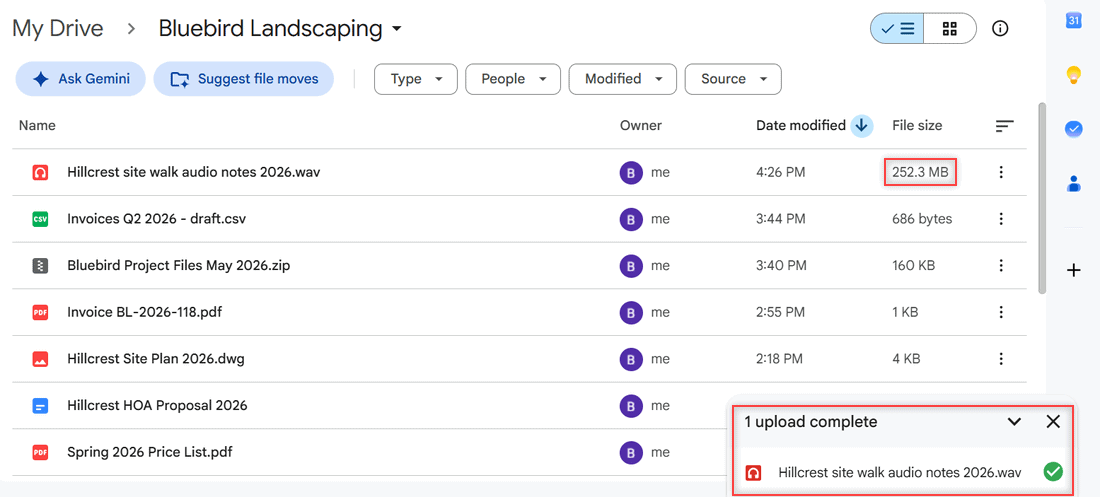
When it’s done, the panel changes to 1 upload complete with a green check, and the file shows up in the folder.
How does this work?
The browser sends the file to Google in the background while you keep working in Drive. My 252.3 MB WAV took about a minute on my connection, but speed depends entirely on your upload bandwidth.
The one rule: keep that browser tab open. Close it and the upload stops. If you need to cancel on purpose, here’s how to stop a Google Drive upload cleanly.
Pro tip: Sort the folder by Date modified, newest first, like in my screenshot. The file you just uploaded lands at the top, so you can check its size right away.
Method 2: Upload a whole folder or drag and drop
Got a folder full of job photos or videos? Don’t pick them one at a time.
- Click New > Folder upload (or press Alt+C then I).
- Choose the folder on your computer and confirm the upload in the browser prompt.
You can also open a folder on drive.google.com and drag files or folders from File Explorer or Finder straight onto the Drive window. I didn’t capture drag and drop here, but it lands in the same upload panel.
How does this work?
Drive keeps the folder structure, so subfolders come along. If you only need part of a folder, use File upload and hold Ctrl (Cmd on a Mac) while you click files in the picker. It works the same way you select multiple files in Google Drive itself.
Watch out for duplicates. If a file with the same name already exists in that folder, Google adds your upload as a new version of it. To keep them separate, choose Keep both files when Drive asks.
Method 3: Use Drive for desktop for huge files and big batches
For really big jobs, like a season of drone footage, I’d skip the browser. Drive for desktop is Google’s free app for Windows and macOS, and it shows Drive as a folder on your computer.
- Download and install Google Drive for desktop, then sign in.
- Open the Google Drive folder in File Explorer or Finder.
- Copy, paste, or drag your large files into it. They upload in the background.
How does this work?
You don’t need to babysit a browser tab, and you can pause or resume syncing at any time from the app. That makes it the safer choice for multi-gigabyte files on a home connection.
The app can stream files, which uses almost no space on your computer, or mirror them, which keeps a full local copy. On a work or school account, your admin may need to install it for you.
I didn’t install it on my demo machine, so there’s no screenshot here. If the app won’t open, see what to do when Drive for desktop will not launch.
Method 4: Upload large files from your phone
The Google Drive app for Android and iPhone handles big files too. I didn’t test it for this post, but Google’s steps are simple.
- Open the Google Drive app.
- Tap New (the + button), then Upload.
- Pick the files. They land in My Drive unless you move them.
How does this work?
On Android, Drive has a Transfer files only over Wi-Fi setting under Settings > Data usage. Turn it on before sending a big video, so you don’t burn mobile data. Stuck at zero? Here’s my fix for Google Drive not uploading from a phone.
How to upload large video files to Google Drive
Videos are where most people hit trouble, mainly because phone and camera footage gets big fast. The upload itself works exactly like any other file: use File upload, Drive for desktop, or the app.
- Formats: Drive plays WebM, MPEG4, 3GPP, MOV, AVI, MPEGPS, WMV, FLV, MTS, and OGG.
- Resolution: you can upload any resolution, but Drive plays videos back at up to 1920 x 1080. Your original file stays untouched.
- Size: up to 5 TB per video, or whatever storage you have left.
After a large video uploads, Drive still has to process it. You may see this message for a while:
Video is still processing. Try again later.That’s normal; wait and try again. If it never plays, my guide on when a Google Drive video cannot be played covers the fixes.
Pro tip: Do the math before a big video upload. My file moved at roughly 4 MB a second, so a 10 GB video would need about 40 minutes on the same connection. If that’s too long for an open tab, use Drive for desktop.
Check the upload landed and what it cost you
I always confirm big uploads before deleting the original from my computer. Click the file, then open the Details panel.
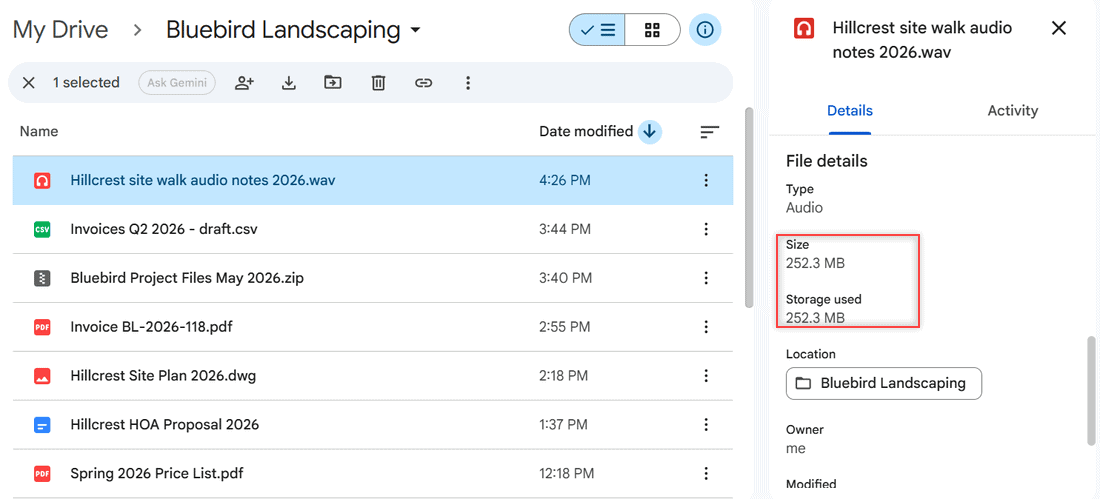
The size should match the file on your computer. Storage used tells you how much of your quota it takes: 252.3 MB for my WAV, since I own it.
Then click Storage in the left menu. Your biggest files are listed first.
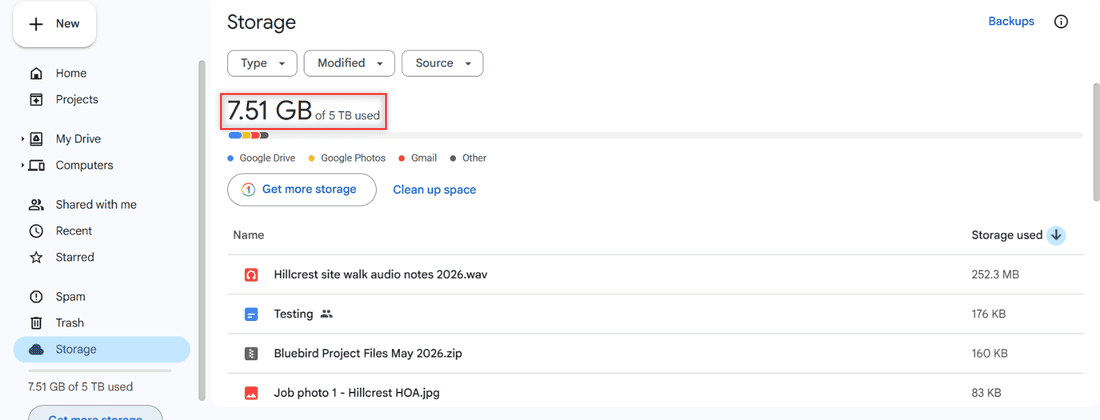
How does this work?
Uploads count against your storage even when you put them in a folder someone else owns. To see totals by folder, here’s how to check folder size in Google Drive.
What to do when a large upload fails or stalls
Big uploads fail for boring reasons far more often than mysterious ones. This is the order I check things in, and it saves me from re-uploading the same 5 GB file three times.
- Check your free space. Open the Storage page and compare the free space with the file size. Drive won’t start an upload it can’t store.
- Check the tab and the computer. A closed tab, a laptop that went to sleep, or a dropped Wi-Fi connection all end a browser upload.
- Check your connection. If Drive keeps flipping offline, work through why Google Drive keeps going offline first.
- Clear the browser cache. An old cached session can hang the upload panel; here’s how to clear the cache in Google Drive.
- Switch methods. If the browser keeps failing on one huge file, upload it with Drive for desktop instead. It can pause and resume, which a browser tab can’t.
On a Workspace account, also think about the daily cap. If you’ve already moved hundreds of gigabytes today, new uploads will wait until the 750 GB limit refreshes.
Things to keep in mind
- Storage comes first. The 5 TB file limit only matters if you have the space. A free 15 GB account can’t take a 20 GB video.
- Personal vs Workspace. Google documents the 750 GB daily upload cap for Workspace users; your admin may also limit storage on a work account.
- Don’t convert big files. Converting to Docs, Sheets, or Slides has much lower limits (50 MB to 100 MB). Leave large Office files in their original format.
- Keep the tab open. Browser uploads stop if you close the tab or let the computer sleep.
- Slow or stuck uploads. Check why Google Drive is so slow before you retry, and see the Waiting to upload fix if the panel never moves.
- Zip small files, not videos. Zipping a folder of documents helps; videos barely shrink. My guide to reduce file size in Google Drive has better options.
Once your big files are in Drive, these come in handy:
- embed a video from Google Drive
- move a Drive video to YouTube
- fix Google Drive upload failure 38
- upload a folder on Android
Frequently Asked Questions
What is the maximum file size for Google Drive uploads?
Regular files, including videos, can be up to 5 TB each, as long as you have enough storage. Files converted to Google Docs, Sheets, or Slides have lower limits. Google Drive Help lists every file limit.
Why is my large file not uploading to Google Drive?
The usual causes are a full storage quota, a closed browser tab, or a slow connection. Check your Storage page first, then try Drive for desktop for very large files.
Is there a daily upload limit on Google Drive?
For Google Workspace accounts, Google says each user can upload and copy 750 GB within 24 hours. The limit refreshes within 24 hours.
Can I close my browser while uploading to Google Drive?
No. A browser upload stops when you close the tab. Drive for desktop keeps uploading in the background, so use it for long uploads.
How long does it take to upload a large video to Google Drive?
It depends on your upload speed. In my test, a 252.3 MB file took about a minute; a 10 GB video on the same connection would take roughly 40 minutes.

I am Carissa Gudinoa, a technology buff, and Office online and Apple expert with over 9 years of experience. I am passionate about helping others get the most out of their Apple devices. I have written extensively about Apple products and technologies. I am committed to providing my clients with the best possible service and am always up-to-date on the latest Apple products and features. I also write extensively on other software available for use at minimal cost or free. This includes Word Online, Outlook Online, Excel Online, and other Office online programs… Check out more.