
Google still doesn’t make a Drive app for Linux, so pick rclone if you want something free and don’t mind a terminal, Insync if you’d rather pay for a desktop app with selective sync, and plain Drive in Chrome if you only touch a few files a week.
In this tutorial, I’ll compare every Google Drive client for Linux that’s still maintained in 2026, with the good and bad parts of each and who it suits. I don’t run Linux myself, so I’ll be upfront: the Drive side comes from my demo account, and every Linux detail comes from each project’s own documentation.
Why there is no official Google Drive app for Linux
Google’s sync app is called Drive for desktop, and Google’s own product page says it’s available for Windows and macOS. Linux isn’t on that list.
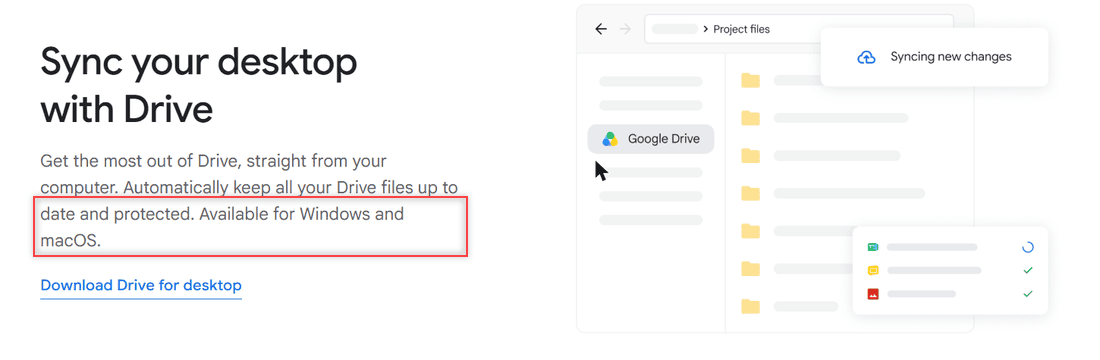
Google’s system requirements page spells it out. Drive for desktop needs 64-bit Windows 10 or later, or macOS Ventura 13.0 or later. For Linux, it says the desktop version isn’t available and points you to Drive on the web.
If you also use a Windows or Mac computer, my guide to installing Google Drive for desktop covers that side.
Here’s a small thing I noticed in my demo account. With no computer connected, the Computers page in Drive says No computers syncing, and Google notes that only folders synced with Drive for desktop show up there.
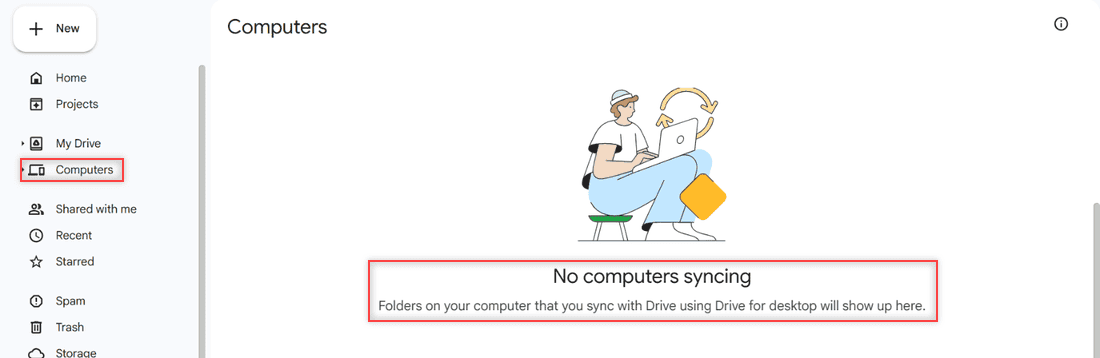
So on Linux, expect that page to stay empty. The tools below work with the files in My Drive directly, so what you sync or upload lands there like any other upload.
The quick comparison table
| What matters | Browser | rclone | Insync | google-drive-ocamlfuse | ExpanDrive |
|---|---|---|---|---|---|
| Kind of tool | Drive website | Command-line tool | Desktop sync app | FUSE mount | Mounted drive app |
| Cost (per its site) | Free | Free, open source | Paid, with a free trial | Free, open source | Free for personal use |
| Keeps a local folder in sync | No | Yes, with sync or bisync | Yes, selective sync | No, it mounts | No, it streams |
| Mounts Drive as a folder | No | Yes, rclone mount | Not on the pages I read | Yes | Yes |
| Google Docs, Sheets, Slides | Open and edit | Exported as docx, xlsx, pptx | Conversion listed | Exported, read-only | Not stated |
| Shared drives | Yes | Yes | Not stated | Team Drive support | Not stated |
| Several Google accounts | Switch accounts | One remote per account | Yes | Yes, with -label | Not stated |
| Offline use | Docs, Sheets, Slides in Chrome or Edge | Synced copies are local | Synced copies are local | Local cache only | Pin folders offline |
What each Linux option does well
Drive in the browser needs nothing installed
Every Linux desktop has a browser, and Drive on the web is the only option Google itself supports there. When I click New, I get File upload and Folder upload next to the Google Docs, Sheets, and Slides shortcuts.
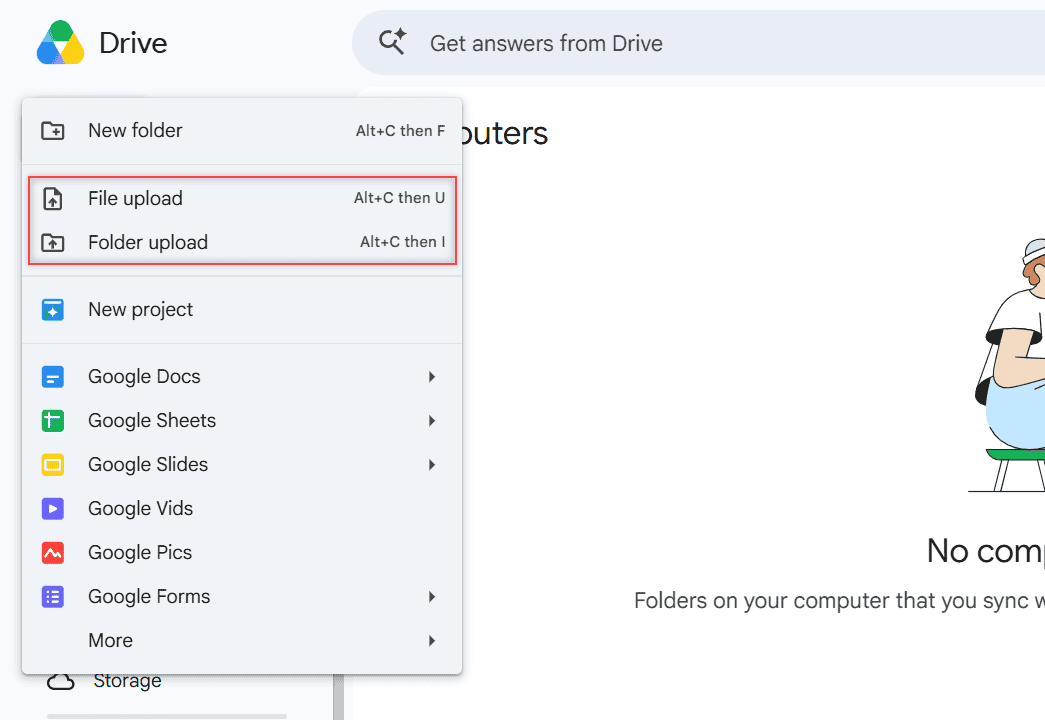
Folder upload keeps your folder structure. For big video files, my tips to upload large files to Google Drive help when an upload stalls.
Offline editing works too, with limits. Google says you need Chrome or Microsoft Edge, the Google Docs Offline extension, and a normal (not private) window. Then you tick the Offline box in Drive Settings.
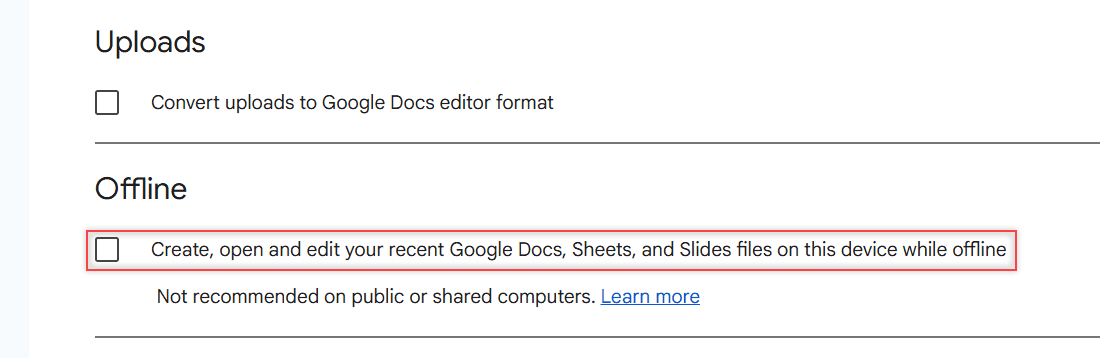
That only covers Docs, Sheets, and Slides. If the offline mode acts up, here’s what to check when Google Drive keeps going offline.
rclone is free, scriptable, and can mount Drive
rclone is the tool most Linux guides end up recommending, and its docs explain why. It copies, syncs, and mounts Google Drive, and it works with shared drives. The project recommends its install script because distro packages are often out of date:
sudo -v ; curl https://rclone.org/install.sh | sudo bashYou then run the setup, pick drive as the storage type, and sign in through your browser. To use Drive like a folder, the mount docs suggest the writes cache mode so normal apps can save files:
rclone config
mkdir ~/GoogleDrive
rclone mount gdrive: ~/GoogleDrive --vfs-cache-mode writes --daemon
Here, gdrive is the name I’d give the remote during setup. For true two-way sync, rclone has bisync. Its docs say to run the first pass with –resync and drop that flag after.
Insync is the closest thing to a desktop app
Insync is a paid app that lists Ubuntu, Mint, Red Hat, Debian, and Fedora among its supported systems. Its site lists selective sync, so you only download the folders you need.
It also handles several Google Drive, OneDrive, and Dropbox accounts in one place. Google Docs conversion and file manager integration appear in its feature table, and its pricing page mentions command-line syncing for Linux.
google-drive-ocamlfuse is a plain, free mount
This open-source project mounts your Drive as a folder using FUSE. The README says it gives full read and write access to normal files, exports Google Docs read-only, supports Team Drives, and handles several accounts with a -label option. Ubuntu users install it from the developer’s PPA:
sudo add-apt-repository ppa:alessandro-strada/ppa
sudo apt-get update
sudo apt-get install google-drive-ocamlfuse
mkdir ~/GoogleDrive
google-drive-ocamlfuse ~/GoogleDrive
The first run opens your browser to approve access. The project is active, too: version 0.9.0 came out in June 2026, according to its GitHub page.
ExpanDrive streams files and caches them offline
ExpanDrive mounts Drive at a normal mount point, so it works with any Linux app. Its page says files stream when you open them, and you can pin folders for offline use. Changes made offline sync back later.
It ships .deb and .rpm packages with apt and yum repos for updates. The site says it’s free for personal use, and it supports Google Workspace and Education accounts.
Drawbacks to know before you commit
The browser cannot sync a folder
Drive on the web is upload and download, nothing more. There’s no folder on your disk that stays in sync, and offline mode skips PDFs and images. Big folders also come down as zip files, so learn how to download from Google Drive without zipping.
rclone needs some setup work in 2026
The rclone Drive docs say its shared client ID is being retired and will stop working during 2026. They now strongly recommend creating your own Google API client ID, which means a trip into the Google Cloud console.
Google’s rate limits also apply. The docs say rclone manages about 2 files per second, so thousands of small files take a while. If Drive feels slow everywhere, see why Google Drive is so slow.
Insync costs money after the trial
Insync is paid. Its pricing page offers a 7-day free trial for individuals and 15 days for its Office plans, and licenses are counted per cloud account. I couldn’t confirm shared drive support on the pages I read.
google-drive-ocamlfuse is still labeled as testing
The README says the app is still under testing, so bugs are possible. It suggests a read-only mount if you’re nervous. Deleting with rm sends files to Drive’s trash, and here’s how long Google Drive keeps deleted files.
GNOME Files lost its Google Drive support
Older guides tell you to add your Google account in Settings, then Online Accounts, and browse Drive in the Files app. GNOME’s own code says that’s going away.
The gvfs project marked its Google backend as deprecated and turned it off. GNOME Online Accounts 3.58 then disabled the Files feature for Google accounts in February 2026. Older distro releases may still have it.
Projects I dropped from the old list
CloudCross hasn’t had a push on GitHub since November 2020, and GoSync’s repo stopped in June 2023. I removed both, along with DriveSync, because I couldn’t verify enough about it.
Who should use which client, and who should pick something else
Pick the browser if you mostly edit Google Docs and upload the odd file. Add Chrome’s offline mode and you’re set.
Pick rclone if you’re comfortable in a terminal, want it free, and like scripting backups. It’s the most flexible option here. Watch out for duplicate copies after a bad sync; here’s how to stop Google Drive from duplicating files.
Pick Insync if you want a desktop app that keeps chosen folders in sync and you’re fine paying for it. Pick google-drive-ocamlfuse or ExpanDrive if you’d rather open Drive as a folder than keep copies on disk.
Pick something else if your whole team is on Windows and Office. Compare Google Drive against OneDrive first, since a Windows team gets Google’s own Drive for desktop app.
If you split your week between Linux and other computers, these might help:
- advantages and disadvantages of Google Drive
- Google Drive version history
- best Chrome extensions for Google Drive
- personal vs business Google Drive
Still deciding?
Is there an official Google Drive client for Linux?
No. Google Drive Help’s system requirements page lists Drive for desktop for Windows and macOS only, and says to use Drive on the web on Linux.
What is the best free Google Drive client for Linux?
rclone is the most capable free option. It syncs, mounts, and works with shared drives. google-drive-ocamlfuse is a simpler free choice if you only want Drive as a folder.
Can I use Google Drive offline on Linux?
In Chrome or Edge you can turn on offline access for Google Docs, Sheets, and Slides. For other files, use a sync tool like rclone or Insync, or pin folders in ExpanDrive.
Does Ubuntu have Google Drive built in?
GNOME’s Files app used to show Google Drive through Online Accounts. GNOME has since turned that feature off, so newer releases need a separate client.

I am Carissa Gudinoa, a technology buff, and Office online and Apple expert with over 9 years of experience. I am passionate about helping others get the most out of their Apple devices. I have written extensively about Apple products and technologies. I am committed to providing my clients with the best possible service and am always up-to-date on the latest Apple products and features. I also write extensively on other software available for use at minimal cost or free. This includes Word Online, Outlook Online, Excel Online, and other Office online programs… Check out more.