
Google Drive keeps deleted files in Trash for 30 days, then deletes them forever on its own. To get one back, click Trash on the left, right-click the file, then click Restore.
After the 30 days, or after you empty the trash, the file is gone for good in most cases.
In this tutorial, I’ll answer how long does Google Drive keep deleted files, show you how to restore a file on a computer and a phone, and explain what you can still try once the trash is empty.
Where your deleted files wait for 30 days
When you delete a file in Drive, it doesn’t disappear right away. It moves to Trash, and the clock starts that day. I tested this in my demo Drive for a made-up business, Bluebird Landscaping Co.
I right-clicked an old file, Riverside Cafe estimate draft 2026.csv, and chose Move to trash. Drive showed a small message at the bottom: File moved to trash, with an Undo button next to it.
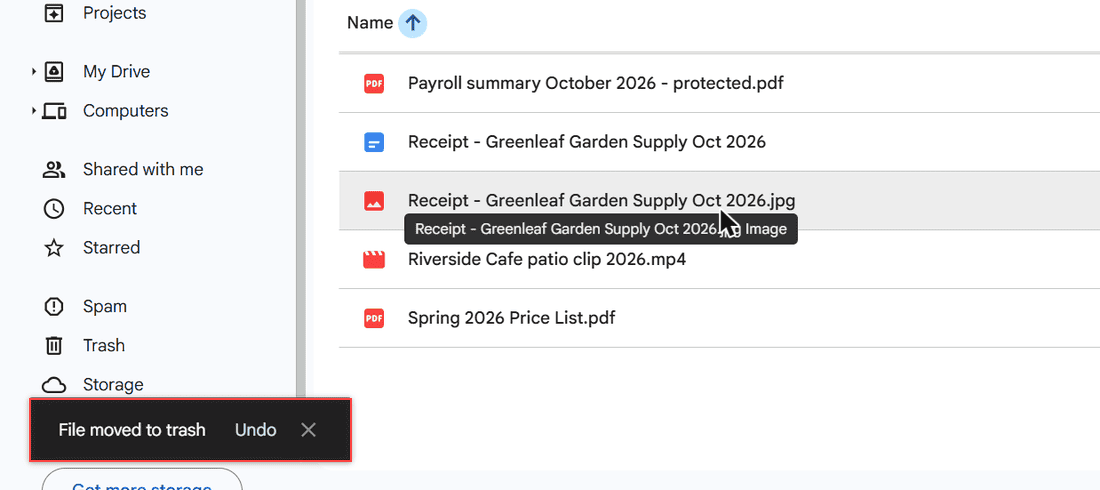
That Undo button is the fastest fix there is. It only stays for a few seconds, though. If you miss it, the file is waiting in Trash.
Click Trash in the left menu at drive.google.com. Across the top, Drive spells out the rule: items in trash will be deleted forever after 30 days. The Empty trash link sits on the same line.
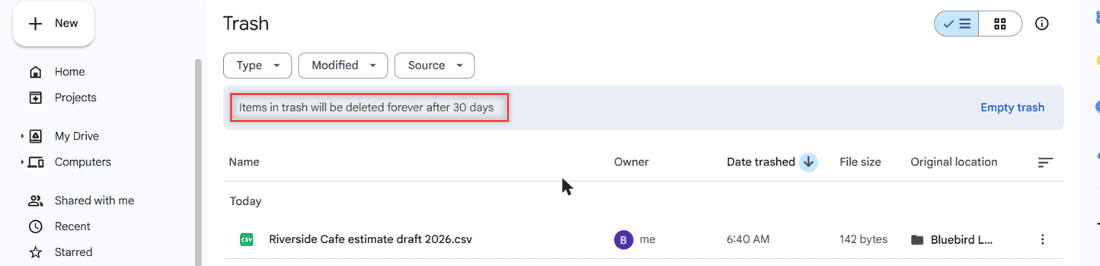
The list shows each file’s owner, the date you trashed it, its size, and its original location. My CSV showed today at 6:40 AM and the Bluebird Landscaping folder it came from.
Want to know how many days a file has left? Look at Date trashed and count 30 days forward. Clicking that column sorts the list, which helps when you search for a missing folder you deleted weeks ago.
Restore a deleted file on a computer
In Trash, right-click the file. You’ll see Open with, File information, Restore, and Delete forever. Click Restore.
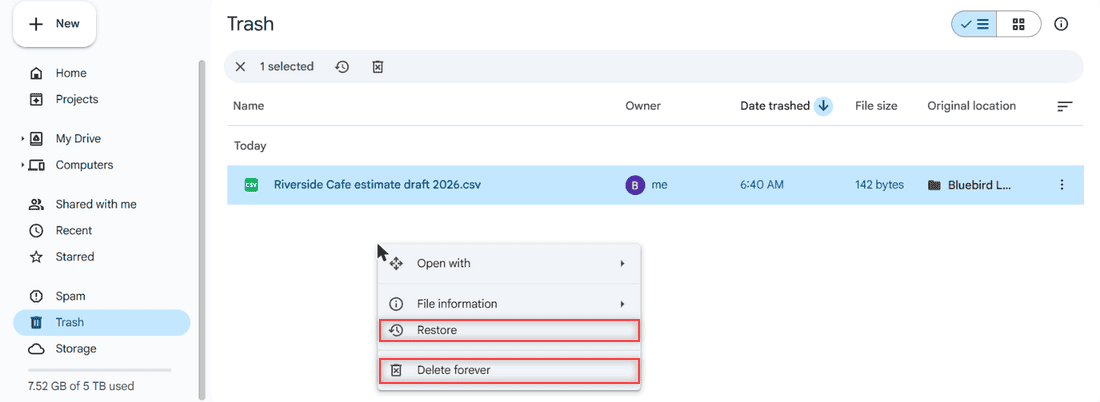
One small thing I noticed: when a file is selected, the 30-day banner hides. It comes back when you click an empty spot in the list.
After I clicked Restore, Drive confirmed it with Restored Riverside Cafe estimate draft 2026.csv, plus Show file location and Undo. My Trash then read Trash is empty.
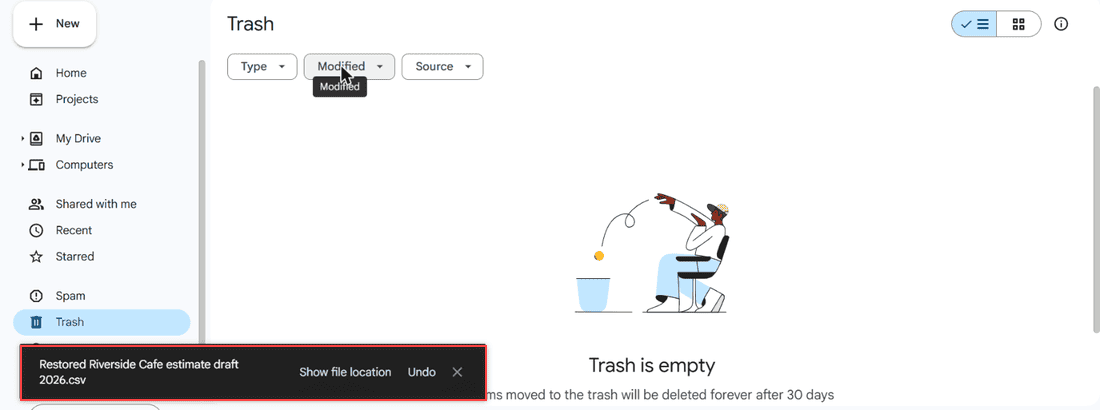
Click Show file location to jump straight to the folder. The file goes back to its original location, the one listed in Trash.
To bring back several files, hold Ctrl (Command on a Mac) and click each one, then right-click and Restore. It works the same way you select multiple files in Drive.
Restore or delete forever on Android or iPhone
Open the Google Drive app and tap Menu at the top left. Tap Trash.
Next to the file you want, tap More (the three dots), then tap Restore. To get rid of it for good instead, tap Delete forever.
To clear everything, tap More at the top right of the Trash screen and choose Empty trash. Make sure you won’t need any of those files first, because the 30-day safety net ends there.
Docs, Sheets, and Slides use the same Trash
There’s no separate trash for Google Docs, Sheets, or Slides. Those files live in Drive, so a doc you delete from the Docs home screen lands in the same Drive Trash, on the same 30-day clock.
That also means one restore method works for all of them. Open Drive, click Trash, and restore the doc from there. It shows up again in Docs right away.
PDFs, photos, videos, and CSV files you uploaded follow the same rule. If it’s stored in Drive, it goes to Drive’s Trash.
What Delete forever and Empty trash really mean
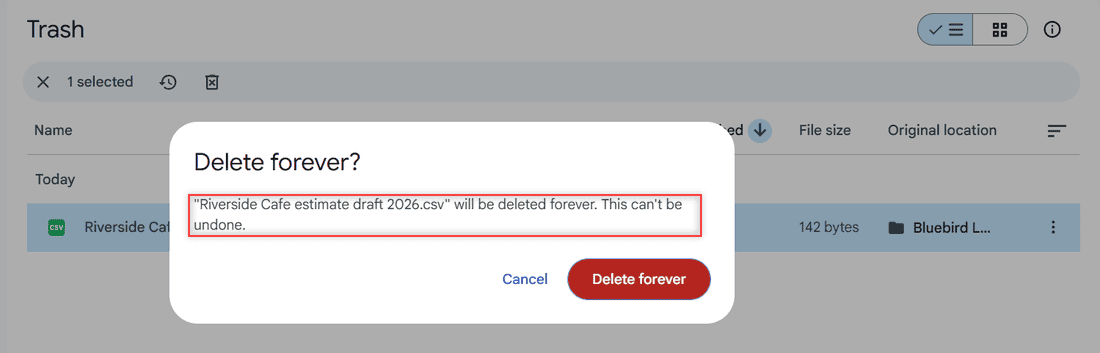
Both buttons skip the 30-day wait. Drive warns you before it acts. When I opened Delete forever on my CSV, the dialog said the file will be deleted forever and this can’t be undone. I clicked Cancel.
Empty trash does the same thing to every file at once. I walk through it step by step in my guide to emptying the Google Drive trash.
Here’s what changes along the way:
- Storage. Trashed files still count toward your storage until they’re permanently deleted. That’s a common reason Drive says storage is full with no files.
- Shared files you own. People you shared a file with keep access while it sits in Trash. Once you delete it forever, they lose access too.
- Files someone else owns. Deleting one only takes it out of your Drive. Everyone else still has it. Here’s how removing shared files works.
Getting a file back after the trash is emptied
This depends on the type of account you have. Check the profile picture at the top right. A work or school address usually means Google Workspace.
Google Workspace accounts
Your admin has an extra 25 days after you empty the trash. In the Admin console, they go to Directory, Users, pick your account, then More options, Restore data, choose a date range and Drive, and click Restore.
There are catches. The admin can’t pick one file. Everything deleted in that date range comes back. Files still sitting in your Trash aren’t covered, so restore those yourself. After the 25 days, the data is purged.
Personal Google accounts
A personal account has no admin. Once you click Delete forever, or the 30 days pass, the only route left is asking Google for help.
Sign in, open the Drive help page on recovering a deleted file, and use Contact us to send a file recovery request. I’ll be plain: there’s no guarantee. Treat it as a long shot, not a backup plan.
Heads up: Skip the paid recovery apps. Files deleted from Drive live on Google’s servers, not your computer, so software on your PC can’t reach them.
When the deleted file isn’t in Trash
If you can’t find it, check these before you give up:
- Wrong account. Many of us have two or three Google accounts. Switch accounts and look in each Trash.
- Someone else owned it. Deleting it only took it out of your Drive. The owner still has it, so ask them to share it again.
- Drive for desktop. Deleting a file from a synced folder on your PC sends it to Drive’s Trash too. If that keeps surprising you, turn off Google Drive sync.
- Older than 30 days. Sort by Date trashed. If it isn’t there, it has already been deleted forever.
Didn’t delete the file, but someone overwrote it? That’s not a Trash problem. Open version history in Google Drive and roll back to an earlier copy.
How I keep important files from slipping away
Thirty days sounds like a lot until a busy month goes by. A few habits have saved me more than once:
- Check Trash before you empty it. Sort by Date trashed and scan the newest files. It takes ten seconds.
- Let Drive empty it for you. If storage isn’t tight, skip Empty trash. The 30-day wait is free insurance.
- Transfer ownership before you delete. If a teammate still needs a file you own, make them the owner first. Otherwise they lose it when you delete it forever.
- Keep a second copy of anything critical. Contracts, tax files, and client estimates deserve a copy outside Drive too.
If you’re leaving a shared project, tell people before you clean up. It’s a lot easier than explaining later why a folder they used every day suddenly went blank.
A few more Drive cleanup guides I lean on
- See recent activity on Google Drive
- Unshare a folder in Google Drive
- Restore a backup from Google Drive
- All Google Drive tutorials
Quick answers
Does Google Drive delete files automatically after 30 days?
Yes, but only files in Trash. Anything you move to Trash is deleted forever after 30 days. Files in My Drive stay until you delete them.
Can I recover Google Drive files deleted more than 30 days ago?
Usually not. A Workspace admin may restore data up to 25 days after the trash is emptied. A personal account can only send Google a recovery request, with no guarantee.
Do deleted files still take up Google Drive storage?
Yes. Files in Trash keep counting toward your storage until they’re permanently deleted, either by you or after the 30 days.
Can Google recover permanently deleted files?
Sometimes, and only if you ask. Signed-in users can request it from Google Drive Help: Find or recover a file. Google doesn’t promise the file can come back.

I am Carissa Gudinoa, a technology buff, and Office online and Apple expert with over 9 years of experience. I am passionate about helping others get the most out of their Apple devices. I have written extensively about Apple products and technologies. I am committed to providing my clients with the best possible service and am always up-to-date on the latest Apple products and features. I also write extensively on other software available for use at minimal cost or free. This includes Word Online, Outlook Online, Excel Online, and other Office online programs… Check out more.