
Bluebird Landscaping Co., the sample Austin lawn care company I use in my examples, runs on one personal Gmail account with a Google One storage plan. It works fine for me and two crew leads. But every time we hire, I wonder if it’s time to move the business to Google Workspace.
In this tutorial, I’ll walk through Google Drive personal vs business the way I’d weigh it for my own shop: storage, shared drives, a business email address, admin controls, sharing, support, and how files move over if you switch.
Know that both run the same Google Drive
Here’s the short version. Google Drive is the same app either way. A personal account is a free Google Account you can add storage to. Google Workspace is a paid business subscription that wraps Drive, Gmail, and the rest in an organization your admin controls.
So you won’t learn a new interface. The web app, phone apps, and desktop app work the same, and Docs, Sheets, and Slides behave alike. If you’re new to the basics, my post on the pros and cons of Google Drive is a good start.
| What you get | Personal Google Account | Google Workspace (business) |
|---|---|---|
| Storage | 15 GB free, shared by Gmail, Drive, and Photos; more with Google One | Pooled storage per user, set by edition |
| Shared drives | No | Yes, if your edition includes them |
| Email address | name@gmail.com | An address at your own domain |
| Admin console | No | Yes: sharing rules, users, file transfers |
| Google support | Help Center and community | Admins can contact Workspace support |
Count storage per account, not per business
On a personal account, every Google Account includes up to 15 GB of storage. Google shares it across Gmail, Google Drive, and Google Photos, so a full photo library eats into your Drive space.
I pay for a bigger Google One plan, so my Storage page says 5 TB. Look at the breakdown, though: Photos uses far more than Drive. That’s my phone backups, not business files.
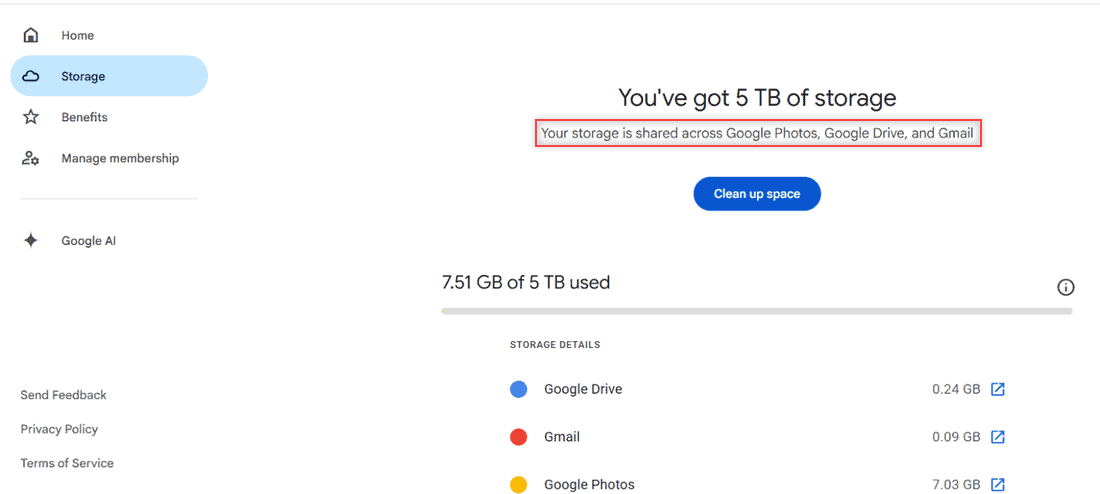
Workspace counts storage differently. At the time of writing (October 2026), Google lists pooled storage of 30 GB per user on Business Starter, 2 TB per user on Business Standard, and 5 TB per user on Business Plus. Each license adds to one pool the whole company shares.
If you’re tight on space today, check how big your Drive folders are before you pay for more.
One detail I like: shared files count only against the owner’s storage, not the people you share with. In Workspace, content in shared drives counts toward the organization’s pool.
Expect shared drives only on a Workspace account
This is the biggest practical gap for me. Shared drives are team spaces where files belong to the organization, not one person. Google says plainly that they’re available only for work or school accounts, not personal Google Accounts.
You can see it in my left nav. A personal Drive has My Drive, Computers, and Shared with me, but no Shared drives item. A Workspace account with shared drives turned on shows one.
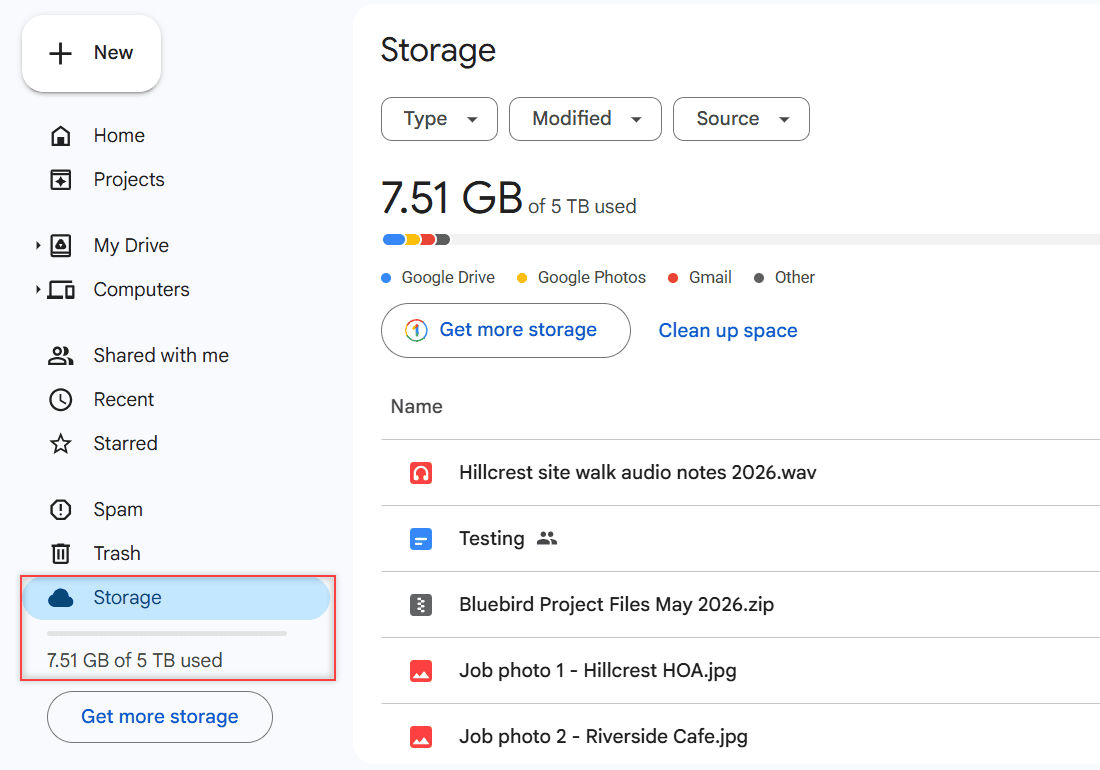
Today, my crew leads see our job folders because I share them one by one. If someone leaves, those files are still mine, which is good, but it’s all manual. I explain the quirks in my post on shared folders and storage space.
Google’s Business editions page lists shared drives under Business Standard, and your admin has to allow them. Check your edition before you plan around them.
Use your own domain for email and sign-in
Right now, clients get proposals from a Gmail address. Workspace lets you send and receive mail using a professional address at your own domain, and that same address is the Google Account your team signs in with.
That matters for Drive, too. When I share a file today, clients see a Gmail name. With Workspace, they’d see the company domain. If you share a lot of client files, my guide to turning on link sharing covers the basics.
Plan for admin controls you control
A personal account has no admin. You make every sharing choice yourself, file by file. Workspace adds the Google Admin console, where an admin sets rules for everyone.
For sharing outside the company, an admin goes to Menu > Apps > Google Workspace > Drive and Docs > Sharing settings > Sharing options. Google lists three choices: Off, Allowlisted Domains, and On. With sharing on, they can still warn users before they share outside or block link sharing.
Business Plus also includes Google Vault, which Google describes as an information governance and eDiscovery tool. Admins can set retention rules, place holds, search, and export the organization’s data.
These rules work both ways. If a client’s admin has locked something down, you’ll see messages like backup disabled by your admin, and the fix is to ask that admin, not work around it.
Keep files when someone leaves
This is the part that worries me most with a growing crew. On a personal setup, if a crew lead keeps job photos in their own Gmail, those files leave with them.
In Workspace, an admin can move a departing person’s files to someone else. Google’s steps are to suspend the user first, then go to Apps > Google Workspace > Drive and Docs > Transfer ownership, pick the From user and To user, and click Transfer Files.
Items in Trash aren’t transferred, so pull back anything you need first. To clean up access on my personal account instead, I unshare the folder in Google Drive the day someone leaves.
Compare the sharing options in the Share dialog
Open the Share dialog on a personal account and look at General access. I checked it on our Spring 2026 Price List.pdf, and there are only two choices: Restricted and Anyone with the link.
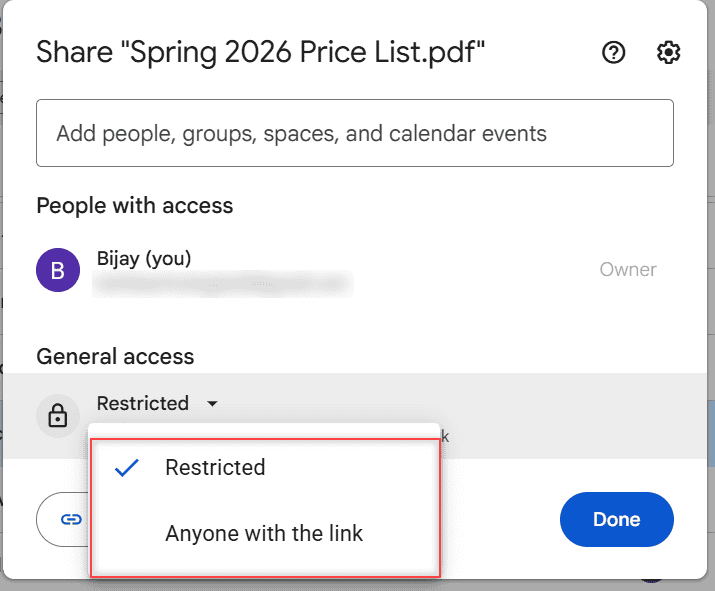
Google’s help lists a third option for work or school accounts: Your Organization, which lets anyone in your organization open the file, based on the sharing levels your admin allows.
On a personal account, an internal file means adding people one by one. Tracking is limited, too: when I tried to check who downloaded my Drive files, I learned download logs are a Workspace admin feature.
Get help from Google only through an admin
With a personal account, my help options are the Google Help Center and the community forums. Workspace adds real support, but only for admins: contacting Google requires the Support administrator privilege in the Admin console. Regular staff go to their admin.
Switch when files need an owner other than you
I wouldn’t switch just for storage. A Google One plan handled that for me. I’d switch when the business needs files to belong to the company, not to me. If you’re also weighing other tools, see my Google Drive vs OneDrive comparison.
Here’s my checklist for the move:
- You’ve hired people who create files you need to keep after they leave.
- Clients expect email from your own domain, not Gmail.
- You want team folders that no single person owns.
- You need sharing rules or data retention you can’t set file by file.
- You’d like someone to call at Google when something breaks.
Moving files takes planning. Google says you can’t transfer a file from a personal account to someone with a work or school account. Instead, share the files with your new work account and make copies, or download and upload them. Google also describes a shared drive route: a Workspace user creates one, and you move the files in.
Copies get new links, so reshare them with clients afterward. I’d move one job folder first to see how long it takes.
Before you decide, these posts fill in the details:
- fix Google Drive storage that looks full
- handle access requests in Google Drive
- turn off downloads for viewers
- how Google Drive and Google Docs differ
Questions I get about this
Can I use a personal Google Drive for my business?
Yes. Plenty of small shops start there, and a Google One plan adds storage. You just won’t get shared drives, a business email address, or admin controls, and files belong to whoever created them.
What is the difference between Google Workspace and Google Drive?
Google Drive is the storage app. Google Workspace is a paid business subscription that includes Drive plus business email at your domain, pooled storage, and an Admin console for managing users and sharing.
How much storage does a Google Drive business account get?
It depends on the edition. Workspace storage is pooled per user, and Google Workspace Admin Help on storage lists the current amounts for each edition.
Can I transfer files from my personal Google Drive to a Workspace account?
Not by changing the owner. Google doesn’t allow transfers from a personal account to a work account, so share the files with your work account and make copies, or download and upload them.

I am Carissa Gudinoa, a technology buff, and Office online and Apple expert with over 9 years of experience. I am passionate about helping others get the most out of their Apple devices. I have written extensively about Apple products and technologies. I am committed to providing my clients with the best possible service and am always up-to-date on the latest Apple products and features. I also write extensively on other software available for use at minimal cost or free. This includes Word Online, Outlook Online, Excel Online, and other Office online programs… Check out more.