
No, they aren’t the same thing. Google Drive is the storage space where all your files live, and Google Docs is the word processor you use to write documents. Every Google Doc you create is saved in Drive, which is why the two feel like one app.
In this tutorial, I’ll explain Google Drive vs Google Docs in plain terms: what each one does, how a doc ends up in a Drive folder, what each can’t do, and which one to open for the job in front of you.
How Drive and Docs fit together
Think of Drive as a filing cabinet and Docs as a typewriter that drops every page straight into that cabinet. Both are free with a personal Google account, and both run in a web browser with nothing to install.
Drive holds files of any kind: photos, PDFs, spreadsheets, zip files, audio, even CAD drawings. Docs only creates and edits text documents, like letters, proposals, and reports.
Google also has Sheets for spreadsheets and Slides for presentations. They work like Docs, and their files land in Drive too. If you’re weighing Drive itself, my list of Google Drive pros and cons covers the bigger picture.
Google Drive vs Google Docs side by side
Here’s the quick comparison I wish someone had shown me when I started.
| Google Drive | Google Docs | |
|---|---|---|
| What it is | Cloud storage and file manager | Online word processor |
| Main job | Store, organize, upload, and share files | Write, edit, and comment on documents |
| File types | Any file type | Google Docs files, plus Word files you open in it |
| Web address | drive.google.com | docs.google.com |
| Where files live | In My Drive, folders, and Shared with me | In Drive, wherever the doc is saved |
| Size limit | Up to 5 TB per uploaded file | About 1.02 million characters per doc |
| Phone app | Google Drive app: browse, upload, move, share | Google Docs app: create and edit documents |
| Cost | Free with 15 GB shared storage | Free; uses that same storage |
The short version: Drive is where things are kept, and Docs is one of the tools that makes things to keep.
The two share the same sharing settings, so a doc you share in Docs shows up as shared in Drive. Here’s how to turn on link sharing in Google Drive when you need a link.
What Drive holds: any file, not just documents
I tested this in the demo Drive for Bluebird Landscaping, a made-up landscaping company. It’s a personal Gmail account, and I opened the Bluebird Landscaping folder in My Drive.
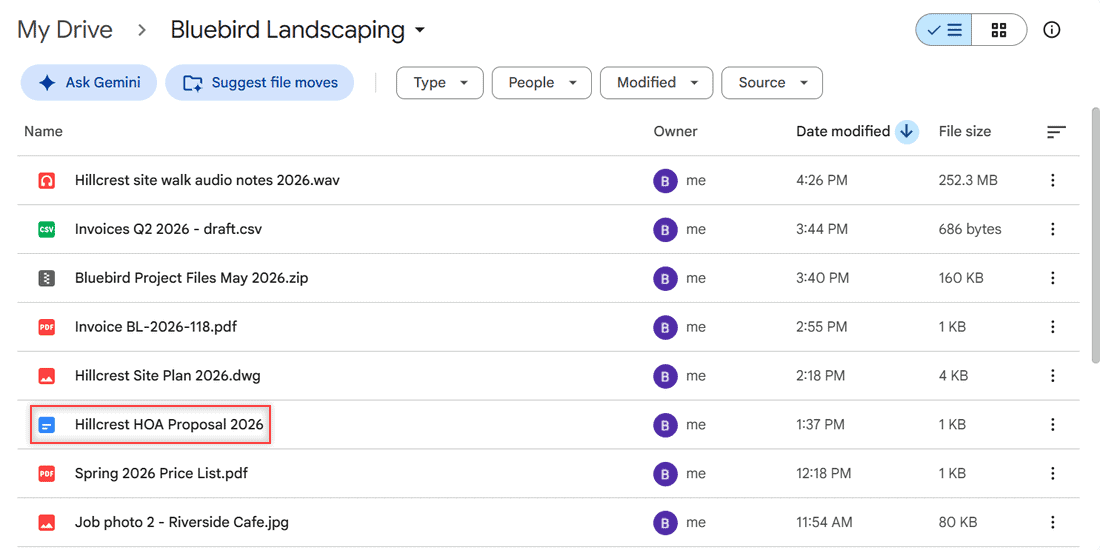
That one folder holds a .wav recording, a .csv export, a .zip archive, PDFs, a .dwg drawing, a .jpg photo, and exactly one Google Doc, Hillcrest HOA Proposal 2026. Drive doesn’t care what the file is. It stores it, shows who owns it, and lets you share it.
Look at the File size column, too. My Google Doc shows just 1 KB, while the audio file is far bigger. To check a whole folder, see how to see folder size in Google Drive.
Drive can preview a lot of these files without other software, but it can’t edit a .dwg or a .wav. For those, you download the file or use a connected app. My guide to open unsupported files on Google Drive walks through that.
Docs is where you write, and every doc lands in Drive
You can start a Google Doc from inside Drive. Click New at the top left, point to Google Docs, and pick Blank document or From a template.
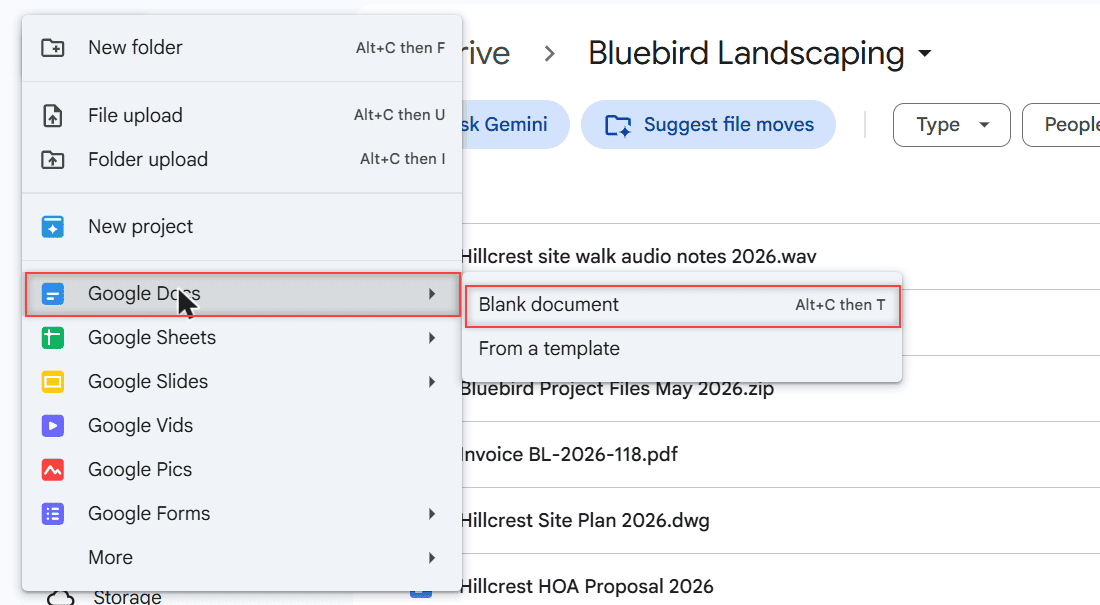
The same menu also offers New folder, File upload, and Folder upload, which are pure Drive jobs, next to Sheets, Slides, Forms, and more. That mix is a good picture of the relationship: Drive is the home, and the editors are rooms inside it.
When you create a doc this way, Drive saves it in the folder you were in. I made Hillcrest HOA Proposal 2026 while inside Bluebird Landscaping, so that’s where it lives.
You can see this from the Docs side as well. With the doc open, click the folder icon next to the title, and a Move dialog shows the doc’s current location.
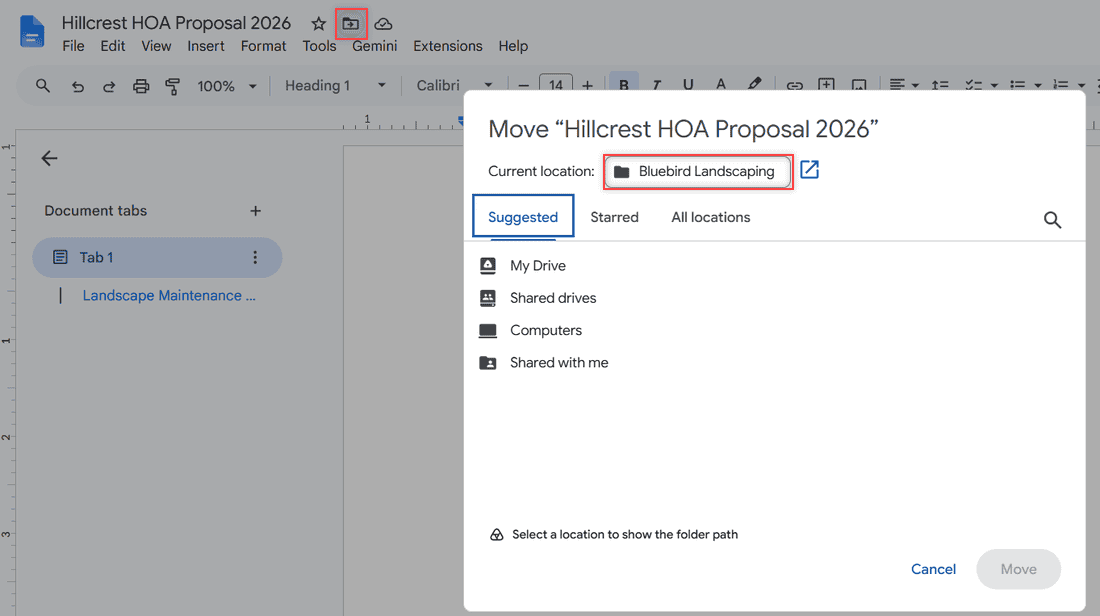
My dialog says Current location: Bluebird Landscaping. You can move the doc to another Drive folder right from here without leaving Docs. If your folders are getting crowded, subfolders in Google Drive help a lot.
Docs is also where the writing tools live: comments, suggestions, and version history so you can restore an earlier draft. You can download a doc as a Word file, a PDF, rich text, or a zipped web page.
The Docs home screen only shows documents
Go to docs.google.com and you’ll see a different front door. At the top is Start a new document with Blank document and templates like Resume and Letter.
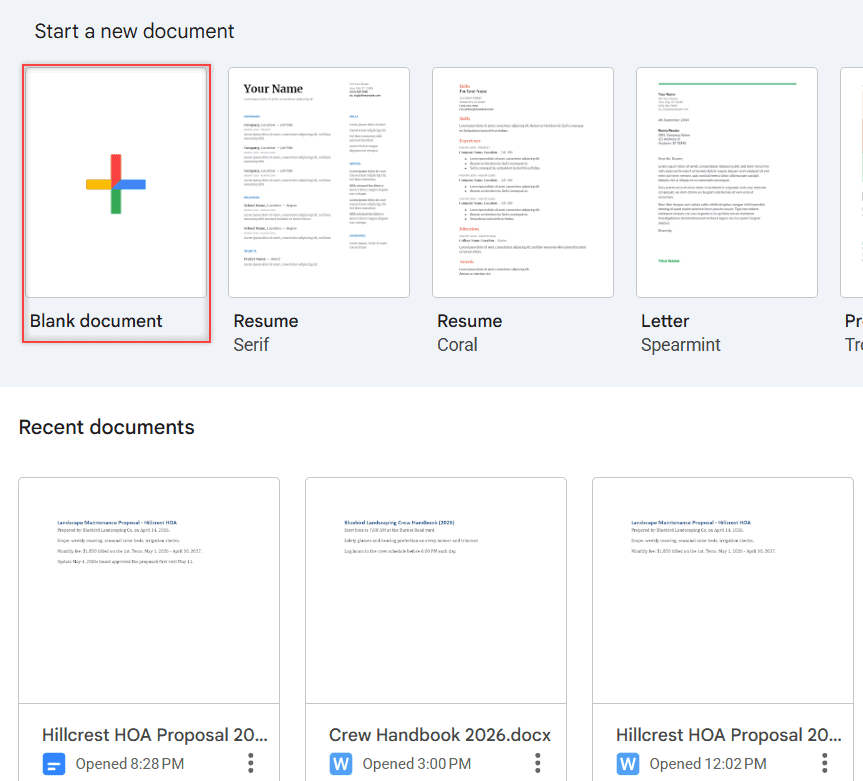
Below that, Recent documents lists only documents. In my account, that’s the Google Doc plus a few Word .docx files with the blue W icon. No folders, no photos, no PDFs. Docs is filtering your Drive down to the files it can open.
That’s the quickest way I know to tell the two apart. If you’re hunting for a document, start in Docs. If you’re hunting for anything else, or you need to see the folder it sits in, open Drive.
Word files, uploads, and the convert setting
When you upload a Word file to Drive, it stays a Word file by default. In my account, opening it shows the doc in Docs with a .DOCX badge next to the title, and I can edit it without converting it. Here’s more on how to save Word docs to Google Drive.
Google calls this Office Compatibility Mode. On a computer it uses Chrome and the Office Editing for Docs, Sheets and Slides extension.
If you’d rather turn every upload into a Google Doc, open Drive Settings and check Convert uploads to Google Docs editor format. It was off in my personal account, and you can only change it on a computer.
Converting is the better choice when several people need to edit at once. Just know that converted files lose macros, and embedded charts and videos turn into images.
What each one can’t do: limits worth knowing
- Docs has a length cap. A Google Doc tops out at about 1.02 million characters. Text documents you convert to Docs can be up to 50 MB.
- Drive takes almost anything. Files that aren’t converted can be up to 5 TB each, but Drive only previews many of them. It doesn’t edit photos, audio, or drawings.
- Docs files use your storage. Your free 15 GB is shared by Drive, Gmail, and Google Photos. Docs, Sheets, and Slides files created or edited after June 1, 2021 count toward it.
- Only files you own count. A doc someone shares with you uses their storage, not yours.
- Offline takes setup. Docs offline needs Chrome or Edge (not incognito) and the Google Docs Offline extension. Then use File, then Make available offline.
If your storage number looks higher than your files suggest, read why Google Drive storage can be full with no files.
Phone apps: Docs edits, Drive organizes
On Android and iPhone, the split is clearer because they’re two separate apps. The Google Docs app is for creating and editing documents. The Google Drive app is for browsing folders, uploading photos and files, moving things, and sharing.
If you tap a Google Doc inside the Drive app, it hands you off to the Docs app to edit it. I keep both apps on my phone. When an upload gets stuck, my fix for Google Drive not uploading from your phone usually sorts it out.
Personal Gmail vs a work or school account
With a personal Gmail account, Drive and Docs are free, and you get 15 GB of shared storage. You can buy more through Google One.
With a Google Workspace account from work or school, you use the same Drive and Docs, but an administrator controls the settings. For example, an admin can turn off offline sync, and storage depends on your organization’s plan. My comparison of Google Drive personal vs business covers the rest.
Which one to use when
- Writing a letter, proposal, or report: open Docs.
- Uploading photos, PDFs, or zip files: open Drive.
- Organizing folders or finding where a file lives: open Drive.
- Editing a Word file with a coworker in real time: open it in Docs, and convert it if several people need to edit together.
- Sharing a whole folder of project files: share it from Drive.
Most days I start in Drive, open the folder for a client, and click the doc I need, which opens Docs for me. If you want to know who opened a doc after you share it, here’s how to see who viewed a Google Doc.
Ready to get more out of both? These are good next reads
- Edit a document in Google Drive
- Upload large files to Google Drive
- Google Drive vs OneDrive
- Find folders in Google Drive
Common questions
Is Google Drive and Google Docs the same?
No. Google Drive is cloud storage for any file, and Google Docs is a word processor. Docs saves every document you create into Drive, so you see your docs in both places.
Do Google Docs take up storage in Google Drive?
Yes. Docs, Sheets, and Slides files created or edited after June 1, 2021 count toward your 15 GB, as Google One Help: How storage works explains. Only files you own count.
Can I use Google Docs without Google Drive?
Not really. You can open Docs at docs.google.com without visiting Drive, but every doc you make is still stored in your Drive and uses its storage.
Do I need a Google account for Google Docs and Google Drive?
Yes. A free personal Google account gives you both, along with 15 GB of shared storage. Work and school accounts get them through Google Workspace.

I am Carissa Gudinoa, a technology buff, and Office online and Apple expert with over 9 years of experience. I am passionate about helping others get the most out of their Apple devices. I have written extensively about Apple products and technologies. I am committed to providing my clients with the best possible service and am always up-to-date on the latest Apple products and features. I also write extensively on other software available for use at minimal cost or free. This includes Word Online, Outlook Online, Excel Online, and other Office online programs… Check out more.