
By the end, every email with “invoice” in the subject skips the Bluebird Landscaping inbox and lands in an Invoices 2026 folder. That includes the Hillcrest HOA May 2026 invoice that was already sitting in my inbox when I saved the rule.
In this tutorial, I’ll show you how to create inbox rules in Outlook on the web, one setting at a time. You’ll also see how to check that the rule worked, how to edit or pause it later, and the faster way to make a rule straight from an email.
A rule is just an instruction: when a message matches a condition, Outlook does an action for you. Mine says “if the subject includes invoice, move it to Invoices 2026.”
What you need before you build the rule
I built this in a Microsoft 365 work mailbox for my made-up business, Bluebird Landscaping Co. Dana Brooks, my office manager, forwards me vendor and client bills, and our bookkeeper, Priya Shah, wants them all in one place. Here’s what you need:
- Outlook on the web. The new Outlook for Windows uses the same Rules page, but I took my screenshots in the browser.
- One clear pattern to match. Mine is the word invoice in the subject line. A sender’s address or a word in the body works too.
- A folder to send the mail to. You can make it ahead of time or create it from inside the rule. If your folder list is crowded, sort your folders in Outlook Online first so the new one is easy to find.
- A sample email that should match, so you can test the rule right away.
Building the Invoices 2026 rule
Every rule on this page has the same parts: a name, at least one condition, and at least one action. An exception is optional. I’ll go through them in the order Outlook shows them.
Open the Rules page in Settings
Click the gear icon in the top-right corner to open Settings. Choose Mail, then Rules. The page explains that you can create rules that tell Outlook how to handle incoming email, and that rules are applied from top to bottom.
Since I had no rules yet, the page said “You haven’t created any rules yet.” I clicked Add rule to open the form.
Name the rule and pick a condition
The form has three numbered boxes. In 1 Name your rule, I typed “Invoices to Invoices 2026”. Pick a name that says what the rule does, because you’ll read it in a list later.
Next, open the 2 Add a condition dropdown. It’s a long list grouped by topic: People, My name is, Subject, Keywords, Marked with, Message includes, Message size, Received, and All messages.
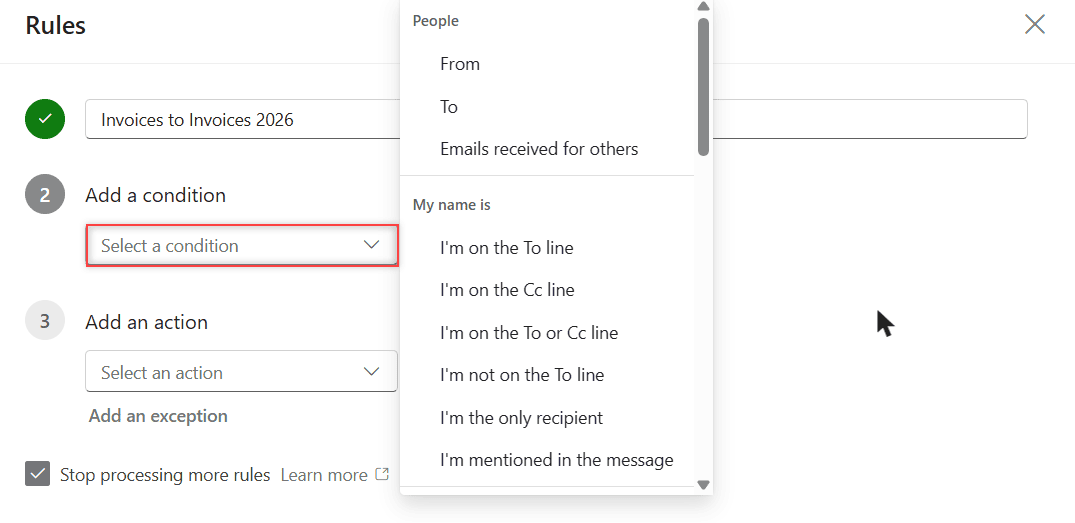
A few that come in handy:
- From matches a sender, like a vendor who always bills you. To get the address exactly right, show the full email address in Outlook Online.
- I’m the only recipient catches mail sent just to you, not to a group.
- Has attachment, under Message includes, picks up anything with a file.
- At least, under Message size, catches large messages.
- Apply to all messages runs the action on everything that arrives.
I chose Subject includes, typed invoice in the box, and pressed Enter. The word turned into a small chip with an X on it. You can type more words the same way, or use Add another condition if a message has to match two things at once.
Choose Move to and the Invoices 2026 folder
Open the 3 Add an action dropdown. The actions are grouped as well:
- Organize: Move to, Copy to, Delete, Pin to top, Permanent delete.
- Mark message: Mark as read, Mark as Junk, Mark with importance, Categorize, Clear categories, Clear flag, Complete flag, Flag message.
- Route: Forward to, Forward as attachment, Redirect to.
- Notify: Display desktop alert, Play a sound.
I picked Move to. A folder picker opened with a search box, a Most Recent list, and the options Select a different folder and Create a new folder. I chose Invoices 2026.
A note then appeared under the action: “The messages will be moved without notifying.” Next to it is a Set notification dropdown if you’d rather get a heads-up. I left it alone, since Priya checks the folder anyway.
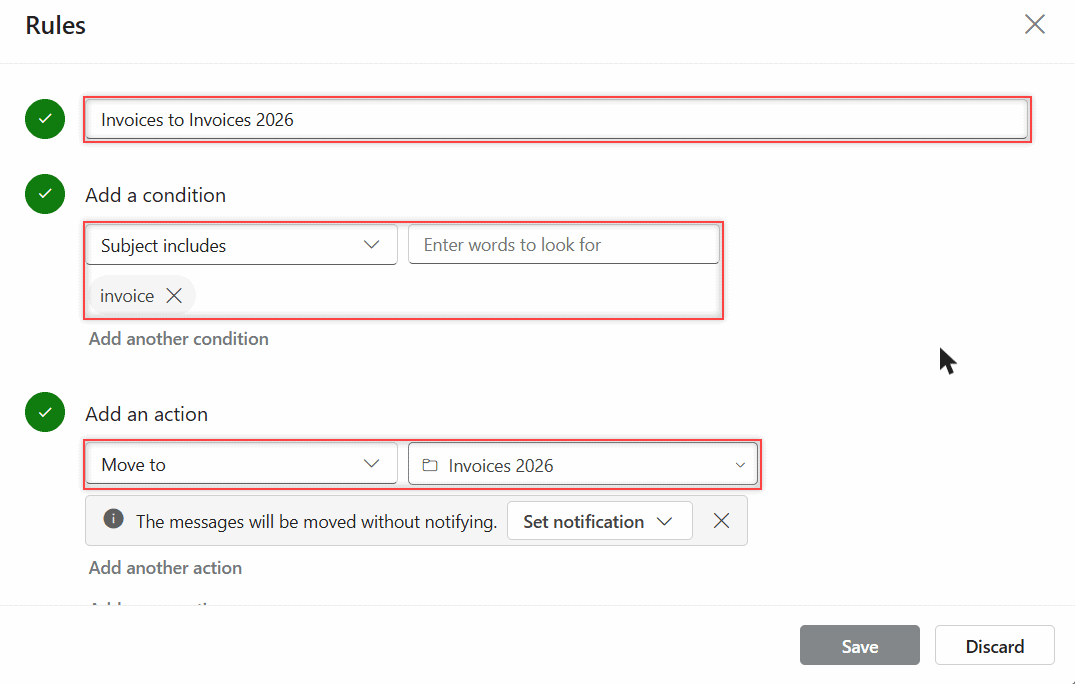
If you need a second action, like marking the email as read, click Add another action. Below that there’s also Add an exception, for mail that matches but should stay put.
Decide on Stop processing more rules and Run rule now
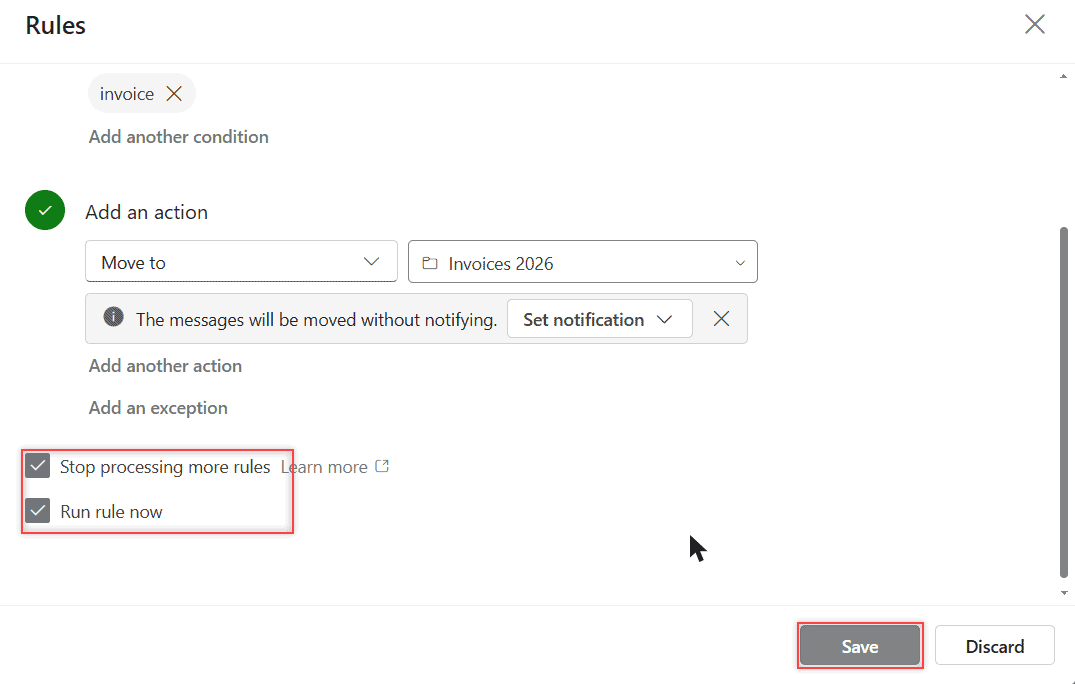
At the bottom of the form are two check boxes. Stop processing more rules was already checked for me, and Microsoft confirms it’s on by default in Outlook on the web. It means that once this rule handles a message, any rules below it are ignored for that message.
I left it checked because an invoice doesn’t need any other rule. If you plan to stack rules on the same mail, clear it.
Then I checked Run rule now. Without it, the rule only acts on new mail. With it, Outlook also goes through the email already in your inbox.
Save the rule and find it in the list
Click Save. You’re back on the Rules page, and the new rule sits in the list with an on/off toggle, up and down arrows, a three-dot menu, and an arrow to expand its details.
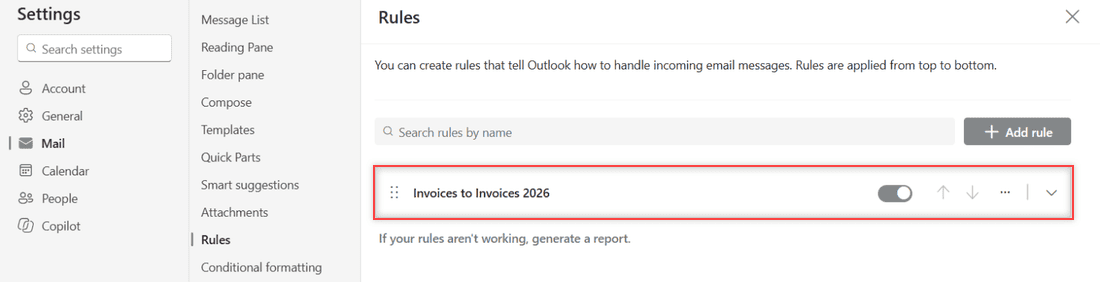
Under the list there’s also a line that says “If your rules aren’t working, generate a report.” Keep that in mind for later.
Check that the rule moved the invoice
Close Settings and look at the folder pane. In my mailbox, Invoices 2026 showed a 1, for one unread email. Inside was “Hillcrest HOA – May 2026 invoice”, the $1,850 bill due June 15, 2026, which had been in my inbox a minute earlier.
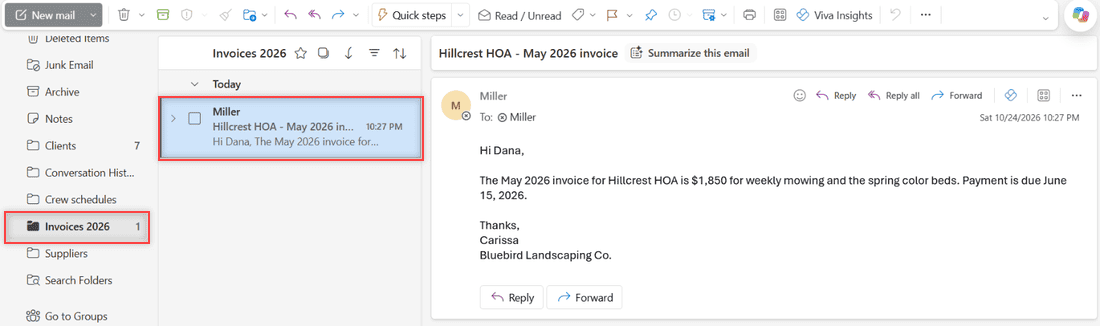
That’s Run rule now at work. For new mail, the easiest test is to send yourself a message with “invoice” in the subject and watch where it lands.
If nothing moves, check these three things:
- The rule’s toggle is on.
- The word in your condition really is in the subject, not only in the body. If it’s in the body, use Subject or body includes instead.
- A rule higher in the list doesn’t catch the message first and stop processing.
Still stuck? Use the generate a report link under the rules list.
Edit, pause, or reorder the rule later
Back on the Rules page, the three-dot menu next to a rule has Run rule now, Edit rule, and Delete rule. It also has Move rule up, Move rule down, Move to top, and Move to bottom. Those were grayed out for me, because one rule has nowhere to move.
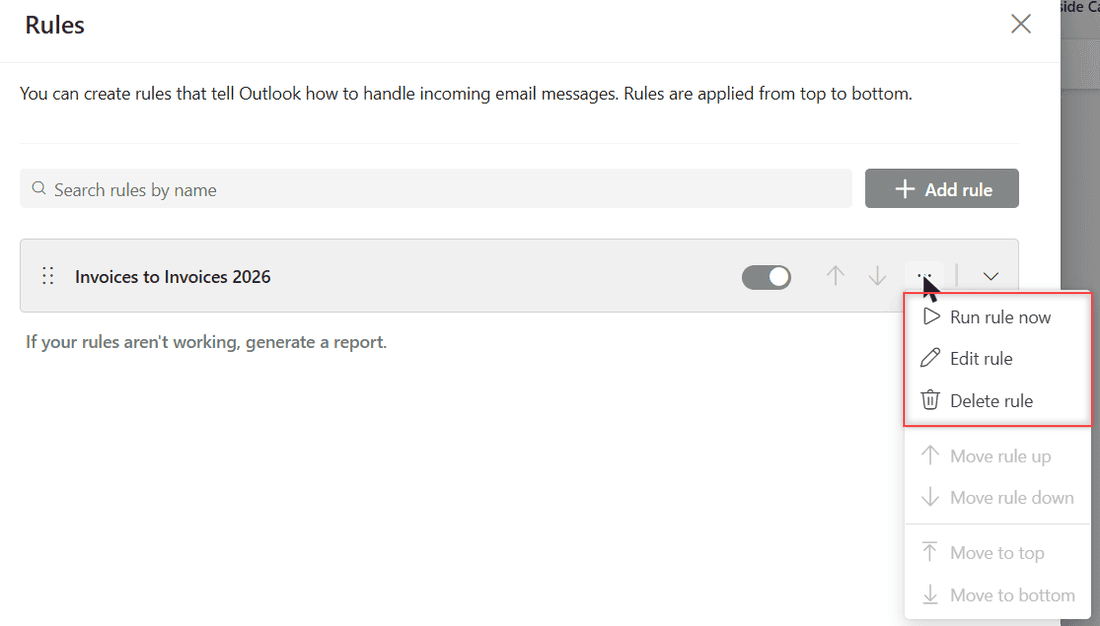
- Pause a rule with its toggle instead of deleting it. That’s handy for seasonal rules.
- Change it with Edit rule. The same form opens, and you save it again.
- Reorder rules with the arrows or the menu. Order matters because Outlook works from the top down.
One more thing to know: Microsoft lists the inbox rule limit for Exchange Online mailboxes as 256 KB. It’s measured as the space your rules use, so long lists of words and addresses fill it faster.
A Move to rule files mail away but doesn’t delete anything, so check your storage space in Outlook now and then.
Make a quick rule straight from an email
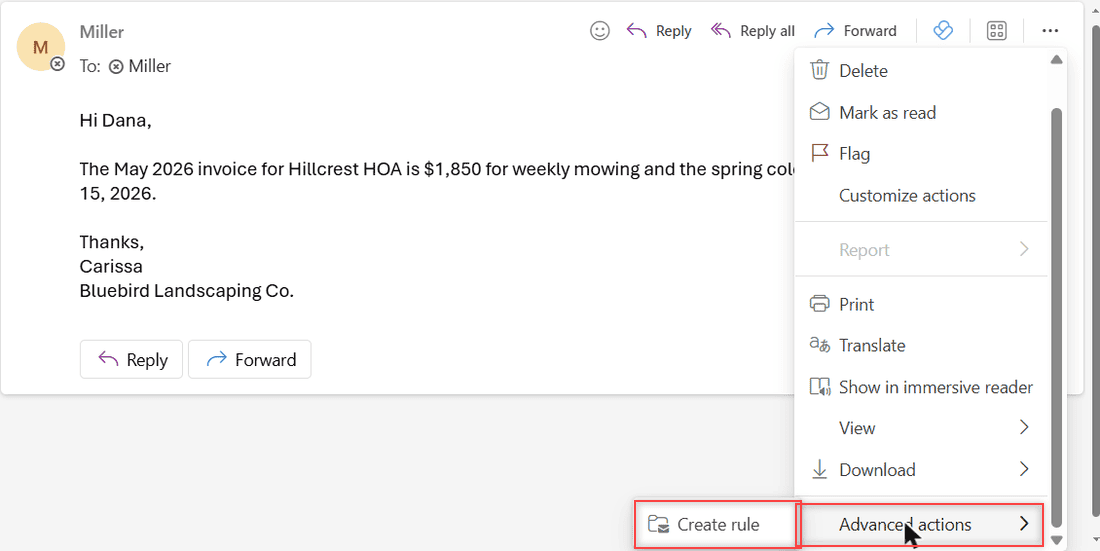
When the rule is about one sender, you can skip Settings. Open the email, click the three-dot More actions button in the reading pane, point to Advanced actions, and choose Create rule. There’s no Rules item at the top of that menu, so look under Advanced actions.
A small dialog opens titled Create a rule. It says “Always move messages from” the sender’s name “to this folder”, with a Select a folder box below.
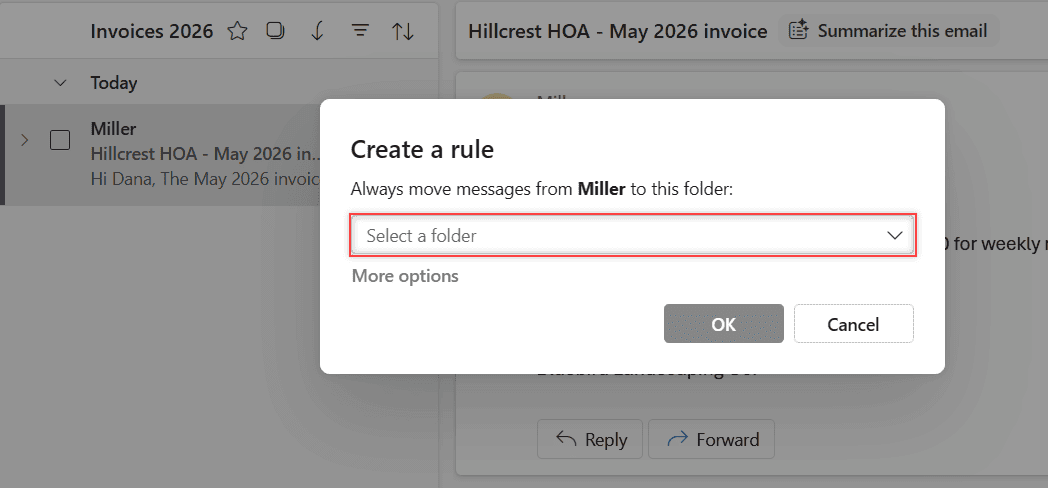
Pick a folder and click OK, and you’re done. There’s also a More options link under the box. I just cancelled, since my invoice rule already covered this.
It’s also a gentler option than when you block a sender in Outlook Online, because the mail still arrives, just somewhere else.
Change it for your own mailbox
You don’t need my invoice setup. Here’s how I’d adapt the same steps:
- Client folders. Use From with a client’s address and Move to that client’s folder. Then you can forward several emails at once to a coworker when a job wraps up.
- Big attachments. Use Message size, At least, and move those to their own folder. Later you can sort that folder by size and clear the heaviest ones.
- Newsletters. Use Sender address includes with the newsletter’s domain, then Mark as read and Move to. Your inbox stops lighting up.
- Send a copy to a teammate. Use Forward to or Redirect to. Microsoft explains that forwarded mail comes from you, while redirected mail keeps the original sender on the From line.
Rules sort mail as it arrives, but they don’t reply for you. When you’re away, set up automatic replies in Outlook instead.
Rules in new Outlook, classic Outlook, and Mac
I only tested Outlook on the web, so here’s what Microsoft’s own guides say for the other versions:
- New Outlook for Windows uses Settings, Mail, Rules, like the web. Microsoft notes it doesn’t support rules for Gmail, Yahoo, or iCloud accounts, and some classic Outlook rules won’t run there because they’re client-side rules.
- Classic Outlook for Windows: go to File, Manage Rules & Alerts, New Rule, or right-click a message and choose Rules, Create Rule. Run Rules Now applies a rule to mail you already have.
- Importing and exporting rules is a classic Outlook feature. Microsoft’s steps go through File, Manage Rules & Alerts, Options, and save your rules as an .rwz file.
- New Outlook for Mac: on the Outlook menu, choose Settings, then Rules, then Add Rule. Legacy Outlook for Mac uses Tools, Rules.
- Outlook.com: Microsoft says rules there apply only to mail you receive after you create them.
I didn’t click through those versions myself, so I’m not listing every button. The parts of a rule are the same everywhere: a condition, an action, and maybe an exception.
Want to keep your Outlook tidy? Try these next
- Clear your recent searches in Outlook
- Save Outlook emails to OneDrive
- Download emails from Outlook Online
- All Outlook Online tutorials
Questions about this setup
Do Outlook rules work on emails already in my inbox?
Not by default. In Outlook on the web, check Run rule now when you save the rule, or pick Run rule now from the rule’s three-dot menu later. My existing invoice moved right away.
Why are my Outlook rules not working?
Make sure the rule is turned on, the condition matches the right part of the email, and a rule higher in the list isn’t stopping it first. The Rules page also has a generate a report link.
How many inbox rules can I have in Outlook?
Microsoft’s Exchange Online limits list the inbox rule limit as 256 KB of space, not a count. Long lists of words and addresses use that space up faster than short, simple rules.
Can I create a rule from an email in Outlook on the web?
Yes. Open the message, click More actions, then Advanced actions, then Create rule. Pick a folder and click OK. Microsoft covers every version in its guide to managing email with rules in Outlook.

I am Carissa Gudinoa, a technology buff, and Office online and Apple expert with over 9 years of experience. I am passionate about helping others get the most out of their Apple devices. I have written extensively about Apple products and technologies. I am committed to providing my clients with the best possible service and am always up-to-date on the latest Apple products and features. I also write extensively on other software available for use at minimal cost or free. This includes Word Online, Outlook Online, Excel Online, and other Office online programs… Check out more.