
By the end, my Monday payroll review with Priya sits on the Bluebird Landscaping calendar as a busy half hour with a small lock on it. Coworkers who can see my calendar know I’m tied up at 9:30, but not what the meeting is about.
In this tutorial, I’ll show you how to mark event as private in Outlook on the web, both while you create an event and later from the calendar. You’ll also see who can still read a private event and how your sharing settings fit in.
What you need before you start
I set this up in a Microsoft 365 work mailbox for my made-up business, Bluebird Landscaping Co. Our bookkeeper, Priya Shah, and I go over payroll once a month, and that’s not something the whole office needs to read about. Here’s what you need:
- Outlook on the web with a work or school account. New Outlook for Windows looks very similar, but my screenshots come from the browser.
- An event you organize. Microsoft’s steps are written for events you created, not invites someone else sent you.
- A calendar other people can see. If nobody has access to your calendar, private doesn’t change much. It matters once your calendar is shared.
If you’re adding the event from scratch anyway, it’s a good moment to set a calendar reminder in Outlook too, so the meeting doesn’t sneak up on you.
Setting up the private payroll meeting
Marking an event private is one button. I’ll walk through the whole event anyway, because the Busy setting next to it decides what people see on your calendar.
Create the event and fill in the details
Open the calendar, click New event, and fill in the basics. I typed “Payroll review with Priya” as the title and set it for Monday, 10/26/2026, from 9:30 AM to 10:00 AM.
Look at the toolbar along the top of the event window. Between the Categories tag icon and My Templates there’s a small lock button. Hover over it, and the tooltip says Not private.
Turn on Private from the lock button
Click the lock button. A short menu opens with two choices: Private and Not private. Not private was checked for me, and Microsoft confirms new events aren’t private by default.
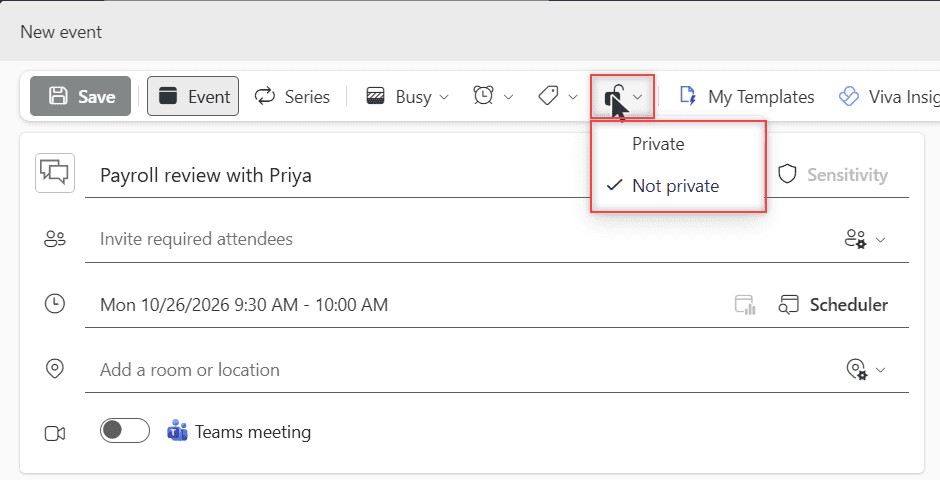
Choose Private. The lock icon changes to a closed lock, and the tooltip now reads Private. That’s your quick check before you save.
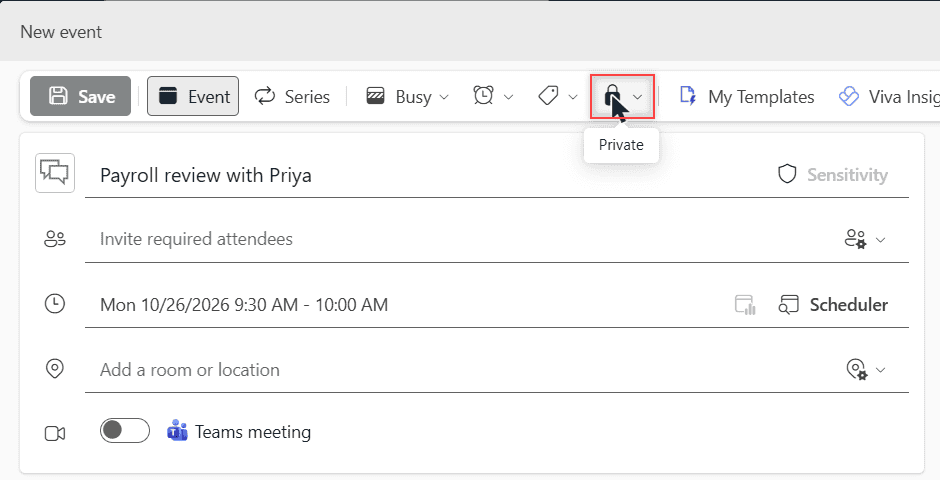
You’ll also spot a Sensitivity button next to the title. That’s a separate setting for sensitivity labels, not the Private option, so you can leave it alone here. If you want to protect an email rather than an event, see how to make an email confidential in Outlook Online.
Keep the time showing as Busy
Next to the lock is the availability menu. It showed Busy on my event. Open it, and you’ll see Free, Working elsewhere, Tentative, Busy, and Out of office.
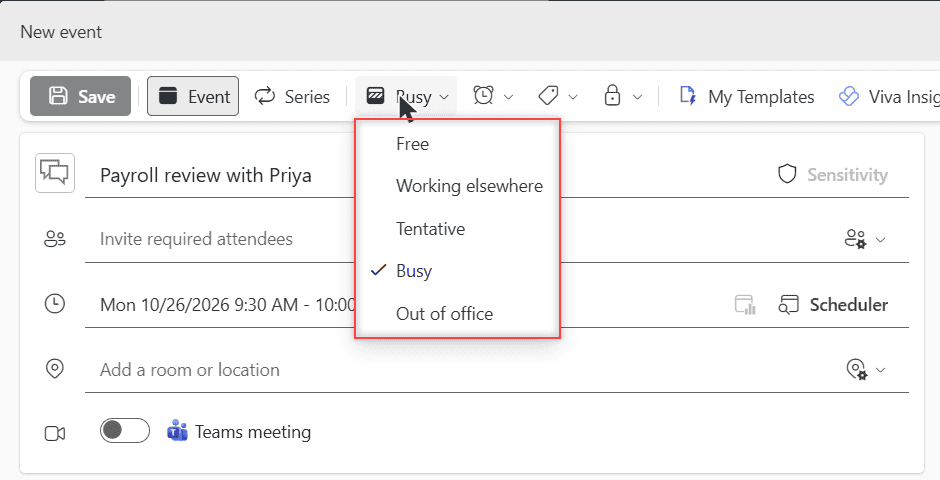
I kept Busy. Private hides what the meeting is, while Busy still tells people the time is taken. If you set a private event to Free, coworkers could book over it, which defeats the point.
Save the event or send the invite
If it’s just a block on your own calendar, click Save. If you added Priya as an attendee, click Send instead. Microsoft notes that attendees still see the details, which makes sense, since they’re in the meeting.
Check that the event is private
Go back to the calendar and switch to Day view for the event’s date. On my Monday, October 26, 2026, the 9 AM “Hillcrest HOA – spring site walk with Dana” looks normal. The 9:30 payroll review has a small lock icon at the right end of the event.
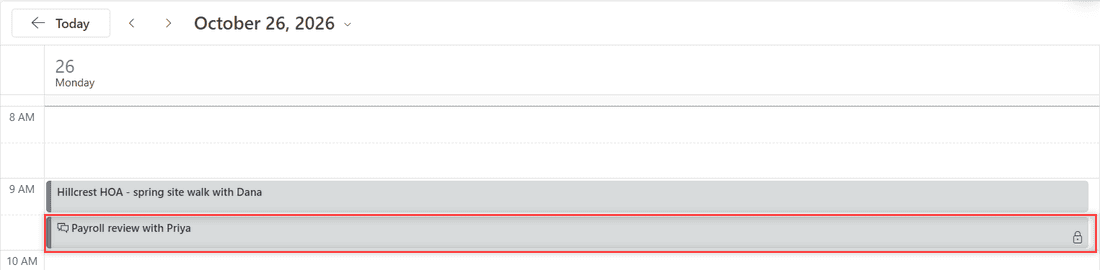
That lock is the sign Microsoft describes for private items in calendar view. If you don’t see it, open the event again and check the lock button’s tooltip.
I only had one test mailbox, so I couldn’t look at my calendar as a coworker. Here’s what Microsoft says happens on their side:
- People you’ve given Read permission to your calendar can’t see the details of your private appointments.
- Delegates who were given “Delegate with access to view private items” can still see them. Microsoft says delegates don’t get this by default.
- Attendees of a meeting you send keep seeing its details.
So private isn’t a lock against everyone. It hides details from coworkers browsing your calendar, not from people you’ve chosen to trust with it.
Make an existing event private with a right-click
You don’t have to open an event to change it. In the calendar, right-click the event. The menu lists Print, Open, Forward, Charm, Send to OneNote, Show as, Categorize, Private, Duplicate event, Save as .ics, and Delete.
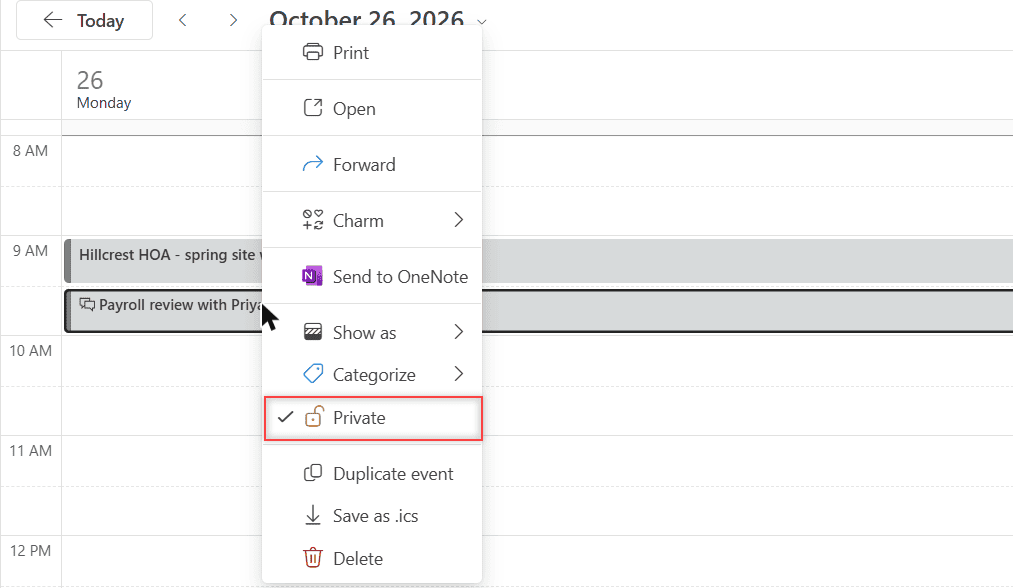
Click Private, and it’s on. A checkmark shows next to it when the event is private, and the lock appears in the calendar. Click it again to turn it off. I tested both ways: the lock disappeared and came back right away. This is handy for older events you forgot to mark.
While you’re in that menu, Categorize is useful too. A category color makes payroll events stand out on your side, much like when you add birthdays to Outlook as their own kind of event.
Decide how much of your calendar people see
Private works per event, so think about how your calendar is shared. In the calendar, select Share to open the Sharing and permissions dialog. There’s a box to invite people, and a line for People in my organization with its own dropdown.
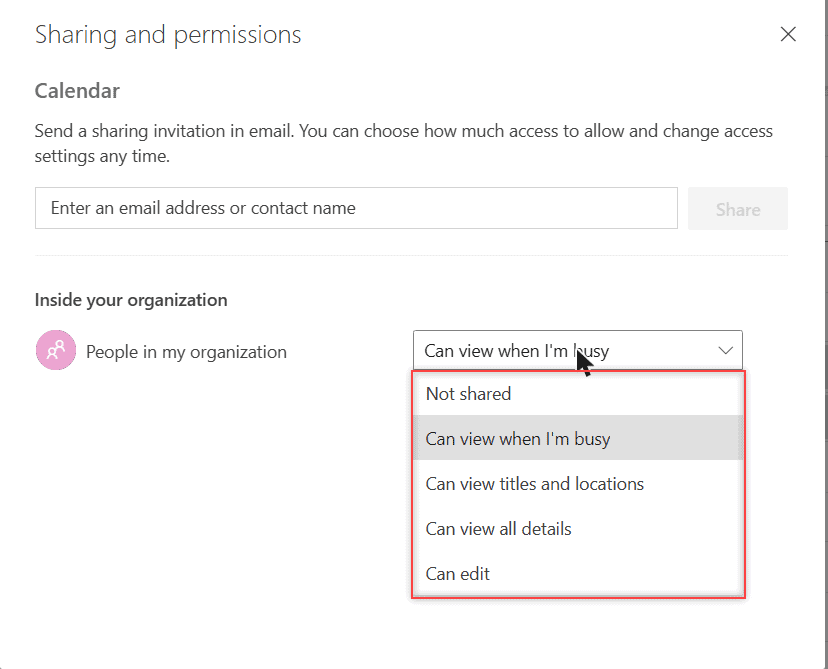
Mine was set to Can view when I’m busy. The full list is:
- Not shared: people in your organization don’t get access to your calendar this way.
- Can view when I’m busy: they see when you’re busy, without event details.
- Can view titles and locations: they see what and where.
- Can view all details: they see everything you put in an event.
- Can edit: they can change your calendar.
Here’s how I’d use it:
- Most events open, a few hidden. Share titles or details with the office, then mark only the sensitive ones, like payroll, reviews, or doctor visits, as private.
- Nothing to share. If people only need to know when you’re free, “Can view when I’m busy” already hides titles. Private then adds a second layer.
- An assistant manages your calendar. Remember that a delegate with access to private items sees them anyway. Only turn that on for someone you trust.
- Time away. For a vacation, show the time as Out of office and set up automatic replies in Outlook so emails get an answer.
There’s no built-in switch that makes every new event private, so you’ll need to set it each time. The right-click menu makes that quick.
Private events in new Outlook, classic Outlook, and Mac
I only tested Outlook on the web, so here’s what Microsoft’s own guide says for the desktop apps:
- New Outlook for Windows: double-click an event you organized, select Private on the Event tab, then save it or send the update.
- Classic Outlook for Windows: select the meeting or appointment, choose Private in the Tags group, then Save & Close.
- Outlook for Mac: Microsoft’s private-event page doesn’t list Mac steps, and I didn’t test it, so I’m not guessing at buttons.
In both Windows versions, Microsoft says the same lock symbol shows on the event in calendar view.
Want to get more out of Outlook on the web? Try these next
- Create inbox rules in Outlook
- Show the full email address in Outlook Online
- Check your storage space in Outlook Online
- All Outlook Online tutorials
Private events matter most once other people can see your calendar. Before you give anyone access, read my rules for sharing an Outlook calendar.
Questions about this setup
What do other people see when I mark an event as private in Outlook?
Microsoft says people with Read permission to your calendar can’t see the details of your private appointments. The time still shows as busy if you set it that way, and the event carries a lock symbol.
Can a delegate see my private events in Outlook?
Only if you gave them “Delegate with access to view private items” when you set them up as a delegate. Microsoft says delegates don’t have that access by default.
Do meeting attendees see the details of a private event?
Yes. Microsoft says the details of a private meeting stay visible to you and the attendees. Private hides them from other people looking at your calendar.
Can I make all my Outlook events private by default?
Not with a built-in setting. New events start as Not private, so mark each one yourself, or use the right-click Private option. Microsoft’s guide to making an appointment or meeting private covers each version.

I am Carissa Gudinoa, a technology buff, and Office online and Apple expert with over 9 years of experience. I am passionate about helping others get the most out of their Apple devices. I have written extensively about Apple products and technologies. I am committed to providing my clients with the best possible service and am always up-to-date on the latest Apple products and features. I also write extensively on other software available for use at minimal cost or free. This includes Word Online, Outlook Online, Excel Online, and other Office online programs… Check out more.