
Last month I sent the Hillcrest HOA Proposal 2026 to a board member a few days before our meeting. The night before, I wanted to know one thing: had she opened it yet? Google Docs can answer that, but only if the file lives in a work or school account.
In this tutorial, I’ll show you how to see who has viewed a Google Doc with the Activity dashboard, what a personal Gmail account sees instead, and four other places that tell you who edited, shared, or can open the file. I’ll also cover how to keep your own views out of someone else’s dashboard.
Who can see the viewers of a Google Doc
Before you go hunting through menus, check which kind of account owns the file. Google’s help is blunt about it: if the file isn’t owned by a Google account through work or school, no one can see the view history. That includes the owner.
So a doc in a free @gmail.com account has no viewer list at all. The files I’m using here belong to Bluebird Landscaping Co., a made-up lawn care business in Austin, and they sit in a personal demo account. That’s why one of my screenshots shows what’s missing rather than a list of names.
Even inside a Google Workspace organization, you need edit access to the file, and you have to be in the same domain as the owner. Here’s the quick version:
| Your situation | Can you see who viewed the doc? |
|---|---|
| Personal Gmail account owns the file | No. Nobody can see view history |
| Workspace file, you have edit access, same domain | Yes, unless your admin turned it off |
| Workspace file, you only have view or comment access | No |
| Workspace file owned by a different organization | No |
| Workspace admin with audit access | Yes, through Drive log events |
If you mostly need to know whether someone got the file, the Google Drive tutorials hub has guides on sharing and access that work on any account. The methods below go from the most direct to the most technical.
Method 1: See who viewed a Google Doc with the Activity dashboard
The Activity dashboard is Google’s built-in viewer list for Docs, Sheets, and Slides. It’s the only place a regular user can see names and view times for a file.
- Open the doc in Google Docs on a computer.
- Click Tools in the menu bar.
- Click Activity dashboard.
- In a Workspace file, look at the viewer list and the chart of viewers over time.
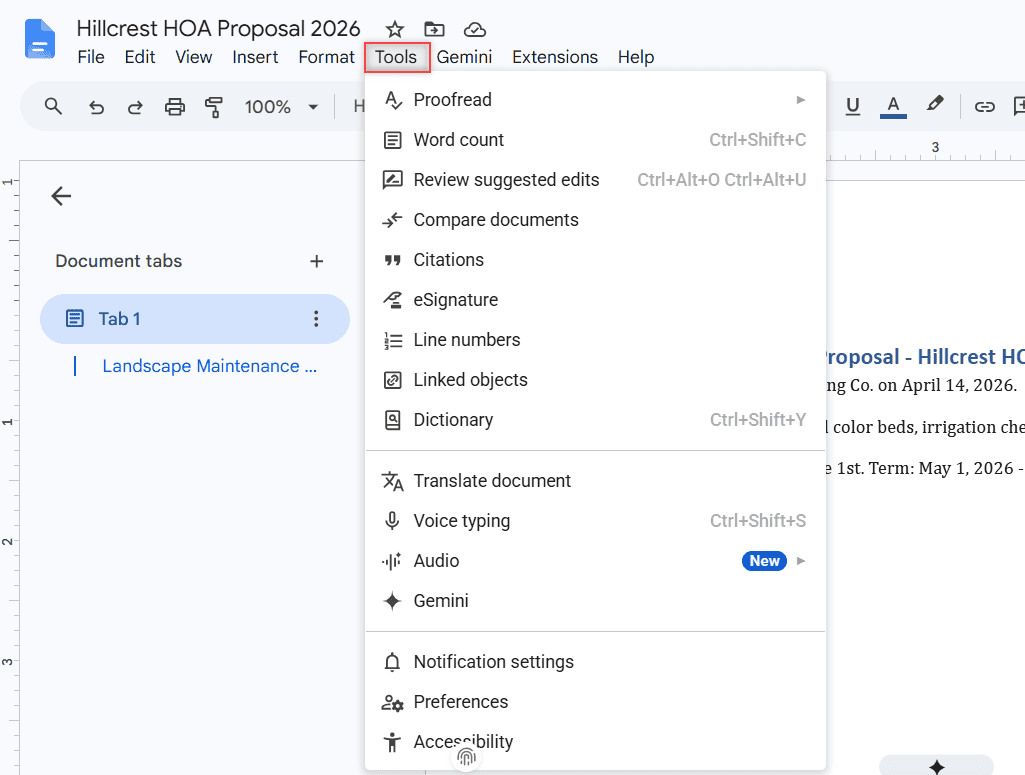
That’s my personal demo account, and the Tools menu doesn’t list Activity dashboard at all. It goes straight from Dictionary to Translate document, because the file isn’t owned by a work or school account.
In a Workspace file where you have edit access, the dashboard lists the people the file is shared with, who viewed it, and when. It also shows a chart of viewers over time, so you can see whether interest picked up after you sent a reminder.
How does this work?
Google records views from signed-in people on files owned by work and school accounts, and the dashboard shows that record to editors in the same domain. Your admin decides whether view history is on for everyone, on only inside your domain, or off. If it’s off, the viewer list stays empty even for the owner.
Pro tip: The same Tools > Activity dashboard path works in Google Sheets and Google Slides. On a Workspace account, that’s how you’d check that every crew lead opened a sheet like the 2026 Crew Schedule.
The dashboard isn’t available in the Docs, Sheets, or Slides mobile apps. Google’s Android help simply says to open the file on a computer to change view history settings, so plan on using a laptop for this.
Method 2: Check edits and shares in the Drive Activity panel
If you’re on a personal account, Google Drive’s Activity panel is the closest thing you get. It won’t show views, but it does show what people did to the file. I covered it in more depth when I wrote about recent activity on Google Drive.
- Go to drive.google.com on your computer.
- Click My Drive on the left.
- In the upper right, click the Info icon.
- Click Activity, then click the doc to filter the list to that one file.
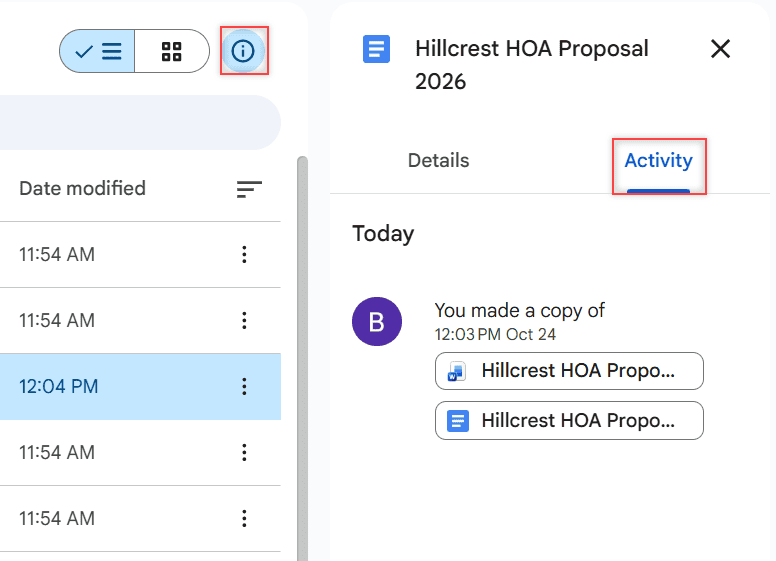
How does this work?
Drive logs actions, not visits. Google lists the kinds of activity it records: edits or comments, renames, moves or removals, uploads to a folder, and shares or unshares. If someone opened the doc and closed it without touching anything, there’s nothing here to show.
This is still handy. When I see a comment from the board member in the list, I know she opened the proposal, even without a viewer list.
Method 3: Find who edited the doc with version history
Version history answers a different question: who changed the doc and when. It works on personal and Workspace accounts, and my guide to Google Drive version history goes deeper into restoring and naming versions.
- Open the doc.
- At the top right, hover over the Last edit icon to see who updated the file last and when.
- Click Last edit to open the version history panel.
- Pick a version to see who made it and the changes it contains.
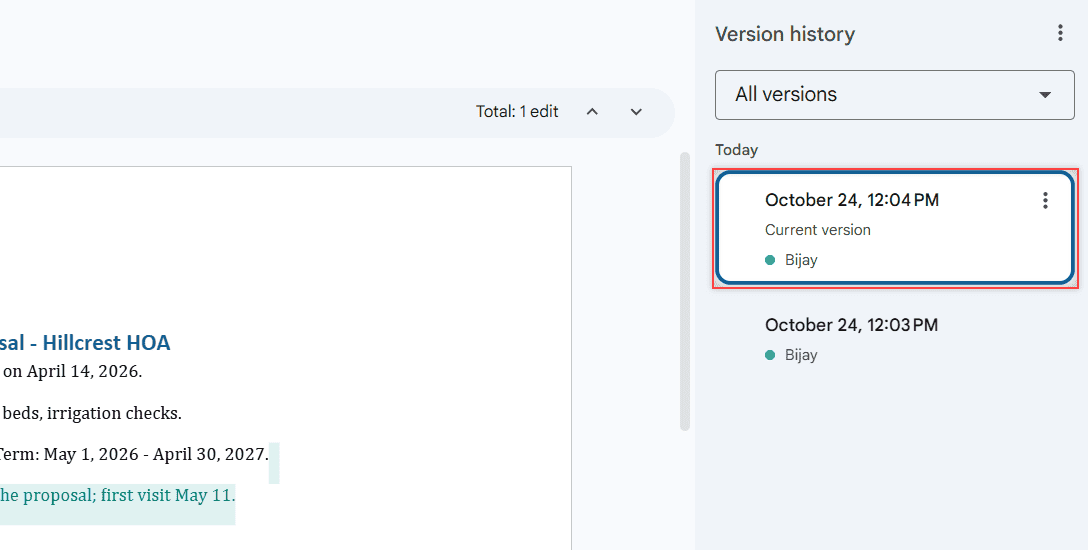
How does this work?
Google saves versions as people edit and tags each one with the editor’s name. You need edit permission to browse earlier versions, so viewers and commenters can’t open this panel.
Version history never lists readers. Older articles sometimes claim free accounts can see viewers this way, but it only shows edits. A blue dot on the Last edit icon means someone updated the file since you last opened it, which is a nice nudge.
When you need to know someone actually read it
On a personal account, the simplest honest answer is to ask. When I really need confirmation, I add a comment at the top of the doc asking the reader to reply or resolve it once they’ve gone through the proposal.
That reply shows up as a comment in Drive Activity, so I get a clear record without any viewer list. It also keeps the question inside the document, which beats chasing people by text.
Method 4: Confirm who has access in the Share dialog
When you can’t see who viewed a doc, the next best question is who could have viewed it. The Share dialog answers that on every account type.
- Open the doc and click Share at the top right.
- Read the People with access list, which shows each person and their role.
- Check General access below it to see whether the doc is Restricted or open to anyone with the link.
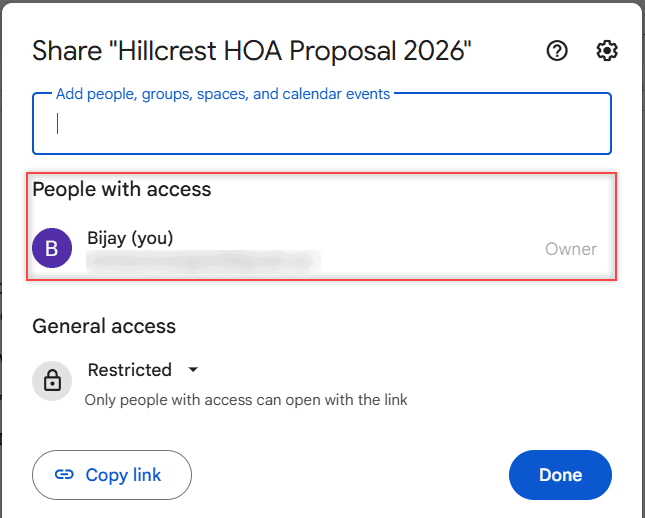
How does this work?
Everyone in that list is a possible viewer. If General access is set to anyone with the link, the real audience could be much bigger, since anyone holding the link counts. If you turn on link sharing, keep in mind that link visitors never show up by name in this list.
Editors can usually reshare a file too, which is why I share proposals as Viewer. My post on whether viewers can download Google Drive files explains what each role can do once they’re in.
Don’t forget the folder the doc sits in. Google’s current sharing model passes folder access down to every file inside it, so someone who can open the Bluebird Landscaping folder can open the Hillcrest doc even if their name isn’t on the file itself.
On an eligible work or school account, you can also click Add expiration when you share with a person. I like this for one-off reviews: the board member gets access for the week of the meeting, and it ends on its own.
Method 5: Look up file views in Drive log events (Workspace admins)
This is the part most guides skip. If you’re a Google Workspace admin, the Admin console keeps an audit log that goes beyond the Activity dashboard.
- Sign in to the Google Admin console with an admin account.
- Go to Menu > Reporting > Audit and investigation > Drive log events.
- Filter by the document’s title or ID and look for View events.
How does this work?
Google says the Activity dashboard isn’t meant for auditing or legal purposes and points admins to the Drive audit log instead. View events appear there, though most Drive audit events are logged only for files owned by users on supported editions.
It matters for privacy, too. When someone hides their view history, that only affects the dashboard, not view logs outside it. Admins also use this log to check who downloaded files from Drive.
How to hide that you viewed someone else’s Google Doc
Now the flip side: can someone see that you viewed their Google Doc? Only if the file is owned by a work or school account, you were signed in, and they have edit access in that same domain. If those all line up, you can turn your view history off.
For one file:
- Open the file in Docs, Sheets, or Slides on a computer.
- Click Tools > Activity dashboard privacy.
- Turn off Show my view history for this document.
For all files at once, open Docs, Sheets, or Slides, click Menu > Settings, and under Activity dashboard turn off Show your view history.
That account-wide switch does show up on a personal account. In my demo account it sits in Docs Settings under Activity dashboard, and it was already switched off.
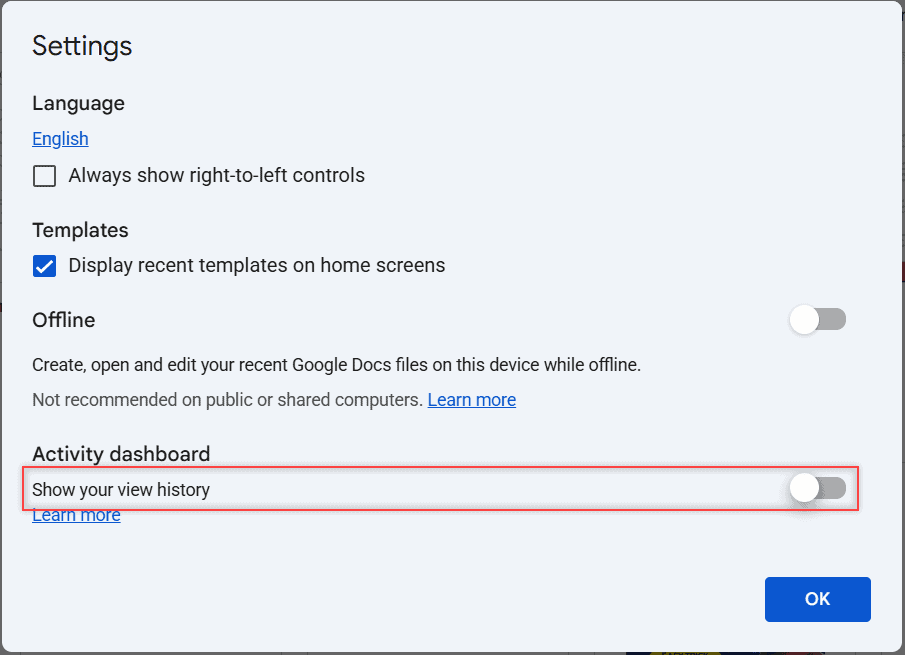
Once it’s off, you won’t appear in anybody’s dashboard, and views you make while it’s off never show. If you turn it back on, your earlier recorded views reappear. You can still see view history on your own files, and if your admin has switched view history off, you can’t switch it back on yourself.
Things to keep in mind
- Personal accounts get no viewer list. Google doesn’t offer one for files owned by free Gmail accounts, and no setting on a personal account turns it on.
- Edit access is required. In Workspace, viewers and commenters can’t open the viewer data, and you must be in the owner’s domain.
- Admins have the final say. View history can be on, on only inside your domain, or off for the whole organization.
- Signed-in people only. Google describes the dashboard as showing signed-in people who view a file, so don’t treat it as a complete count of every link visitor.
- Computer only. The dashboard and its privacy settings live in the browser versions of Docs, Sheets, and Slides.
- Edits are not views. Drive Activity and version history show changes, comments, and shares. Someone can read the whole doc without leaving a trace there.
If you’re deciding where a document should live in the first place, my comparison of Google Drive vs Google Docs explains how the two fit together. And if a teammate can’t open the doc at all, they can use the request access option in Google Drive so you get an email.
Want to keep a closer eye on your shared files? These walk-throughs help:
- get notified about new files in a folder
- unshare a folder in Google Drive
- remove shared files from Google Drive
Frequently Asked Questions
Can you see who viewed a Google Doc without Google Workspace?
No. Google says that if a file isn’t owned by a work or school account, no one can see its view history. On a personal account you can still check edits, comments, and shares in Drive Activity.
Can I see who viewed my Google Sheet or Google Slides?
Yes, the same way as a doc. Open the file, click Tools, then Activity dashboard. The same Workspace and edit access rules apply.
Does Google Docs show anonymous viewers?
Google describes the dashboard as showing signed-in people who view a file. People who open a link-shared doc without signing in won’t appear by name.
Can someone see if I viewed their Google Doc?
Only if their file is owned by a work or school account, you were signed in, and they have edit access in that domain. Google Docs Editors Help on Activity dashboard view history explains how to hide your views.
Why does my Activity dashboard show zero viewers?
Usually the file belongs to a personal account, your admin turned view history off, or the people who opened it hid their view history.

I am Carissa Gudinoa, a technology buff, and Office online and Apple expert with over 9 years of experience. I am passionate about helping others get the most out of their Apple devices. I have written extensively about Apple products and technologies. I am committed to providing my clients with the best possible service and am always up-to-date on the latest Apple products and features. I also write extensively on other software available for use at minimal cost or free. This includes Word Online, Outlook Online, Excel Online, and other Office online programs… Check out more.