
Where did that file go? You know you saved it in Drive, but now it’s not in the folder, not on the home screen, and not where you swear you left it. Most of the time, it’s still in your account, just somewhere you didn’t think to look.
In this tutorial, I’ll walk you through the checks I use when I find Google Drive files missing, from a smart search and the Trash to orphaned files, shared files that lost their access, sync gaps on your computer, and what a Workspace admin or Google can still restore.
I’ll use the sample files from my landscaping business, Bluebird Landscaping, so you can see exactly what each screen looks like.
Method 1: Search Drive by name and check the Location column
Before anything else, search. A file that “disappeared” has very often been moved into another folder, sometimes by you with a stray drag, sometimes by someone you share with. Search finds it no matter which folder it’s in, the same way you’d find folders in Google Drive.
- Open drive.google.com and click the Search in Drive box at the top.
- Type one word you’re sure is in the file name. I typed hillcrest.
- Press Enter to see the full results list instead of the quick suggestions.
- Look at the Location column to see which folder each match lives in.
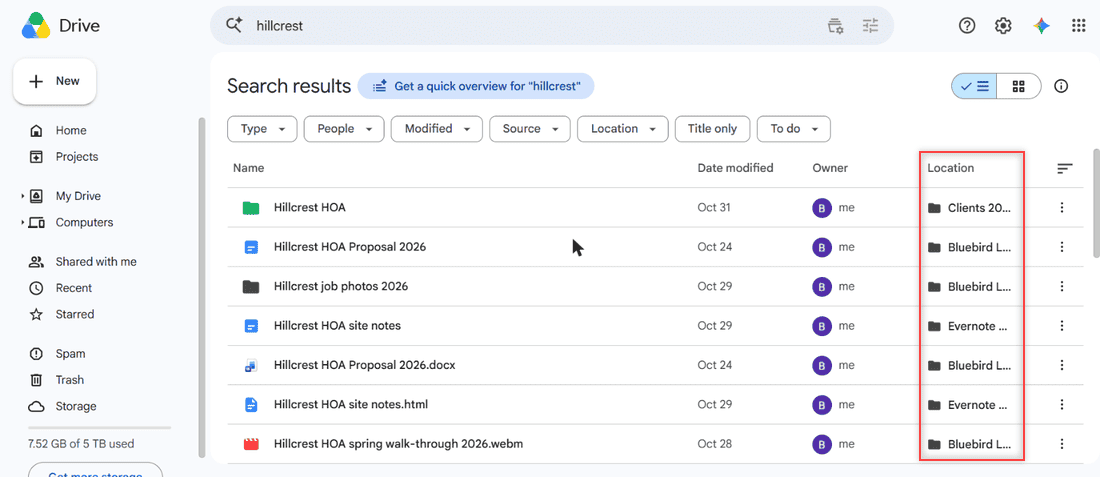
My search turned up the Hillcrest HOA folder, the Google Doc proposal, the Word version, job photos, site notes, and even an HTML and a video copy. They were spread across three folders, and the Location column showed me each one at a glance.
If the name search comes up short, open the search options. Click the sliders icon at the right end of the search box to get the Advanced search dialog.
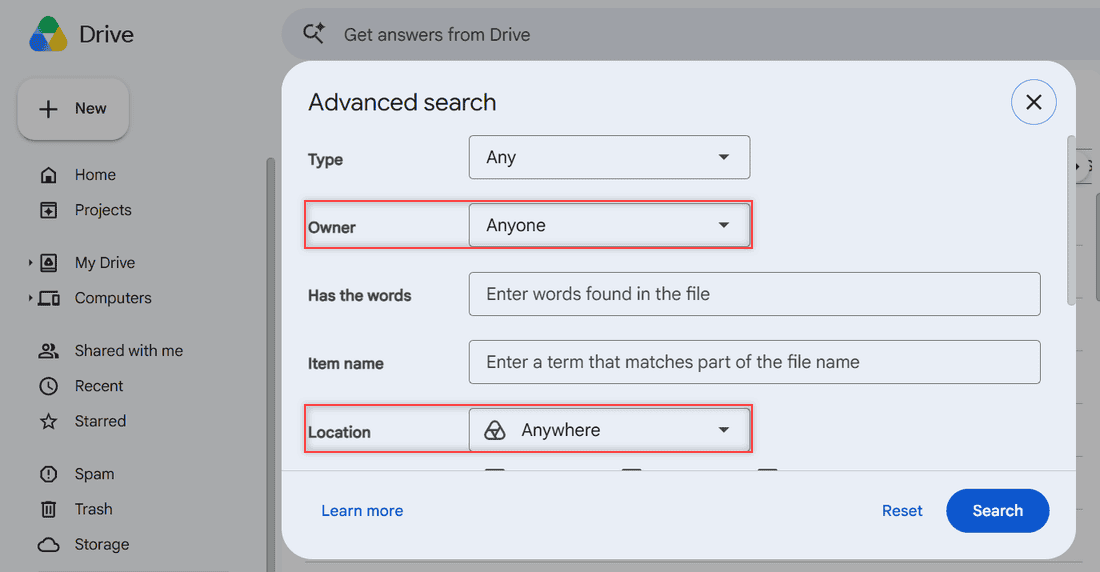
Here you can pick a file Type, an Owner, words the file contains (Has the words), part of the Item name, and a Location. Leaving Owner on Anyone and Location on Anywhere gives you the widest net.
How does this work?
Drive search looks at file names and, for many file types, the text inside the file too. That’s why “Has the words” can find a proposal even if you renamed it to something forgettable.
You can also type search operators straight into the box. These are the ones I use most when hunting for a lost file:
owner:meshows only files you own.type:spreadsheetortype:pdfnarrows results to one kind of file.after:2026-10-01shows files modified after a date (use YYYY-MM-DD).title:invoicessearches only file names.
Pro tip: Combine operators. Typing
owner:me type:spreadsheet after:2026-10-01found my October invoice files in seconds, even though I’d forgotten their exact names.
Method 2: Look in the Trash and restore the file
If search finds nothing, the file may have been deleted. When you delete something in Drive, it goes to the Trash first. Google Drive Help says files stay in the Trash for 30 days, and then they’re deleted forever.
- In Drive, click Trash in the left sidebar.
- Sort by Date trashed so the most recent deletions are at the top.
- Right-click the file you want back.
- Click Restore.
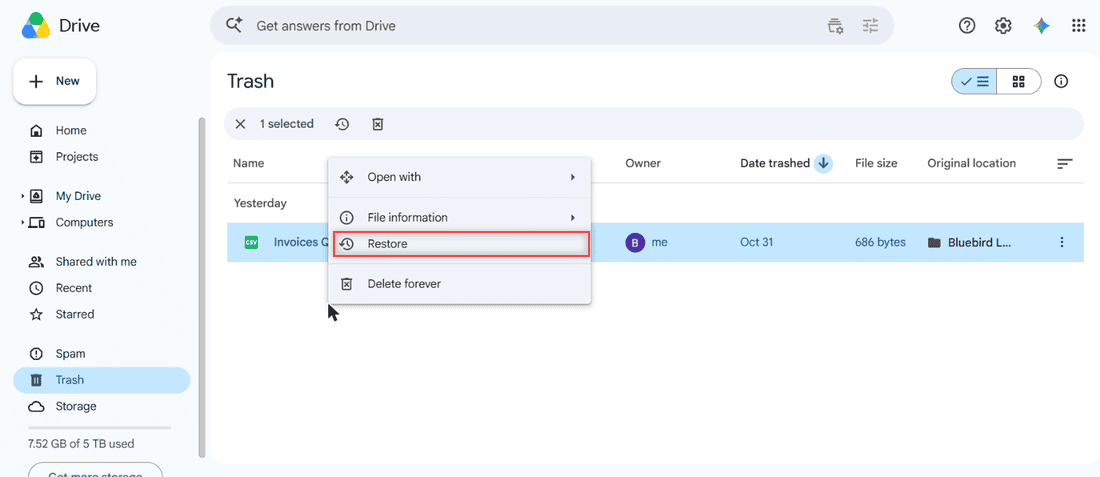
In my demo account, “Invoices Q2 2026 (1).csv” had been trashed on Oct 31, and its original location was the Bluebird Landscaping folder. One click on Restore and it was gone from the Trash.
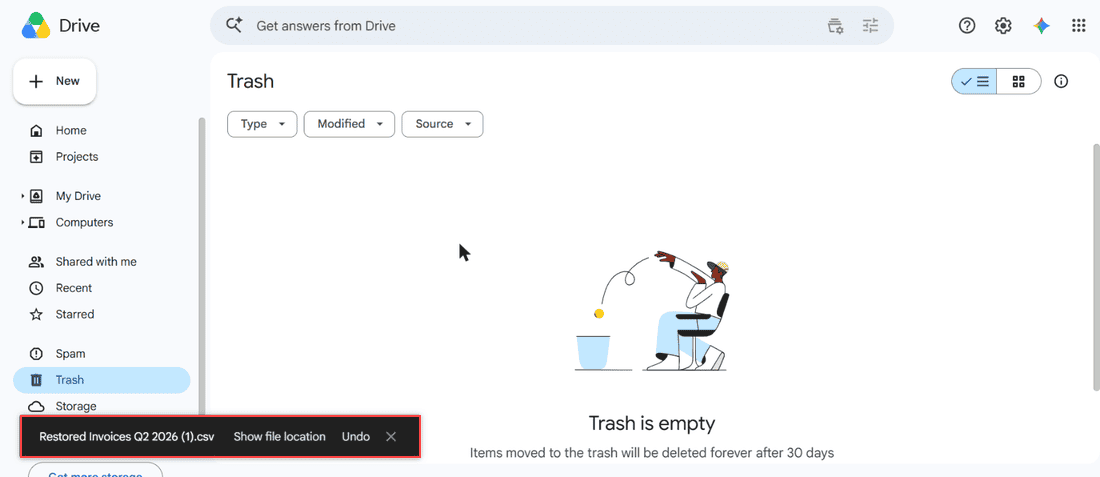
Drive confirms with a small message at the bottom: “Restored Invoices Q2 2026 (1).csv” with Show file location and Undo links. Click Show file location to jump straight to the folder it went back to.
How does this work?
A restored file goes back to its original folder with its name and contents intact. The 30-day clock is the key limit, so check the Trash soon. I explain the details in my post on how long Google Drive keeps deleted files.
Be careful with the other option in that menu. Delete forever skips the 30-day wait, and so does using Empty trash in Google Drive. After that, you can’t restore the file from the Trash yourself.
You can also search the Trash from anywhere with the operator is:trashed, which is handy when your Trash holds hundreds of items.
Method 3: Check the Activity panel for moves and deletes
The Activity panel tells you what happened to files in a folder: who moved them, renamed them, deleted them, or restored them. It’s my go-to when a file vanished from a shared folder and I want to know why.
- Open the folder where the file used to be. I opened Bluebird Landscaping.
- Click the Info icon (the small “i”) at the top right.
- Switch to the Activity tab.
- Scroll through the list and look for moves, renames, or deletions around the time the file disappeared.
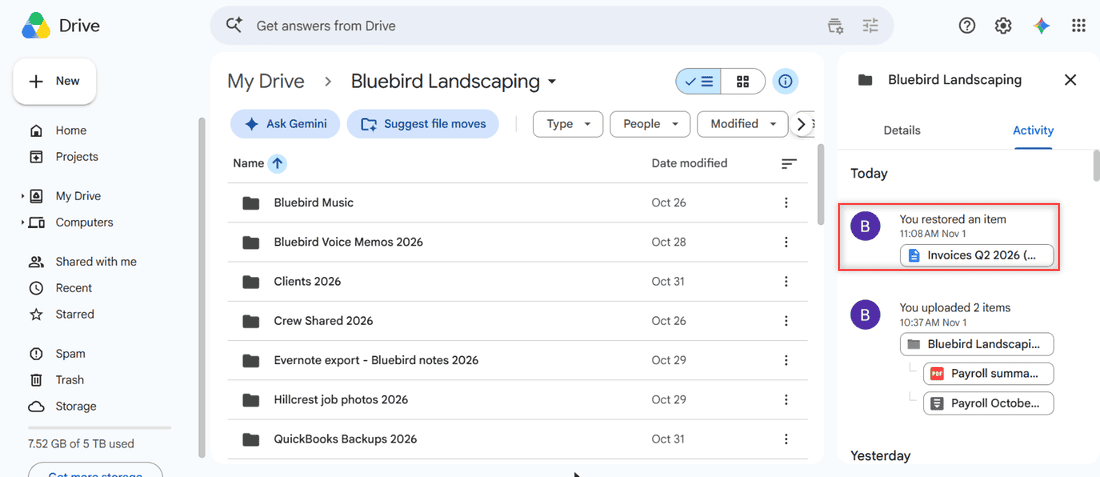
My panel showed “You restored an item” at 11:08 AM on Nov 1, right after the Trash test, and “You uploaded 2 items” earlier that morning. If someone else had moved the invoice out of the folder, their name would show up here instead.
How does this work?
Activity is attached to the folder or file, and Google Drive Help notes it’s most useful for items you own. It lists the action, the person, and the time.
If an entry says the file was moved, click it to see where it went. I cover more of this panel in my guide to recent activity on Google Drive.
On a phone, the Drive app doesn’t show this panel the same way. Google suggests opening drive.google.com in your mobile browser and choosing Request Desktop Site to see it.
Method 4: Find orphaned files with is:unorganized
This one surprises people. A file can lose its folder without being deleted. Google calls these unorganized files, and many guides call them orphaned files. They still exist, but they don’t sit in any folder you can browse to.
According to Google Drive Help, it happens when the file’s original folder is deleted or you lose access to that folder. For example, you created a file inside someone else’s folder and they deleted the folder. Your file moves to My Drive on its own, but it’s easy to miss there.
- Click the search box in Drive.
- Type
is:unorganized owner:meand press Enter. - Move any file you find into a folder so you can find it again later.
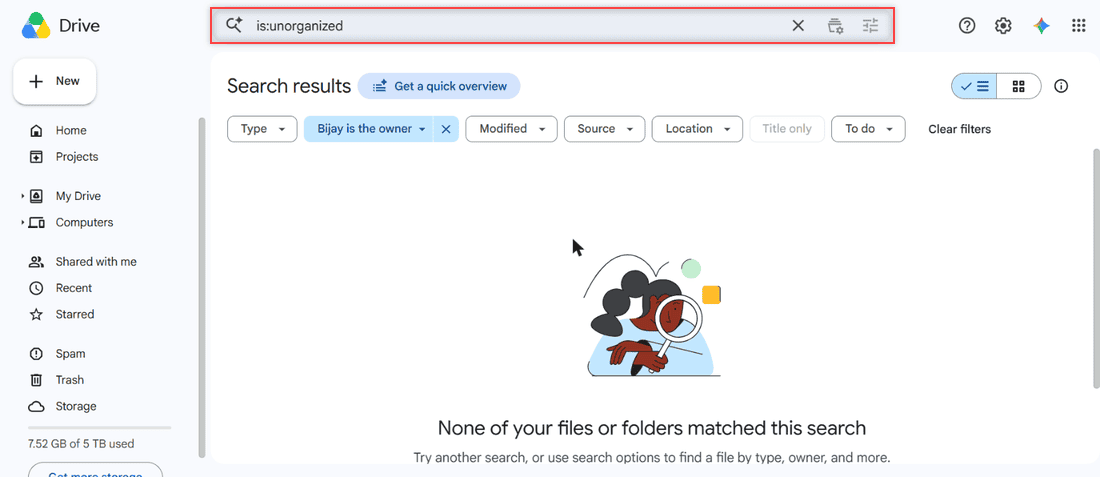
Drive turned owner:me into a filter chip that said my name is the owner. My demo account had no orphaned files, so I got “None of your files or folders matched this search.” If you see the same message, orphans aren’t the cause, and you can move on.
How does this work?
The is:unorganized operator lists items that have no parent folder. Adding owner:me keeps the list to files you created, which are the ones you can actually move and keep.
Method 5: Check whether a shared file lost its access
If the missing file belonged to someone else, you might not have lost it at all. Your access may have changed. Google Drive Help lists a few reasons this happens:
- The owner removed you from the file or from its parent folder.
- The owner moved the file into a folder you can’t open.
- The file sits in a folder with limited access, so you can’t open it unless you were given access to that folder directly. It may show up grayed out.
- The owner deleted the file. When an owner trashes a file, the people it was shared with lose it too.
To spot items in limited-access folders where you’re a viewer, search is:limited_access. For everything else, the fix is the same: ask the owner to check your permissions or share the file again.
If you open the old link and see a no-access page, you can request access to the Google Drive file right from that screen. My guide on why you’re unable to access a document in Drive covers the other error pages.
How does this work?
Shared files only show up for you as long as the owner’s sharing settings include you. Nothing you do in your own Drive can bring a file back once the owner removes you, which is why asking them is the only real fix.
Shared drives work a little differently in Google Workspace. Files in a shared drive belong to the organization, not to one person. If you’re removed from the shared drive, you lose those files too, so contact whoever gave you access.
Method 6: Make sure you are signed in to the right account
I’ve done this one myself. I spent ten minutes looking for a proposal before I noticed I was in my personal account, not the business one.
Lots of people have a work and a personal Google account in the same browser. Click your profile picture at the top right of Drive and check the email address. If it’s the wrong one, pick the other account from the list and search again.
The two kinds of accounts don’t share files, so a file saved in one simply won’t exist in the other. If you’re not sure which one you used, my comparison of Google Drive personal vs business accounts explains how they differ.
Pro tip: Check the Activity panel of the folder from Method 3 while signed in to each account. Whichever account shows the upload is the one that has the file.
Method 7: Fix files missing only on your computer
Sometimes the file is fine on drive.google.com but missing from the Google Drive folder on your computer. That points to Drive for desktop, not to Drive itself.
Drive for desktop has two ways to handle My Drive. With Stream files, your files live in the cloud and show up on a virtual drive on your computer. Google says they’re only available while Drive for desktop is running, and only online unless you make them available offline.
With Mirror files, a full copy is kept in a folder you choose, so the files are there even offline. To see which one you use:
- Click the Drive for desktop icon in the taskbar (Windows) or menu bar (Mac).
- Click the Settings gear, then Preferences.
- Click Folders from Drive on the left and read the My Drive syncing options.
If Drive for desktop isn’t running, streamed files won’t appear at all. Start it again, or follow my fix for when you can not launch Drive for desktop.
Also check the error list in the same menu. A file that failed to sync stays on one side only. My guide to the Drive for desktop error list shows how to retry those files.
How does this work?
Drive for desktop keeps your computer and the cloud matched. When it’s paused, signed out, or stuck on an error, the two sides drift apart, so a file can look missing on one while it sits safely on the other.
Method 8: Refresh the page or clear your browser cache
Once in a while, Drive’s web page just shows an old view. New uploads don’t appear, or a moved file still shows in its old folder. Try these in order:
- Reload the page (press F5, or Cmd+R on a Mac).
- Open a private window (Ctrl+Shift+N in Chrome) and sign in to Drive there.
- Try another browser or another computer.
- Clear your browser’s cache and cookies, then sign in again.
If the file appears in the private window, your normal browser’s stored data is the culprit. My steps to clear the cache in Google Drive cover Chrome, Edge, Firefox, and Safari.
I only see this when Drive has been open in a tab for days. A quick reload usually fixes it before I need anything else.
When the file is deleted forever: ask your admin or Google
If the file isn’t in the Trash and none of the methods found it, it was probably deleted forever. What happens next depends on the kind of account you have.
Work or school account (Google Workspace)
A Google Workspace admin can restore Drive files for up to 25 days after a user empties their Trash. In the Google Admin console, the admin goes to Directory > Users, picks your account, clicks More options > Restore data, chooses a date range and Drive, and clicks Restore.
There are catches. The admin can’t pick single files; everything deleted in that date range comes back. Restored files return to their original folder, and you have to share them again. So give your admin the exact date you deleted the file.
Personal Google account
Personal accounts don’t have an admin. If you own the file and it was deleted recently, sign in and open Google’s recovery help page, where Google offers a way to request file recovery. Google doesn’t promise to get a file back, so treat it as a last try.
Things to keep in mind
- 30 days in the Trash. After that, the file is deleted forever, and you can’t restore it from the Trash.
- Only owners control recovery. If someone else owned the file, they’re the one who can restore it or share it with you again.
- Workspace admins have 25 days. That window starts when the Trash is emptied, and restores work by date range.
- Personal accounts rely on you. No admin can step in, so check the Trash early and keep important files backed up.
- Moved isn’t deleted. Search and the Activity panel find most “missing” files in minutes.
If your files really are gone and your storage still looks full, this guide on why Drive storage is full with no files explains what’s taking up the space.
A few more Drive fixes worth a look:
- bring back an older version of a file
- clean up files shared with you
- pause or turn off Drive sync
- fix Drive that keeps going offline
Frequently Asked Questions
Why did my files disappear from Google Drive?
Most files are moved, not deleted. Someone may have moved them to another folder, the parent folder may have been deleted (leaving them unorganized), the owner may have removed your access, or you may be signed in to a different Google account.
Can I recover Google Drive files deleted more than 30 days ago?
Not from the Trash. A Google Workspace admin can restore files up to 25 days after the Trash was emptied. Personal account owners can sign in and request recovery from Google, but it isn’t guaranteed.
How do I find files I created in a folder that was deleted?
Search Drive for is:unorganized owner:me. These files move to My Drive automatically, per Google Drive Help: find lost files.
Why can I see a file on drive.google.com but not on my computer?
Drive for desktop may be paused, signed out, or showing a sync error. With Stream files, files appear only while the app is running, so start Drive for desktop and check its error list.

I am Carissa Gudinoa, a technology buff, and Office online and Apple expert with over 9 years of experience. I am passionate about helping others get the most out of their Apple devices. I have written extensively about Apple products and technologies. I am committed to providing my clients with the best possible service and am always up-to-date on the latest Apple products and features. I also write extensively on other software available for use at minimal cost or free. This includes Word Online, Outlook Online, Excel Online, and other Office online programs… Check out more.