
Go with Google Drive if your work happens in Docs, Sheets, and Gmail and you share files with people who already have Google Accounts.
Go with Koofr if you care most about privacy, want your files kept in the EU, or need one place to search the Dropbox, OneDrive, and Google Drive accounts you already have.
In this tutorial, I’ll walk you through Google Drive vs Koofr point by point: free space, privacy, sharing limits, version history, apps, and the kind of person each one suits. I show the Drive side from my own account. I don’t have a Koofr account, so every Koofr detail comes from Koofr’s own website.
Same job, very different companies
Both services store your files online, sync them to your devices, and let you share links. Google Drive arrived in 2012. Koofr, a smaller European company, says it launched in 2013.
The gap is in what each company is built around. Drive is one piece of a Google Account, sitting next to Gmail, Google Photos, and the Docs editors. Koofr sells itself on privacy: it says it uses no third-party tracking tools, no cookies other than the login cookie, and no ads or marketing emails.
At Bluebird Landscaping Co., my made-up demo business, our crew handbooks, job photos, and price lists all live in Drive. I checked Koofr’s features, pricing, and comparison pages in October 2026 for the other side of this.
Comparing more than two services? I’ve also put Google Drive against OneDrive and Google Drive against MEGA side by side.
The quick comparison table
| What matters | Google Drive | Koofr |
|---|---|---|
| Free storage | Up to 15 GB, shared with Gmail and Google Photos | 10 GB, “Free forever” for Koofr files only |
| Paid plan sizes | Google One plans, up to 5 TB on my demo account | Briefcase 10-100 GB, Suitcase 250 GB-1 TB, Crate 2.5 TB and up, plus a 10 GB bonus |
| Billing | Google One membership | Koofr says only yearly subscriptions right now |
| File size limit | Up to 5 TB for files that aren’t Google Docs, Sheets, or Slides | Koofr says no individual file size or file type limits |
| Where data lives | Google’s data centers | Servers in Germany (EU), ISO 27001 data centers |
| Encrypted private folder | No separate vault | Koofr Vault, open source and zero-knowledge |
| Share link passwords | No password option | Passwords and expiry dates on links |
| Deleted file recovery | Trash, plus version history for edits | 7 days on the free plan, up to 30 days on paid |
| Built-in editors | Google Docs, Sheets, Slides | Real-time collaboration on Office documents |
| Connects other clouds | No built-in multi-cloud search | Dropbox, Google Drive, and OneDrive with one search |
Reasons I stay with Google Drive
Everything opens inside the Google world
When I right-click a file in Drive and hover over Open with, I see Google Docs right there. Below it are suggested apps like Lumin PDF and DocHub, plus Connect more apps for anything else I need.
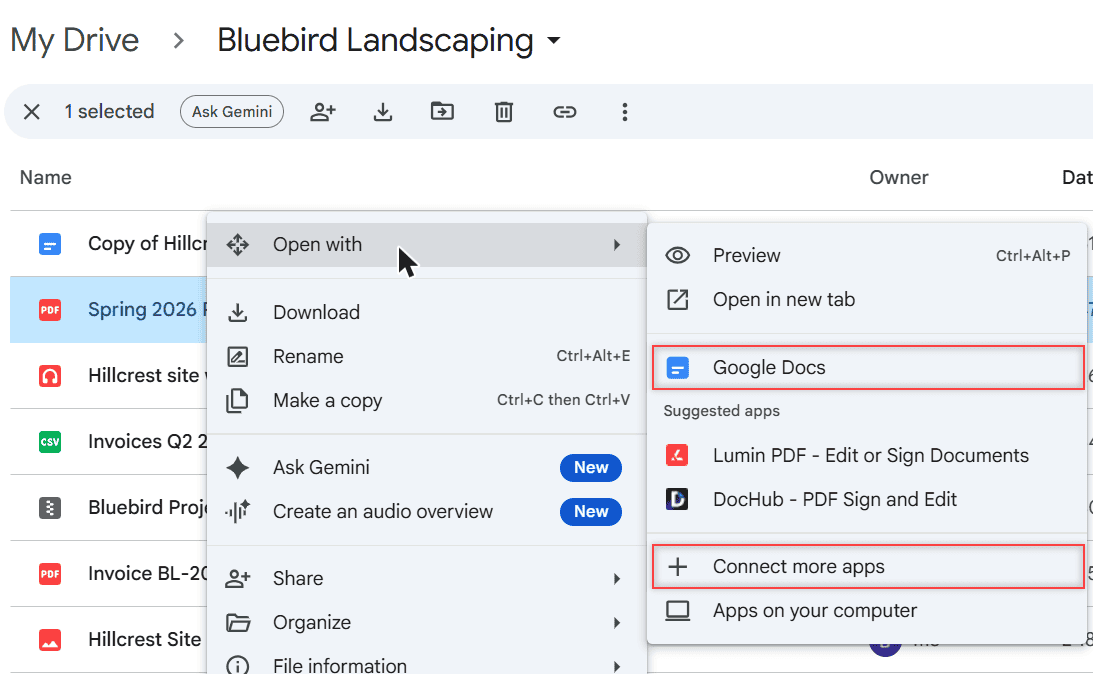
That’s how I turn a client’s PDF into something I can edit in a minute. If a file won’t open at all, here’s how I open unsupported files on Google Drive.
Koofr says it supports real-time collaboration on Office documents. But my clients already have Gmail, so Drive keeps things simple for everyone.
Version history has my back
Google says a version of an uploaded file may be deleted after 30 days or once there are 100 newer versions. You can stop that by turning on Keep forever. For Google Docs, you need edit permission to see the version history at all.
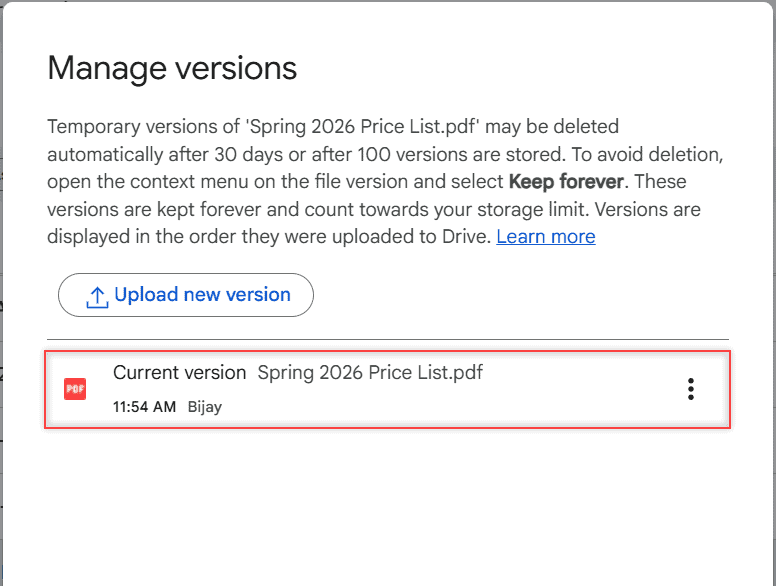
I’ve rolled back our price list after a bad edit more than once. My guide to Google Drive version history walks through restoring an older copy. Koofr’s pages I checked don’t say anything about file versions, so I can’t compare that part fairly.
Offline editing is a checkbox away
In Drive Settings, the Offline box lets me work on recent Docs, Sheets, and Slides files with no internet. That’s handy on job sites with weak signal.
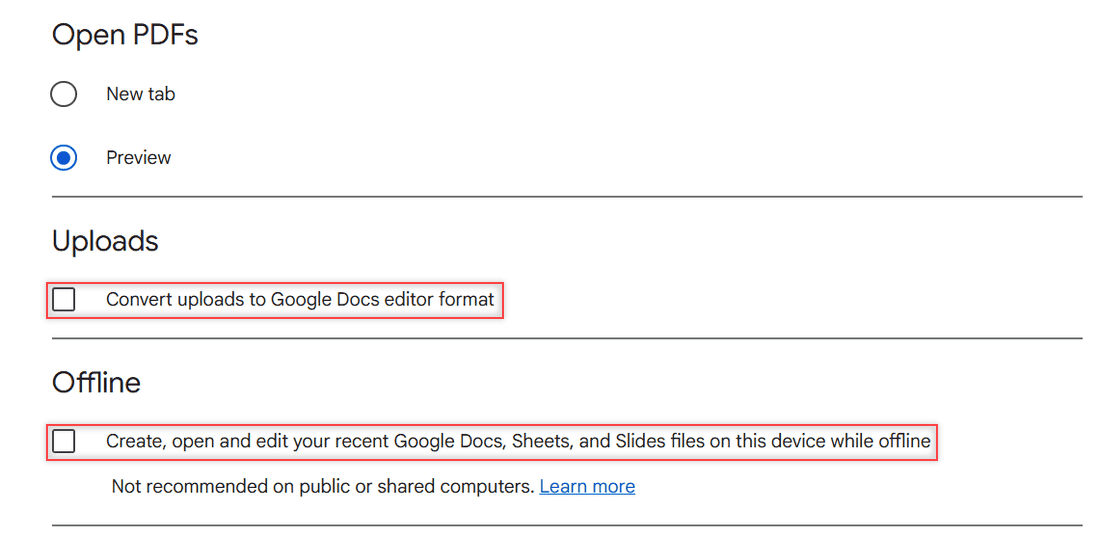
If yours drops the connection over and over, see why Google Drive keeps going offline.
File size limits and big uploads
Google says you can store files up to 5 TB each in Drive, as long as they aren’t Google Docs, Sheets, or Slides files. Those have their own caps: a Google Doc tops out around 1.02 million characters, and a Google Sheet at 20 million cells.
I’ve never come close to 5 TB with one file. Our biggest uploads are drone videos of finished patios, and those are a few gigabytes at most.
If a large upload stalls, my tips to upload large files to Google Drive usually get it moving again.
Koofr says it has no individual file size limits and no file type limits. On paper that beats Drive, but for most people both limits are far beyond anything they’ll upload. The free plan’s daily public transfer limit matters more if you share big files often.
Drive drawbacks you should know about
The free 15 GB isn’t only for Drive. Google says it’s shared across Gmail, Google Drive, and Google Photos. My demo account is on a paid 5 TB Google One plan, and the Storage page shows that split.
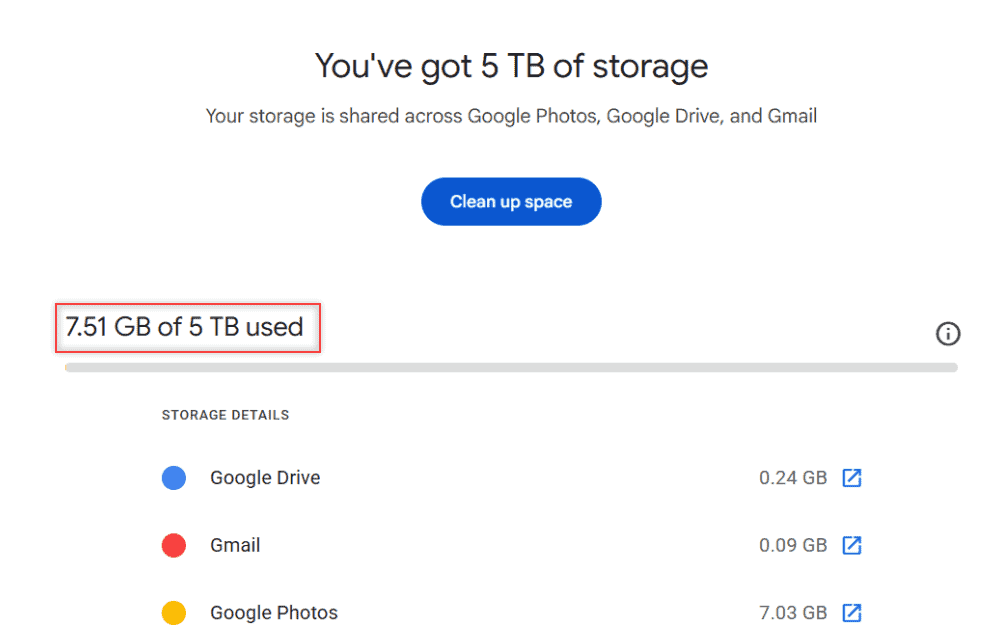
So a big inbox can fill up your Drive. When that happens and Drive looks empty, my fix for Google Drive storage full with no files shows where the space went.
Sharing is the second drawback. On my personal account, General access is either Restricted or Anyone with the link, with Viewer, Commenter, or Editor roles. There’s no box for a link password.
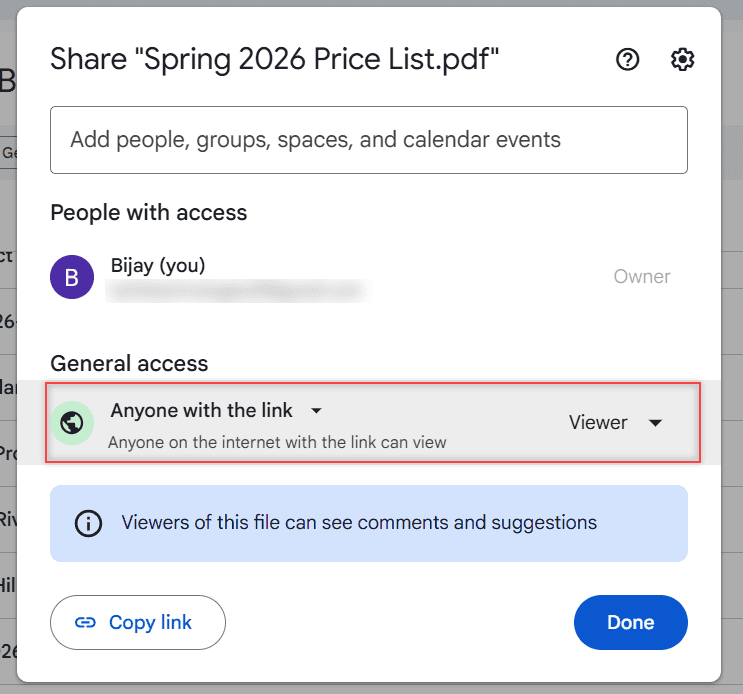
That’s fine for a price list, but not for anything private. Here’s how I turn on link sharing in Google Drive and choose the right role.
Where Koofr has the edge
Privacy and EU storage
Koofr says its servers are in Germany, in ISO 27001 data centers, and that it follows GDPR. For a small business with European clients, that can settle the question on its own.
Koofr Vault adds another layer. Koofr calls it open source, client-side, zero-knowledge encrypted storage, so only you can unlock what’s inside. The free plan includes one Vault Safe Box.
One home for all your clouds
Koofr says you can connect Dropbox, Google Drive, and OneDrive and search across them in one place. It also lists a duplicate finder, which is useful if the same photos sit in three accounts.
For power users, Koofr supports WebDAV and Rclone, and it has web, desktop, and mobile apps for iOS, Android, and Huawei. Its desktop sync also lets you set exclude rules.
More control over shared links
Koofr lets you put a password and an expiry date on a share link. Paid accounts can also set a custom link address. Receive links let clients upload files to you without an account.
Koofr drawbacks, going by its own pages
The free plan is tight. Koofr lists private sharing with up to 10 other Koofr users, up to 10 public links that expire after 14 days, and up to 10 public receive links.
Free accounts also get a 50 GB daily public transfer limit, and deleted files are kept for only 7 days. Billing is yearly only for now, which is a bigger commitment than some people want.
Who should use it, and who should pick something else
Pick Google Drive if you write and edit with other people, you already live in Gmail, or your clients all have Google Accounts. That’s my business, so Drive stays.
Pick Koofr if you want EU storage, a zero-knowledge vault, password-protected links, or one search box for several cloud accounts.
Pick something else if your team runs on Word and Excel every day. OneDrive may fit better. If you’re stuck between Google account types, read personal vs business Google Drive.
You can also use both. Koofr says it can connect your Google Drive, so you could keep working in Drive and still search everything from Koofr.
Before you choose, these Google Drive guides might help:
- advantages and disadvantages of Google Drive
- how to add a password to Google Drive
- how to see folder size in Google Drive
- Google Drive vs Dropbox
Still deciding?
What is the Koofr daily sharing limit?
Koofr’s pricing page lists a 50 GB daily public transfer limit on the free plan. Free accounts can also have up to 10 public links, each lasting 14 days.
Is Koofr better than Google Drive?
For privacy, EU storage, and password-protected links, Koofr has the edge. For editing documents together and working with Gmail, Google Drive is the better fit.
How much free storage do I get with Koofr vs Google Drive?
Koofr gives 10 GB free for your Koofr files. Google gives up to 15 GB, but it’s shared with Gmail and Google Photos, as Google One Help explains.
Can I connect Google Drive to Koofr?
Yes. Koofr says you can connect Google Drive, Dropbox, and OneDrive and search across all of them from Koofr.

I am Carissa Gudinoa, a technology buff, and Office online and Apple expert with over 9 years of experience. I am passionate about helping others get the most out of their Apple devices. I have written extensively about Apple products and technologies. I am committed to providing my clients with the best possible service and am always up-to-date on the latest Apple products and features. I also write extensively on other software available for use at minimal cost or free. This includes Word Online, Outlook Online, Excel Online, and other Office online programs… Check out more.