
A while back I got an email saying a client had shared a file called Invoice_Final with me in Google Drive. I wasn’t expecting an invoice from her, and the button said “Open” in big friendly letters. I didn’t click it. I texted her instead, and she’d never sent it.
In this tutorial, I’ll answer a question I hear a lot, can a Google Drive link be dangerous (yes, it can), and walk you through the six rules I follow. They cover fake share emails, sign-in traps, risky downloads, spam shares, and your own sharing settings.
Check who shared it and whether you expected it
Why: Google itself says phishing messages often impersonate someone you know, like a coworker or friend, and ask you to click a link or download something. A Drive share email is a perfect disguise because we all get real ones.
How: before you open anything, ask two questions. Do I know this sender? Was I expecting this file? If the answer to either is no, contact the person another way, by text or a new email, not by replying.
Urgency is a red flag too. “Final notice” or “payment overdue” in a file name is meant to rush you. If you’re the one who needs a file from someone, it’s safer to request access to a Google Drive file than to trust a random link.
Look at the real address, but a real one is not proof
Why: a fake share email can send you to a page that only looks like Google. Hovering shows where the link really goes.
How: on a computer, rest your mouse on the button or link without clicking and read the address that pops up. Links to Drive files usually start with drive.google.com or docs.google.com. Anything else that dresses itself up as Drive is a reason to stop.
Here’s the catch, though. A real Google address only means the file lives on Google. The file itself can still be a phishing page, a fake form, or a harmful download someone uploaded. So use the address to rule things out, never to rule them in.
Never type your password after clicking a shared link
Why: Google’s Gmail help is clear here. If you’re already signed in, emails from Google won’t ask you to enter that account’s password. A sign-in box right after you click a “shared file” link is the classic trap.
How: close that tab. Then type drive.google.com into your browser yourself and look in Shared with me. If the file is real, it’ll be there. If you think you already typed your password into a fake page, change it right away and check recent activity at myaccount.google.com/notifications.
I also turned on 2-Step Verification, which Google describes as an extra layer in case your password is ever stolen. You’ll find it under Security & sign-in in your Google Account.
Don’t open downloads Drive warns you about
Why: Drive checks files for malware, but it has limits. Google says there’s a 100MB scanning limit and some file types can’t be scanned. A failed or skipped scan isn’t proof of danger, but it does mean no one checked the file for you.
How: if Drive or Gmail shows a warning, don’t download or open the file. That’s Google’s own advice. Here’s more on how Google Drive scans files for viruses. On a work or school account, Google also checks files shared from outside your organization and blocks the ones it flags.
Move unwanted shares to Spam and block the sender
Why: anyone who knows your email address can share a file with you. Drive’s classifiers catch a lot of it, but not everything.
How: in Drive, right-click the file in Shared with me and click Block or report, then Report. You can also drag it into Spam. Reported files stop sending comment notifications, drop out of Drive search, and get reviewed by Google. Drive’s Spam page spells out what happens next.
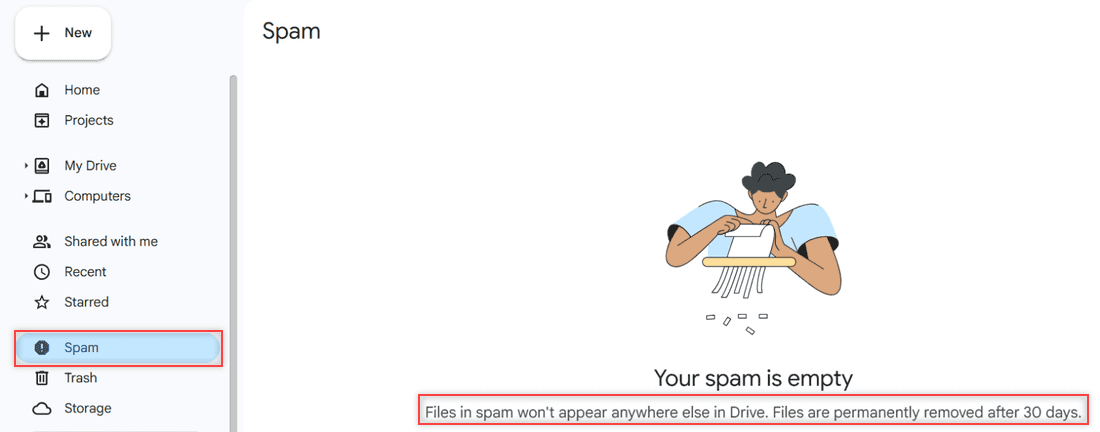
To stop that person for good, right-click a file they own and choose Report or block, then Block. They won’t be able to share with you anymore. To clear out files without reporting them, see how to remove shared files from Google Drive. On work or school accounts, you can’t block people in your own domain.
Keep your own links Restricted
Why: a link set to Anyone with the link works for whoever has it, including people it gets forwarded to. Google also notes that your name and email show as the file’s owner when you share a link.
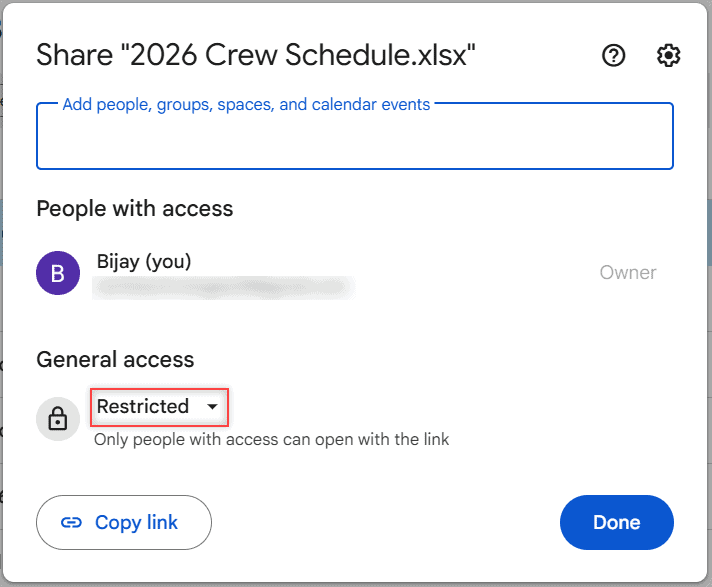
How: click Share and look under General access. I keep work files on Restricted, so only the people I add can open them, even with the link.
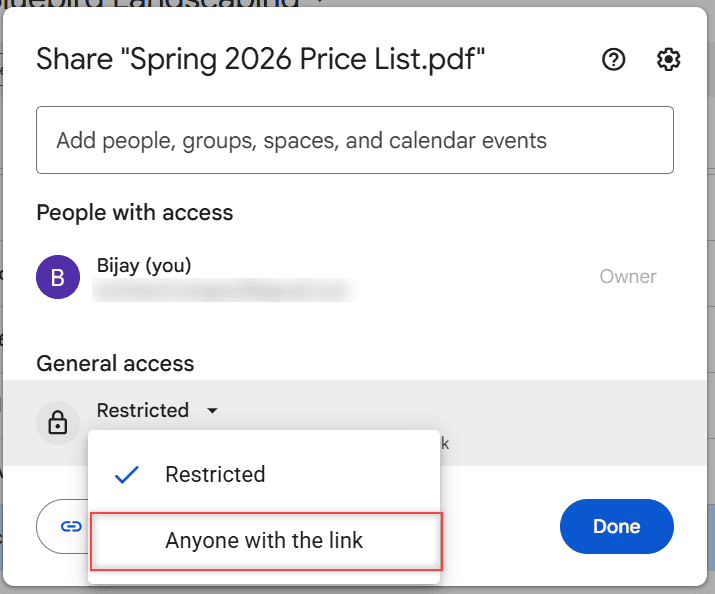
When I do need a public link, I open the General access menu, pick Anyone with the link, and set the role to Viewer. Here’s how to turn on link sharing in Google Drive the right way.
Viewer doesn’t stop copying, though. Viewers can usually download files unless you change that, so read whether viewers can download your Drive files before sharing anything private.
My Drive link safety checklist
- I know the sender and I expected the file, or I’ve confirmed it another way.
- The link points to drive.google.com or docs.google.com, and I still treat the file with care.
- I never enter my password after clicking a link. I go to drive.google.com myself.
- I skip any download Drive or Gmail warns me about.
- Unwanted shares go to Spam, and repeat senders get blocked.
- My own files stay Restricted, and public links are set to Viewer.
- 2-Step Verification is on, and I run Security Checkup now and then.
Want to tighten up your Drive a bit more? Start here
Questions I get about this
Can you get a virus from a Google Drive link?
Opening the link alone is rarely the problem. The risk is downloading and running a harmful file, or signing in on a fake page. Skip files Drive warns about and anything you weren’t expecting.
How do I know if a Google Drive link is safe?
Confirm the sender, hover to check that it goes to drive.google.com or docs.google.com, and never sign in from the link. Even then, a real address doesn’t guarantee a safe file.
What happens if I click a phishing Google Drive link?
If you didn’t type anything or download anything, close the tab. If you entered your password, change it and review your account. Google’s Gmail Help: avoid and report phishing emails lists the steps.
Can someone hack you through Google Drive?
Drive itself isn’t the weak spot. People get caught by fake sign-in pages and harmful downloads shared through it. A strong password, 2-Step Verification, and Security Checkup go a long way.
How do I report a Google Drive file?
Right-click the file in Shared with me, click Block or report, then Report, and pick the type of content. The file moves to Spam, and Google reviews it.

I am Carissa Gudinoa, a technology buff, and Office online and Apple expert with over 9 years of experience. I am passionate about helping others get the most out of their Apple devices. I have written extensively about Apple products and technologies. I am committed to providing my clients with the best possible service and am always up-to-date on the latest Apple products and features. I also write extensively on other software available for use at minimal cost or free. This includes Word Online, Outlook Online, Excel Online, and other Office online programs… Check out more.