
Short answer: you can’t add your own font to Outlook on the web. You can pick any of its 73 built-in fonts, though. Go to Settings > Mail > Compose, choose a font under Message format, then click Save.
In this tutorial, I’ll show you how to add fonts to Outlook the ways that actually work: setting a default font on the web, changing the font in one message, and using fonts from your PC in classic Outlook.
Change the default font in Outlook on the web
I set this up in the Microsoft 365 mailbox I use for my made-up business, Bluebird Landscaping Co. Every new email I write starts in this font, so it’s worth getting right once.
- Open Outlook on the web and click the gear icon at the top right.
- In Settings, click Mail, then Compose.
- Under Message format, set Compose messages in HTML format.
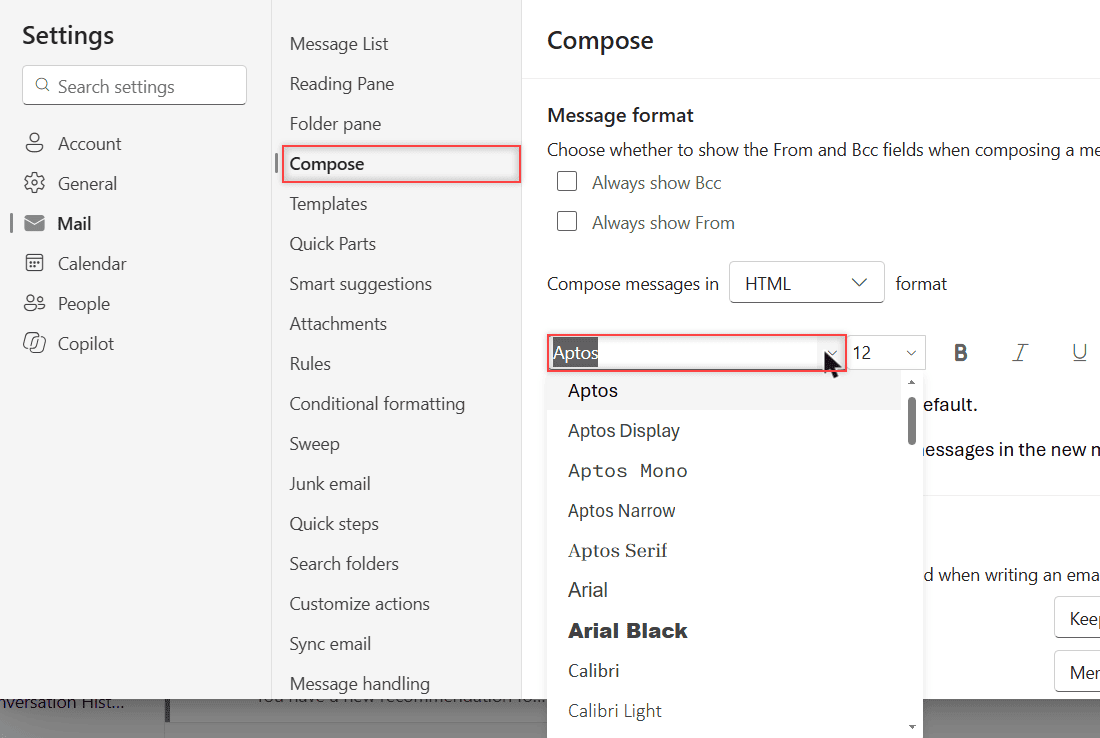
- Click the font box (mine said Aptos) and pick a font from the list.
- Set the size, and bold, italic, underline or color if you want them.
When I picked Georgia, the preview line, “Messages you write will look like this by default,” changed right away. Save and Discard buttons showed up at the bottom of the panel.
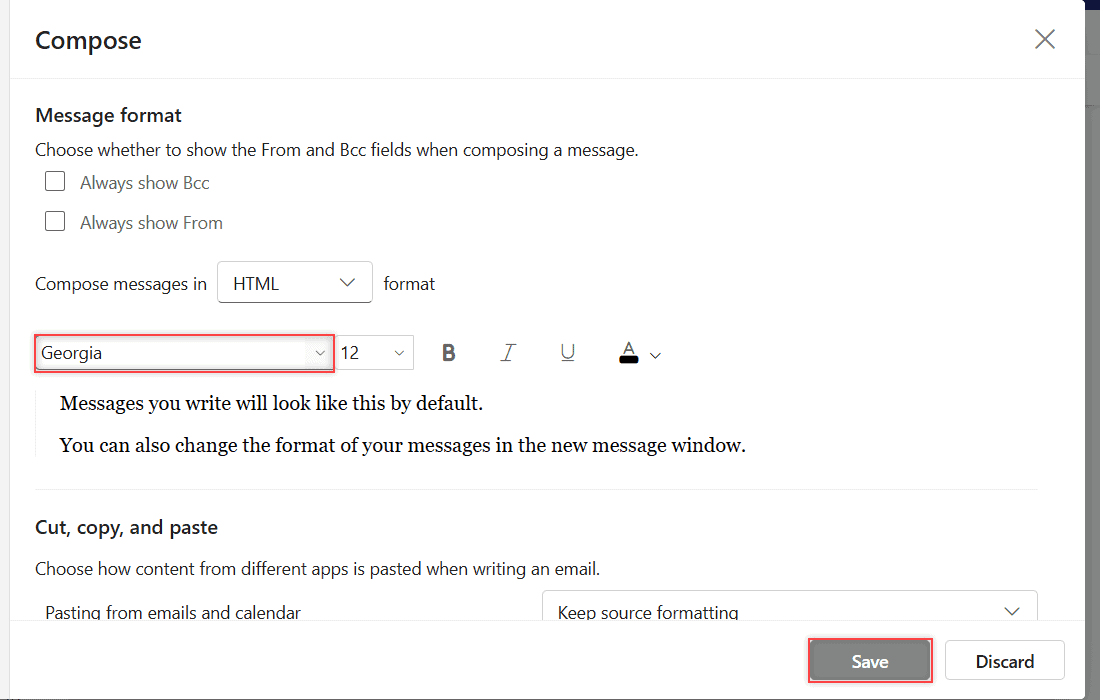
Click Save to keep it. I clicked Discard, so my mailbox is still on Aptos. Your signature has its own formatting, and so do saved HTML templates in Outlook.
Pro tip: Plain text messages have no fonts at all. If the font box looks greyed out, check that HTML format is selected first.
Use a different font in just one email
Sometimes I want one email to look different, like a seasonal flyer, without touching my default. You can do that right in the message window.
- Click New mail.
- Click into the body of the message.
- On the Message tab (or Format text), open the font box.
- Pick a font, then start typing. Or select text you already wrote and pick a font for it.
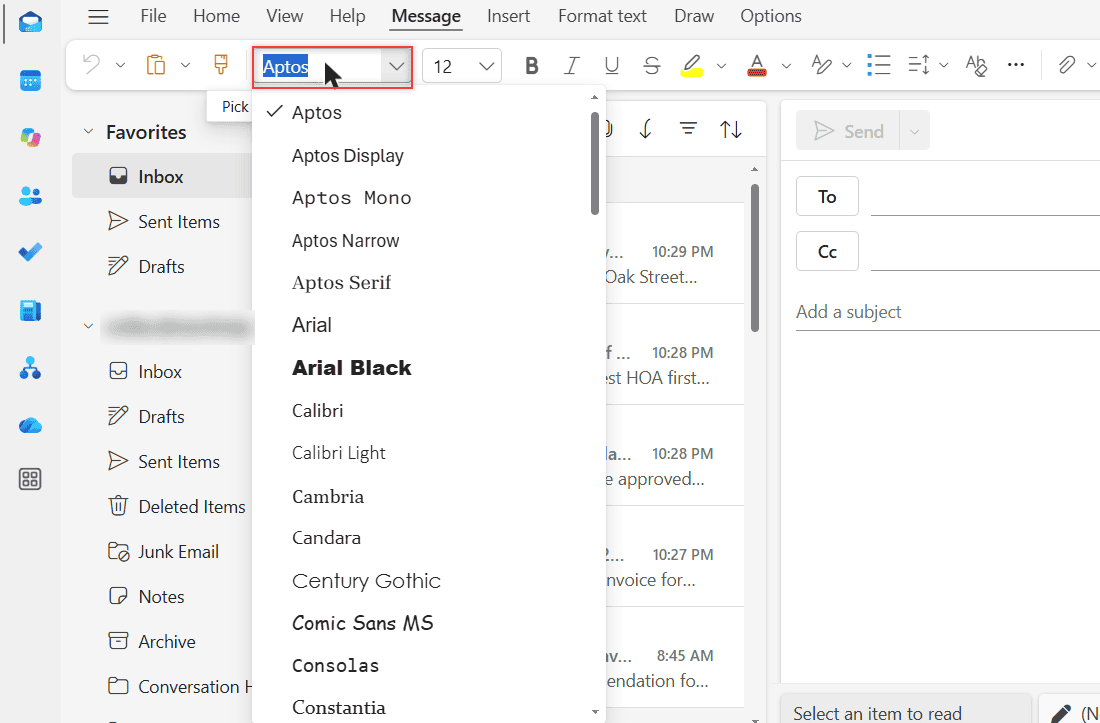
It’s the same 73 fonts you see in Settings. If you’re dressing up a message with pictures, Outlook stock images work well alongside a heading font like Georgia or Century Gothic.
Why you can’t add your own font on the web
Older guides, including the first version of this post, described a “More fonts” option with a search bar and a plus button. I checked on October 24, 2026. It isn’t there.
The font box lists 73 fonts and nothing else. You get the Aptos family, Arial, Calibri, Cambria, Georgia, Garamond, Segoe UI, Tahoma, Verdana and the rest, then fonts for Chinese, Japanese, Korean, Thai and Indian languages. There’s no upload button.
So I tried a trick. Segoe Print is installed on my Windows PC but isn’t on the list. I typed it into the font box in Settings and pressed Enter. It snapped straight back to Aptos.
I did the same in a new message. I typed Segoe Print, pressed Enter and wrote a line. The box still said Aptos, and so did my text. Outlook on the web simply ignores fonts that aren’t on its list.
If you need a certain look, pick the closest built-in font. For a logo or fancy lettering, an image works better, but keep the image size small so it loads fast.
Add fonts to classic Outlook for Windows
Classic Outlook for Windows is different, because it can use fonts installed on your PC. Microsoft’s steps for installing a font in Windows 10 or 11 are short.
- Find the font file you downloaded. It may be inside a .zip file in Downloads.
- Double-click the font file to open it in the font previewer.
- Click Install, close the previewer, and open Outlook.
Then set it as your default. Go to File > Options > Mail > Stationery and Fonts. On Personal Stationery, click Font for new messages or for replies and forwards, pick it, then click OK three times.
Change the default font in new Outlook
In the new Outlook for Windows, the setting sits in the same spot as the web version. Go to View > View settings > Mail > Compose, pick a font under Message format, and click Save.
While you’re in Compose settings, it’s a good time to look at the other options, like sending a confidential email in Outlook.
When recipients see a different font
Here’s the catch with any font, even one you can pick. If it isn’t installed on the recipient’s computer, their mail program swaps in a font it has. Your Georgia email might arrive as Times New Roman.
- Stick to common fonts. Arial, Calibri, Georgia, Tahoma and Verdana are safe picks for most people.
- Custom fonts travel badly. A font you installed in classic Outlook only shows up for people who have it too.
- Test it. Send one email to yourself on another device before you send it to customers.
Before a long trip, don’t forget to set up automatic replies in Outlook so people aren’t left waiting.
More Outlook Online how-tos from my mailbox
- Forward several emails at once
- Create inbox rules in Outlook Online
- Show a sender’s email address
- All Outlook Online tutorials
Fonts aren’t the only thing that shapes how your mail looks. My guide on how to change your signature in Outlook walks through adding one, editing it and setting a default.
Quick answers
Can I add custom fonts to Outlook on the web?
No. Outlook on the web only offers its built-in list of 73 fonts. Typing another font name, even one installed on your PC, just switches back to the default.
Why isn’t my font showing for recipients?
If the font isn’t installed on their computer, their mail program substitutes one it has. Common fonts like Arial, Calibri or Georgia are the safest choice.
How do I change the default font in new Outlook?
Go to View > View settings > Mail > Compose, pick a font under Message format, and click Save. Microsoft lists the steps for every version in Change or set the default font in Outlook.
How do I add fonts to Outlook 365 on my computer?
Install the font in Windows first, then open classic Outlook and choose it under File > Options > Mail > Stationery and Fonts.

I am Carissa Gudinoa, a technology buff, and Office online and Apple expert with over 9 years of experience. I am passionate about helping others get the most out of their Apple devices. I have written extensively about Apple products and technologies. I am committed to providing my clients with the best possible service and am always up-to-date on the latest Apple products and features. I also write extensively on other software available for use at minimal cost or free. This includes Word Online, Outlook Online, Excel Online, and other Office online programs… Check out more.