
Got a folder of songs, voice-overs, or demo tracks on your computer or phone and want them somewhere safe you can reach from any device? Google Drive takes audio files just like documents, and it even plays them for you.
In this tutorial, I’ll show you how to add music to Google Drive from a computer, an Android phone, and an iPhone or iPad, how to keep a whole music folder synced, and how to play and download your songs later.
Method 1: Upload music files on a computer
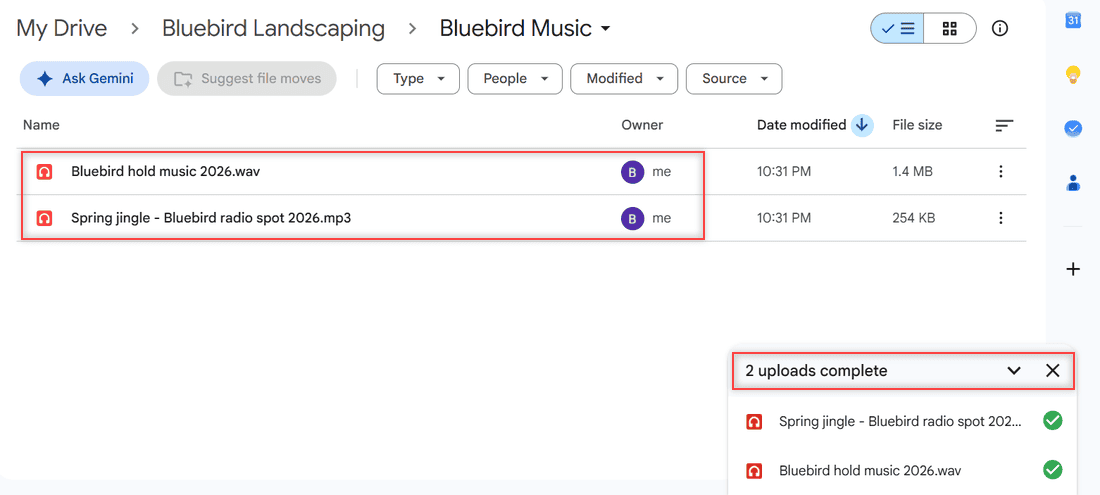
For my tests I used my made-up business, Bluebird Landscaping. It has two audio files: “Bluebird hold music 2026.wav”, the music callers hear on hold, and “Spring jingle – Bluebird radio spot 2026.mp3”, a short radio ad.
The browser is the fastest way when you have a handful of tracks. First, give your music its own home so it doesn’t get lost among documents. You can create subfolders in Google Drive later for albums or projects.
- Go to drive.google.com and open the folder where your music should live. I opened My Drive > Bluebird Landscaping.
- Click New, then New folder.
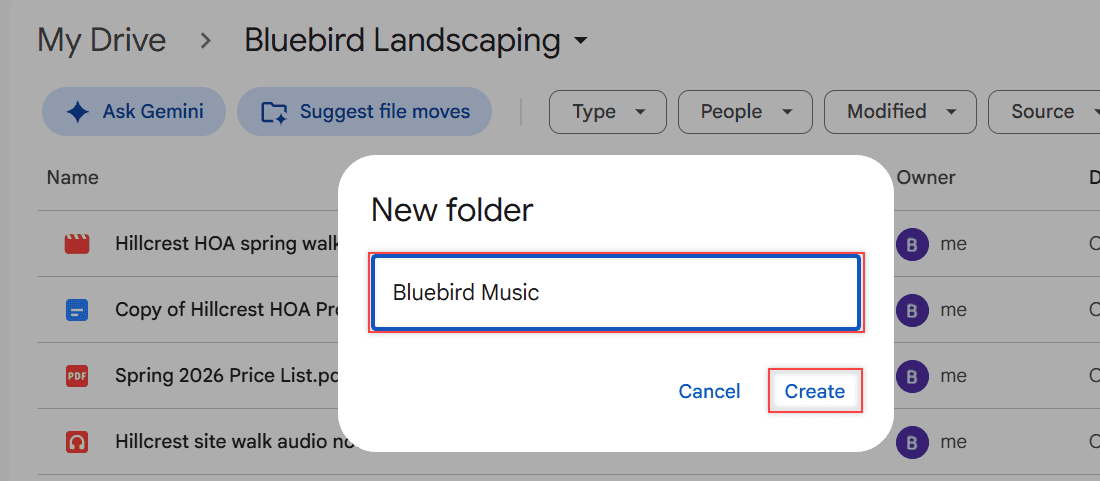
- Type a name, like Bluebird Music, and click Create.
Now open the new folder and add the songs:
- Double-click the folder to open it.
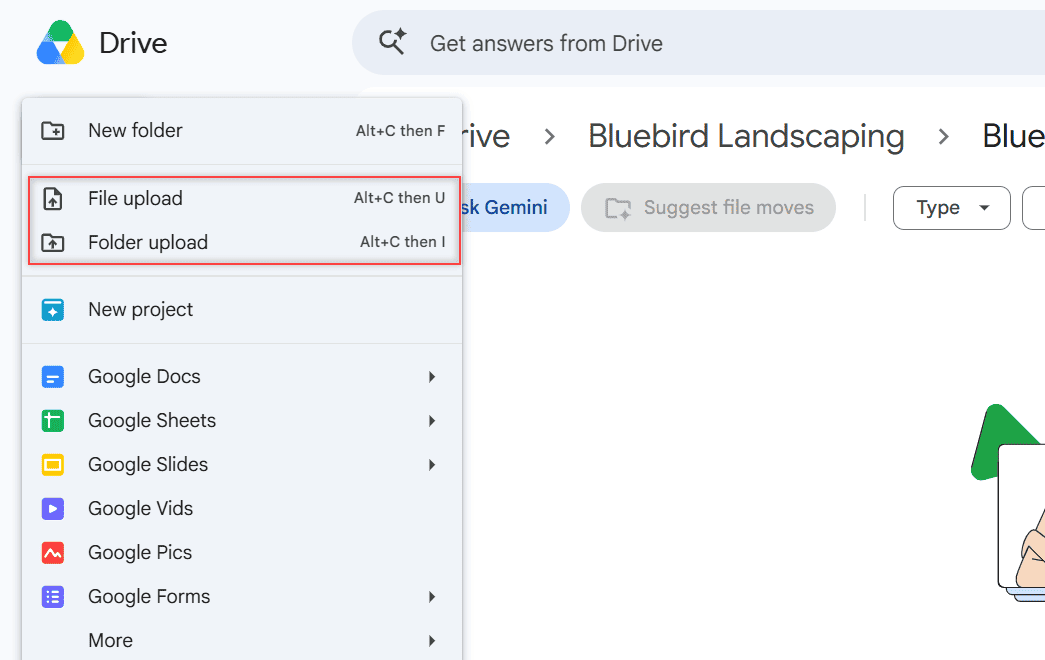
- Click New, then File upload to pick single songs, or Folder upload to send a whole album folder.
- Select the music files on your computer and click Open (or Upload for a folder).
A small panel opens at the bottom right and shows each file’s progress. Mine said “2 uploads complete” with a green check next to both tracks a few seconds later.
How does this work?
Drive stores a copy of each file exactly as it was on your computer. It doesn’t convert an MP3 or WAV into anything else, so the song you download later is the same file you uploaded.
If you upload a file with the same name as one already in the folder, Google says Drive saves it as a new version of the old file. You can choose Keep both files to have two separate copies instead.
Pro tip: You can skip the menus entirely. Open the music folder in Drive and drag your songs from File Explorer or Finder straight into the browser window. Keyboard fans can press Alt+C, then U for File upload, or Alt+C, then I for Folder upload.
Big albums in lossless formats can take a while. If you’re moving many gigabytes, my guide on how to upload large files to Google Drive has tips that keep long uploads from failing.
Method 2: Add music from an Android phone
Songs you recorded, bought as downloads, or copied onto your phone can go to Drive from the Drive app. Here are the steps from Google’s help page:
- Open the Google Drive app.
- Open the folder you want, like Bluebird Music.
- Tap New (the plus button), then tap Upload.
- Find the song in your phone’s storage, often the Music or Download folder, and tap it.
The upload runs in the background. If it sits there forever, these fixes for Google Drive stuck on waiting to upload usually get it moving.
Worried about your data plan? In the Drive app, open the menu, tap Settings, and under Data usage turn on Transfer files only over Wi-Fi. Google notes this option only appears when your phone can use mobile data.
How does this work?
The Drive app uses Android’s file picker, so any audio file the picker can see can be uploaded. To move a whole album at once, here’s how to upload a folder to Google Drive on Android.
Method 3: Add music from an iPhone or iPad
On an iPhone, your song files have to be in the Files app (On My iPhone, iCloud Drive, or another location) for the Drive app to see them.
- Open the Google Drive app.
- Tap Add (the plus button), then File upload.
- Browse to the song and tap it.
- Tap Location and pick the folder, for example Bluebird Music.
- Tap Upload.
The same steps work for recordings you made yourself. I covered that case in detail in how to upload voice memos to Google Drive.
What about Apple Music, Spotify, or YouTube Music songs?
Songs you download inside a streaming app aren’t regular music files. They’re protected and stay inside that app, so they won’t show up in the file picker, and I won’t show any trick to pull them out.
What you can upload are files you own or have the rights to: tracks you recorded, music you bought as DRM-free downloads, or music the artist gave you to use.
How does this work?
The Drive app only sees what iOS lets it see, which is the Files app. If a song uploads on Wi-Fi but stalls on cellular, check these fixes for Google Drive not uploading from a phone.
Method 4: Sync a whole music folder with Drive for desktop
If your music library lives on a Windows PC or Mac and keeps growing, uploading by hand gets old. Google Drive for desktop does it for you. If you don’t have it yet, here’s how to install Google Drive on your computer.
You have two options:
- Drag songs into the Google Drive folder. After you sign in, Drive for desktop adds a “Google Drive” location on your computer. Anything you drag into it uploads to My Drive.
- Sync your existing Music folder. In the Drive for desktop settings, add the folder from your computer you want to sync. New songs you drop into it later upload on their own.
On a Mac, the Google Drive location shows up in the Finder sidebar. If it’s missing, see how to add Google Drive to Finder.
How does this work?
Google says folders you sync from your computer are mirrored. That means the songs stay on your hard drive and a copy lives in Drive. On drive.google.com, they appear under “Folders from your computer”, not in My Drive.
Files in the Google Drive location itself are streamed by default, which uses almost no space on your computer until you open a song.
Pro tip: Sync only the music folder, not your whole user folder. Smaller syncs finish faster and don’t eat storage with files you never meant to back up.
Play your music right inside Google Drive
Once your songs are in Drive, you don’t have to download them to listen. Double-click an audio file and Drive opens a simple player.
When I opened the Bluebird spring jingle, Drive showed a waveform with a pause button, the time (0:07 of 0:16), and a volume slider. The top bar has Open with, Share, and a Download icon.
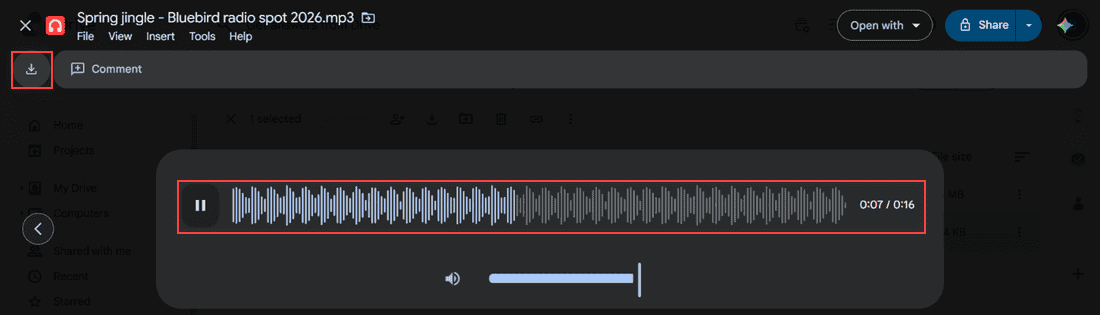
Google lists MP3, MPEG, WAV, .ogg and .opus as the audio formats Drive handles. Other formats still store fine, but Drive may not play them. My guide to open unsupported files on Google Drive covers what to do then.
Drive’s player is great for checking a track or sharing a song with a friend. It isn’t a music app, though: there are no playlists or shuffle, and each file plays on its own.
Want someone else to hear a track? Click Share in the player’s top bar, add their email, and pick Viewer. They can play the song in their browser without installing anything, which is how I send the radio spot to a client for approval before it airs.
Find all your songs in one search
After a few months of uploads, music ends up scattered across folders. Drive’s search can pull every audio file into one list.
- Click the search box at the top of drive.google.com.
- Type type:audio and press Enter. You can also click the Type filter and choose Audio.
- Add a word from the song name to narrow it down, like type:audio jingle.
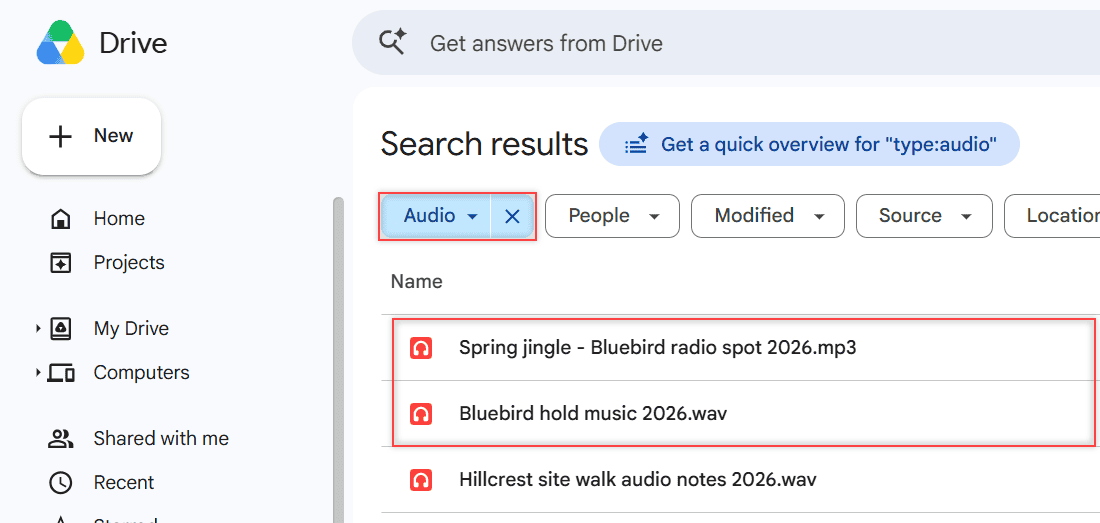
My search found the MP3, the WAV, and an older WAV I’d forgotten about in the Bluebird folder. If you’re hunting for a folder rather than a file, these ways to find folders in Google Drive help.
Download a song from Google Drive to your device
Many people searching for this want the opposite: to get a song out of Drive and onto their computer or phone. On a computer:
- Right-click the song in Drive.
- Click Download.
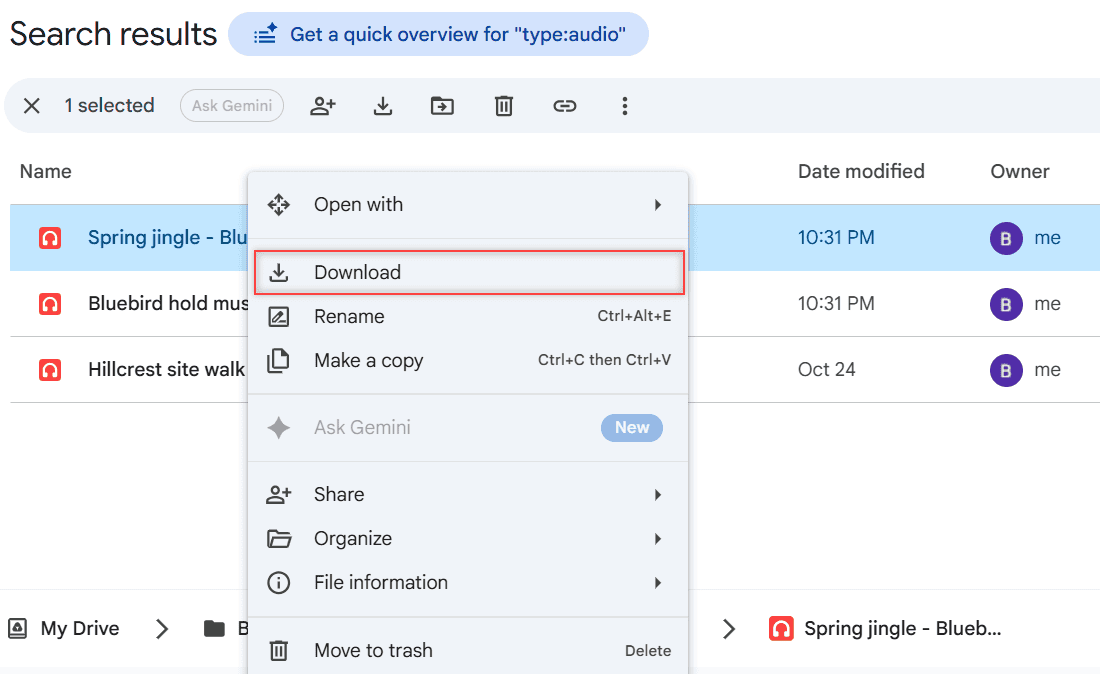
The file lands in your Downloads folder with its original name. If you select multiple files in Google Drive and download them together, Drive bundles them into a .zip file first.
On a phone:
- Android: tap More (three dots) next to the song, then Download.
- iPhone or iPad: tap More, then Open in or Send a copy, and save it to the Files app or open it in a music app.
Download option missing on a shared song? The owner may have turned it off. Here’s why you cannot download files from Google Drive and what to ask them for.
Things to keep in mind
- Storage is shared. A free Google Account gets up to 15 GB, and that space is shared by Drive, Gmail, and Google Photos. A big WAV library can fill it quickly.
- Work or school accounts are different. Google says you can’t buy more storage yourself on these accounts. Ask your admin if your music folder doesn’t fit.
- Uploads to shared folders count against you. Even if a friend owns the folder, the songs you upload use your storage.
- Only upload music you own or have the rights to.
- Lossless is big. My 16-second WAV was 1.4 MB while the MP3 was 254 KB. Keep WAV or FLAC for masters and MP3 for everyday listening.
If Drive says it’s full but your folders look small, read why Google Drive storage is full but shows no files.
A few more guides for managing your music folder:
- save files from Google Drive to your phone
- see how big your music folder is
- stop a Google Drive upload that went wrong
- download several songs without a zip file
Frequently Asked Questions
Can I download music directly to Google Drive?
Not straight from a website. Download the song to your computer or phone first, then upload it to Drive with New > File upload or the Drive app. Only do this with music you own or have the rights to.
What audio formats does Google Drive support?
Google lists MP3, MPEG, WAV, .ogg and .opus as audio formats, per Google Drive Help: files you can store in Google Drive. Other formats upload too, but Drive may not play them in the preview.
Can I listen to music on Google Drive without downloading it?
Yes. Double-click an audio file on a computer, or tap it in the Drive app, and Drive plays it in its built-in player. You need an internet connection unless the file is available offline.
Why can’t I upload my Apple Music or Spotify songs to Google Drive?
Songs downloaded inside streaming apps are protected and stay inside those apps, so they aren’t files you can pick. Upload music you bought as DRM-free downloads or recorded yourself.

I am Carissa Gudinoa, a technology buff, and Office online and Apple expert with over 9 years of experience. I am passionate about helping others get the most out of their Apple devices. I have written extensively about Apple products and technologies. I am committed to providing my clients with the best possible service and am always up-to-date on the latest Apple products and features. I also write extensively on other software available for use at minimal cost or free. This includes Word Online, Outlook Online, Excel Online, and other Office online programs… Check out more.